
Access all our platforms from a single account.

Asia Market Quick Take – 29 July, 2026

Key points:
- Macro: US intercepts surprise Iranian attack
- Equities: US stocks mixed as chipmakers slide; SK Hynix’s earnings miss
- FX: Dollar holds steady with FX markets consolidating ahead of the FOMC decision
- Commodities: WTI spikes on Iran tensions; gold steady near $4,020 before Fed
- Fixed income: US Treasury yields fell across the curve with 10 year at 4.6%
------------------------------------------------------------------
Disclaimer: Past performance does not indicate future performance.
Macro:
- RBA Governor Michele Bullock said another rate hike may still be needed to curb inflation but highlighted a highly uncertain outlook. Markets cut the odds of an August hike to about 20%, though investors still see the cash rate at 4.60% by year-end. Focus now shifts to Wednesday’s Q2 CPI, with core inflation expected at 3.7%, above the 2%–3% target.
- Renewed Middle East hostilities have revived geopolitical and energy-supply concerns. The US said it intercepted a surprise Iranian attack on its troops, while Iran-backed militias in Iraq hit Saudi oil facilities with drones for a second day. Iran also rejected Oman’s proposal for shared control of the Strait of Hormuz. Separately, API data showed a 3.3 million-barrel drop in US crude inventories, highlighting tight supply.
- The S&P CoreLogic Case-Shiller 20-City Index rose 1.6% YoY in May 2026, the fastest since August 2025 and above the 1.3% forecast, but real prices fell for a 12th month with inflation at 4.2%. Chicago led gains (6.9%), followed by New York (4.2%) and Cleveland (3.1%), while Las Vegas (-1.9%), Seattle and Denver (both -1.8%), and Tampa (-1.6%) saw the biggest drops. Prices rose 0.9% on the month, or 0.2% seasonally adjusted.
- The US goods trade deficit narrowed to $101.5 billion in June from $105.9 billion in May as imports (-2.6%) fell more than exports (-1.8%). All major import categories declined. For the first half of 2026, the deficit shrank to $535.5 billion from $716.6 billion a year earlier, indicating continued normalization of trade flows amid policy uncertainty.
Equities:
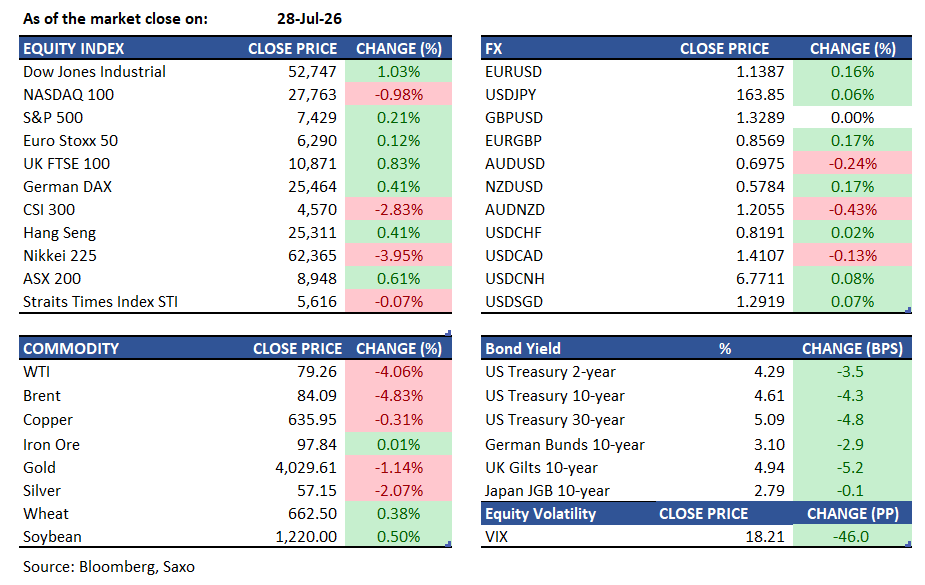
- US - US stocks ended mixed Tuesday as chipmakers slumped but earnings and lower oil prices lent support. The S&P 500 rose 0.2% and the Dow gained 537 points, while the Nasdaq 100 fell 1%. AI and data-center spending worries hit chip names: Micron -8.8%, AMD -8.1%, Intel -5.9%, Sandisk -14.2%, with sentiment also pressured by the strong IPO of China’s CXMT. Defensives outperformed, with health care and consumer staples leading. Coca-Cola jumped 5% on an earnings beat and guidance hike, Microsoft rose 1.1%, Eli Lilly gained 1.9%, Berkshire Hathaway 3.1%, and Visa 1.1%, while Meta was little changed ahead of results.
- Europe - European stocks edged higher Tuesday, lifted by earnings and softer energy prices. The Euro STOXX 50 rose 0.2% and the STOXX 600 0.4%. LVMH added 1%, Unilever jumped 8.5% on a guidance hike, Mercedes-Benz gained 2.9% on a profit beat, Safran rose 3%, and Orange 3.1% after raising its outlook. Barclays fell 5.6% after its balance sheet release. Tech lagged as AI-spending worries hit semiconductors; ASML dropped 3% amid reports of new Chinese competition in chip equipment.
- Asia - Asian markets face a cautious open as SK Hynix’s earnings miss and an Iran-driven oil spike weigh on sentiment ahead of the Fed. SK Hynix fell 4.5% pre-market despite a 557% profit surge that missed high expectations. The Hang Seng is set to extend strong July outperformance, while the Nikkei and Topix face pressure from chip weakness and the Kyushu earthquake. Singapore’s STI is heading for its best month since November 2020, up 8.6%, led by DBS and OCBC. ASMPT slightly missed Q2 profit estimates but beat on Q3 revenue guidance, and Singapore Airlines swung to a Q1 net loss on surging fuel costs.
Earnings this week:
- Wednesday - Microsoft, Meta Platforms, Lam Research, Procter & Gamble, ARM Holdings, Qualcomm, Vertiv, Starbucks, SK Hynix, Hermès, L’Oréal, Rio Tinto
- Thursday - Apple, Amazon, Mastercard, Coinbase, PRADA, Budweiser APAC
- Friday — ExxonMobil, Moderna, AbbVie, Chevron, Kioxia
FX:
- USD is essentially unchanged ahead of the FOMC, with the DXY flat at 101.44 (+0.02%) and G10 and EM pairs showing only micro-moves, underscoring a market in wait-and-see mode before the Fed decision and Chair Warsh’s press conference. The DXY is flat at 101.44, up 0.02%, reflecting micro-moves rather than new direction.
- EURUSD is steady at 1.1390, up 0.03%, and GBPUSD is unchanged at 1.3292, up 0.02%, as both consolidate after Tuesday’s sharp gains, with EUR up 1.76% and GBP up 2.26%.
- USDJPY is marginally lower at 163.80, down 0.03%, but the yen remains under structural pressure with markets focused on BOJ Governor Ueda’s comments after Friday’s meeting.
- AUDUSD is flat at 0.6975 as traders wait on Australia’s Q2 trimmed-mean CPI, with consensus at +0.9% q/q, a key input for the RBA’s August decision.
- NZDUSD is at 0.5785, up 0.02%. In the commodity bloc, USDCAD edges down to 1.4103, a 0.03% decline, making CAD a modest overnight outperformer, while USDCHF ticks up to 0.8193, a 0.02% rise, amid its growing role as a funding currency.
- Nordic FX is slightly firmer versus USD, with USDSEK at 9.6891, down 0.01%, and USDNOK at 9.6824, down 0.07%, the best G10 move overnight but still a very small adjustment.
Commodities:
- WTI surged as much as 5% to top $83 a barrel in late Tuesday trading after Iran launched ballistic missiles at US forces in the Middle East, snapping a three-day decline that had seen Brent post its biggest three-day drop in months. Iran also rejected an Omani plan to reopen the Strait of Hormuz. US equity futures dipped on the news. Asian energy shares — including Woodside, Santos, Inpex and S-Oil — are expected to follow oil higher at the open.
- Gold near $4,020 after a 1.1% drop ahead of a finely balanced Fed decision; swaps price ~33% odds of a 25 bp hike as Mideast tensions linger. Silver held steady at $57.16/oz after shedding over 2% in the prior session. Platinum was unchanged, while palladium edged higher.
Fixed income:
- US Treasury yields fell 4–5 basis points across the curve
on, with the 10-year closing at 4.604% and the 30-year at 5.094%, driven by lower oil prices and weakness in technology shares. Gains were partially reversed in after-hours trading as the Iran missile attack sent Treasury futures lower. - The Treasury sold $44 billion in 7-year notes at 4.473% — the highest stop since December 2024 — tailing the when-issued yield by 0.2 basis points. Despite the slight tail, Treasuries held their session gains, with the auction completing the final coupon sale until 11 August.
- Australian 3-year yields added 2 basis points to 4.58% and 10-year yields edged 1 basis point higher to 4.70% ahead of today's CPI data, with bonds also tracking the late-session rise in oil prices. Singapore will auction bonds today. UK gilts are seen as having room to outperform bunds and Treasuries near-term, given the BOE's expected less-hawkish stance relative to the Fed and ECB.
For a global look at markets – go to Inspiration.
This content is marketing content and should not be considered investment advice. Trading financial instruments carries risks and historic performance is not a guarantee for future performance.
The instrument(s) mentioned in this content may be issued by a partner, from which Saxo receives promotion, payment or retrocessions. While Saxo receives compensation from these partnerships, all content is conducted with the intention of providing clients with valuable options and information.