
Access all our platforms from a single account.

Asia Market Quick Take – 26 November, 2026

Key points:
- Macro: Hot PCE and strong GDP reinforce December Fed hike expectations
- Equities: Nasdaq briefly enters bear territory; S&P slips, Dow rises
- FX: USD remains structurally supported; AUD leads gains after sharp prior weakness
- Commodities: Gold, silver rebound on softer dollar; higher CME margins cap upside
- Fixed income: Treasuries rallied as yield fell across the curve
------------------------------------------------------------------
Disclaimer: Past performance does not indicate future performance.
Macro:
- October PCE inflation rose to 3.8% year-over-year, the highest in five months, with core PCE up 3.3% year-over-year — above the 3.2% forecast — cementing expectations for a further Fed rate hike in December.
- US Q3 GDP was revised sharply higher to +4.3% annualised (second estimate), well above the +3.5% consensus and the advance reading of +3.4%, driven by stronger personal consumption (+4.2%) and business investment.
- Real personal spending was flat in October after a strong Q3, suggesting consumers took a breather heading into the holiday season, while personal income beat at +0.7% versus the +0.4% estimate.
- Weekly jobless claims fell sharply to 189k in the week ending 21 November, well below the 200k consensus and the prior week's downwardly revised 202k, pointing to continued labour market resilience.
- October durable goods orders rose only 0.2% month-on-month, missing the +0.7% estimate, though non-defence capital goods orders ex-aircraft rose a solid 1.2%.
- Fresh US tariff plans on goods from China and the EU added to risk-off sentiment in European and emerging markets.
Equities:
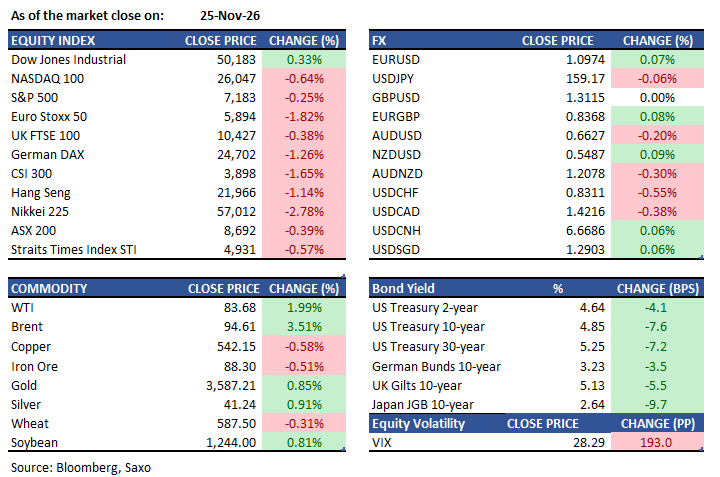
- US — On Wednesday, US markets saw wild intraday swings as the Nasdaq 100 briefly fell 20% from its closing high — touching bear market territory — before dip buyers drove a late recovery, trimming the loss to 0.6%. The S&P 500 closed 0.3% lower while the Dow Jones rose 0.85% on Tuesday. Nvidia fell 3.9% on Wednesday. Deere beat on Q4 earnings but issued a disappointing FY27 outlook. After hours, Urban Outfitters dropped 10% on a Q3 comparable sales miss.
- EU — European stocks fell for a second consecutive session on Wednesday. The Stoxx 600 dropped 1.1%, the Euro Stoxx 50 fell 1.82% to its lowest since May, and the DAX declined 1.3% to its lowest close since June. ASML fell 5.8% and Infineon dropped 6.5% on AI trade concerns. Rockwool was the session's largest faller at -15.6%. Bureau Veritas surged 6.6% to a record high after Advent was reportedly considering a bid for the French testing firm. Sanofi gained 4.9% on upgrades. Autos bucked the trend on JPMorgan's positive sector outlook.
- Asia — Asian equities are advancing this morning after Wall Street's late recovery. The MSCI Asia Pacific gauge is up 0.4%, with gains in Japan and South Korea. On Wednesday, the MSCI Asia Pacific fell 2.7%, led by a 7.6% plunge in Taiwan and a 5.8% drop in South Korea — the region's two key AI trade barometers. In Hong Kong, CATL tumbled 12% on Wednesday, its largest drop since its Hong Kong listing, on weaker earnings concerns and forced selling. The Hang Seng has been under pressure from the broader tech selloff. Japan's retail margin losses are ballooning, with unrealised losses on long margin positions averaging 19.7%, near the 20% threshold associated with forced selling risk. The STI has been relatively insulated but faces headwinds from the broader EM risk-off mood.
Earnings this week:
- Friday - Meituan
FX:
- The combination of sticky PCE inflation, resilient US labour data, and renewed tariff threats continued to underpin USD strength as a structural theme, even as the session ended with the index marginally lower. The Bloomberg Dollar Spot Index closed down 0.1%, reversing an intraday rise of up to 0.3%.
- The AUD was the worst G-10 performer against the U.S. dollar, with AUDUSD down 0.2% at 0.6631 after earlier sliding as much as 1.2%.
- JPY remained in focus after Finance Minister Katayama warned of "one-sided and rapid" FX moves, reiterating that authorities stand ready to act in coordination with the US Treasury. The JPY had briefly weakened past 160 against USD in recent sessions before rebounding on intervention speculation.
- CHF extended its broad rally as a global equity selloff boosted safe-haven demand, jumping about 0.8% to 0.9089 per euro—a level last seen on March 23—and rising roughly 0.6% to 0.8305 per dollar, making it Wednesday’s best-performing G-10 currency.
- TWD came under significant pressure, weakening past 33 against USD — a key psychological level — before partially recovering. Analysts cited official efforts to calm the stock rout and speculation of policymaker intervention to steady the currency.
Commodities:
- Gold rebounded above $3,500 an ounce on Wednesday after briefly plunging as much as 3.7% to below that level intraday, closing up 0.9% as Treasury yields and the dollar eased off their earlier highs, prompting bargain buying. As of Thursday morning, gold is near $3,575 an ounce, though the hot PCE print continues to weigh on the outlook as it reinforces expectations for further Fed rate hikes.
- Silver similarly recovered alongside gold on Wednesday, with both metals recapturing key levels after an initial sharp selloff driven by the tech-stock rout and haven-driven dollar strength. CME Group raised margins on Comex gold and silver futures following a review of market volatility, effective this week, which may add near-term headwinds to any sustained rebound.
- Copper fell 2% on the LME on Wednesday to $11,646 per metric ton, its lowest since December last year, putting the metal on track for a monthly decline of approximately 17% — one of its worst monthly performances in over a decade — as AI trade concerns and renewed tariff uncertainty continued to weigh on industrial metals sentiment.
Fixed income:
- US Treasuries rallied strongly on Wednesday as the Nasdaq 100's plunge into bear market territory drove a rush into haven assets. The 10-year yield fell as much as 10 basis points to 4.83%, before paring gains as equities recovered, closing around 4.845%. The 2-year yield declined to approximately 4.633%.
- The US Treasury's $44 billion 7-year note auction on Wednesday tailed by approximately 1 basis point, awarded at 4.708% versus a 4.698% when-issued yield, with a bid-to-cover of 2.43x versus the recent 2.49x average — the 13th consecutive weak result at this tenor, though the market reaction was muted given the prevailing safe-haven bid.
- PGIM flagged a wide trading range for the 10-year Treasury yield of roughly 4.25%–5.50%, centred near 4.90%, with a risk scenario of a 4.75%–6.00% range, noting that yields are likely to continue a "stair-step higher" until inflation convincingly returns toward target.
For a global look at markets – go to Inspiration.
This content is marketing content and should not be considered investment advice. Trading financial instruments carries risks and historic performance is not a guarantee for future performance.
The instrument(s) mentioned in this content may be issued by a partner, from which Saxo receives promotion, payment or retrocessions. While Saxo receives compensation from these partnerships, all content is conducted with the intention of providing clients with valuable options and information.