
Access all our platforms from a single account.

Asia Market Quick Take – 23 November, 2026

Key points:
- Macro: South Korea, Taiwan and China ramp market support amid AI-driven selloff
- Equities: AI trade unwinds; S&P and Nasdaq plunge, erasing $4 trillion
- FX: Softer dollar, risk appetite improves; yen softens; PMIs and PCE crucial
- Commodities: Gold falls to its lowest level in over a year
- Fixed income: US junk bond yields jump to a 19-month high of 8.51%
------------------------------------------------------------------
Disclaimer: Past performance does not indicate future performance.
Macro:
- Michigan’s consumer sentiment rose to 51.5 in November 2026, a three-month high, on stronger post-election business expectations. Lower-wealth households gained from cheaper gas, while wealthier stockholders were hurt by AI-driven market volatility. Sentiment is still 9% below February, and inflation expectations (3.7% year-ahead, 3.3% long-term) remain elevated.
- Australia’s Flash Composite PMI fell to 46.1 in November 2026 from 48.2, the sharpest private-sector contraction since August 2021. Manufacturing and services slumped as new orders and output dropped, employment fell (more in manufacturing), price pressures eased, and business sentiment hit a three-year low.
- Canada’s retail sales are forecast to drop 1.5% m/m in October 2026. In September, sales rose 0.8%, led by gasoline stations (+6.9% value, +1.6% volume) and small gains at motor vehicle and parts dealers (+0.2%). Core retail sales were up 0.1%, mainly due to a 1.5% rise at general merchandise retailers.
- South Korea has convened an emergency “F4” meeting, readied a stock stabilization fund last used in 2008, and temporarily eased share buyback limits.
- Taiwan, after the Taiex’s worst weekly drop in 35 years, has widened short-selling curbs, is actively buying stocks, and is considering lower margin requirements, even as export orders hit record growth.
- In China, mainland exchanges will cut margin financing requirements to boost liquidity, and listed companies have accelerated share buybacks. These measures are providing only a partial floor, with analysts warning that government action may not fully offset the impact of the global AI trade unwind.
Equities:
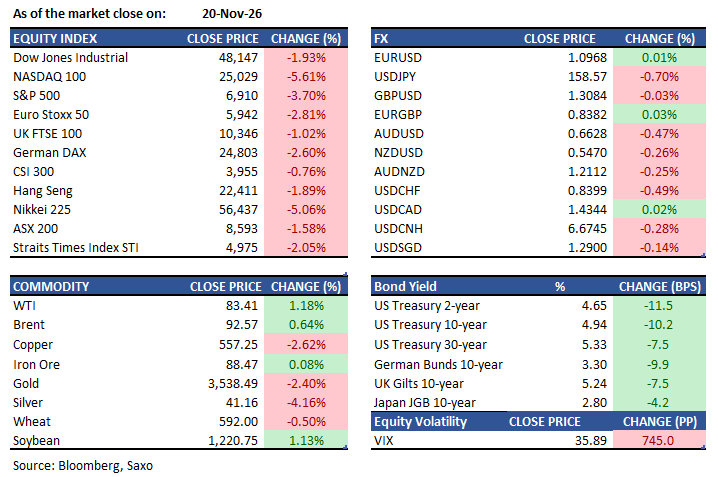
- US — On Friday (21 Nov), the S&P 500 fell 3.7% for its seventh straight day of losses, entering a technical correction, while the Nasdaq 100 plunged 5.6% — its worst week since March 2020 — wiping over $4 trillion in market value. The selloff was driven by an unwinding of the AI trade following Nvidia's post-earnings slide 14% to its lowest since June 2025 and Anthropic's IPO tumbling 8.5% on its debut. The VIX surged to 35.89, its highest since April 2025. As of Sunday evening, S&P 500 futures rose ~1.9% and Nasdaq 100 futures climbed ~2.6%, signalling a potential bounce at Monday's open.
- EU — The Stoxx Europe 600 fell 5.8% last week, its worst since April 2025, as the AI trade de-rating spread from Wall Street. On Friday (20 Nov), the index closed down 2% at 625.65. The Euro Stoxx 50 ended the week 6.97% lower at 5,941.95, its largest weekly decline since April 2025. The DAX dropped 2.6% on Friday to 24,802.78. ASML fell 9.3% on Friday, leading the Stoxx 600 lower, while Abivax dropped 17.2%. The FTSE 100 fell 1% to 10,346.34, with HSBC declining 3.6%.
- Asia — Asian markets are bracing for further volatility this Monday following Friday's Wall Street rout, though US equity futures bouncing ~2% overnight is providing some relief. Japan's Nikkei 225 fell 5.1% on Friday (20 Nov) — its worst week since April 2025 — with SoftBank among the hardest hit. The Kospi opened 2.8% lower this morning, with Samsung falling 5.6% and SK Hynix dropping 6% in pre-market trading. Taiwan's Taiex tumbled 6.2% on Friday, bringing its weekly loss to nearly 18% — the worst since 1991 — despite authorities tightening short-selling curbs. The Hang Seng is expected to face pressure, though China's margin financing cut and share buyback acceleration may provide some support. The ASX 200 fell 0.2% in early Monday trade, paring steeper early losses as materials stocks lent support. Chinese listed companies disclosed share buyback plans totalling 73.5 billion yuan since 8 October, providing a partial cushion.
Earnings this week:
Monday - Zoom, Semtech, Want Want China Holdings
Tuesday - Best Buy, HP Inc, Abercrombie & Fitch, Urban Outfitters, Kohl’s, Dollar Tree, Autodesk, Bilibili, Medtronic, Dell, Workday, Noah Holdings
Wednesday - John Deere, Li Auto, OMS, Haidilao
FX:
- Mildly softer USD and improved risk sentiment, with the Bloomberg Dollar Spot Index down 0.11% after four straight weeks of gains and all three traditional safe-haven currencies (USD, JPY, CHF) weaker as US equity futures rebound.
- In G10, USDJPY trades at 158.90 (+0.21%), with the yen giving back part of Friday’s sharp safe-haven rally that pulled the pair away from the psychologically important 160 level; one-week implied volatility is at a two-week high and Japanese officials remain alert to rapid, one-sided FX moves, while technical support sits near 158.44 (21-DMA).
- EURUSD is slightly firmer at 1.0978 (+0.09%) and GBPUSD at 1.3101 (+0.13%), both supported by the softer dollar and risk-on tone, with today’s flash November PMIs for the eurozone and UK seen as key inputs for ECB and BoE policy expectations.
- AUDUSD is at 0.6637 (+0.14%), holding above 0.6600 despite weak PMI data and rebounding after last week’s 2.1% drop, with strategists highlighting its tight correlation with Nasdaq moves in a way reminiscent of the early 2000s; AUDNZD sits near multi-month lows around 1.2106, though some banks forecast a recovery toward 1.23–1.24 by March 2027.
- NZDUSD is at 0.5473 (+0.05%), stabilising just above levels last seen in 2009 after stronger-than-expected retail sales, but the kiwi remains under pressure from elevated oil prices and Middle East-related growth concerns, with the RBNZ recently opting to hold rates amid global uncertainty.
- USDKRW is at 1,339.35 (-0.19%) with the won modestly stronger despite a sharp Kospi drop, supported by a 95.2% year-on-year surge in exports in the first 20 days of November and the prospect of a rarely used market stabilisation fund.
Commodities:
- Copper has plunged approximately 16–18% from its recent all-time high set in September, falling to its lowest since April on Friday (20 Nov) as the AI trade unwind removed a key bullish driver — data centre infrastructure buildout. Copper futures fell 9% last week alone, with LME prices dropping 5.7% on Tuesday (18 Nov) in a single session. The physical market in China, however, tells a different story, with premiums for spot metal remaining elevated.
- Gold fell 3.4% to around $3,561.70 per troy ounce on Friday (20 Nov), touching its lowest level in over a year, as expectations for further Fed rate hikes overshadowed typical safe-haven demand. Silver also dropped sharply to its lowest since October 2025. Gold's inability to rally despite the equity rout has raised concerns about broader market sentiment cracking.
- Oil prices have retreated significantly from recent highs, with WTI briefly approaching $80 last week as a lull in US-Iran hostilities allowed some traffic through the Strait of Hormuz. Bloomberg's Commodity Index has slumped 13% from its September peak. Oil futures were steady in early Asian trading on Monday.
Fixed income:
- US Treasuries surged on Friday (20 Nov) as investors fled equities for havens. Two-year yields fell 15 basis points to 4.612% on the day and 20 basis points on the week — the biggest weekly drop since August 2025. Five-year yields fell 15 basis points to 4.707% and seven-year yields declined 15 basis points to 4.787%. The 10-year yield stood at approximately 4.944% as of Sunday evening, with Treasury futures easing slightly as US equity futures rebounded.
- Strategists at Bank of America, BMO Capital Markets and JPMorgan remain committed to curve-flattening trades, wagering that short-term Treasuries will underperform longer maturities as the Fed continues to tighten. The 30-year yield fell 11 basis points on Friday to 5.297%, though it remains within its recent one-month range of 5.256%–5.476%.
- US junk bond yields surged to a 19-month high of 8.51% on Friday (20 Nov), with spreads widening to 344 basis points — an 18-month high — as mounting doubts about the AI trade and renewed inflation fears revived bets on further Fed hikes. Treasury Secretary Bessent warned on Sunday that the Fed risks overtightening, adding a policy uncertainty dimension heading into this week's PCE print.
For a global look at markets – go to Inspiration.
This content is marketing content and should not be considered investment advice. Trading financial instruments carries risks and historic performance is not a guarantee for future performance.
The instrument(s) mentioned in this content may be issued by a partner, from which Saxo receives promotion, payment or retrocessions. While Saxo receives compensation from these partnerships, all content is conducted with the intention of providing clients with valuable options and information.