
Access all our platforms from a single account.

Asia Market Quick Take – 23 July, 2026
Key points:
- Macro: US–Iran tensions and Houthi tanker attacks lift oil risks
- Equities: Alphabet fell on huge 2026 capex plans; Tesla slid after weak results
- FX: USDJPY broke 163 on BOJ hike chatter; CHF underperformed, EUR steady
- Commodities: Oil jumped on Red Sea attacks; gold extended gains despite Middle East tensions
- Fixed income: Treasury yields hit new cycle highs; 20-year auction tailed
------------------------------------------------------------------
Disclaimer: Past performance does not indicate future performance.
Macro:
- US-Iran war escalates: US Central Command launched further strikes against Iranian military targets on Wednesday evening ET. Iran and the US both played down the prospect of peace negotiations, keeping geopolitical risk elevated heading into the Asia open.
- Houthi Red Sea attacks: Iran-backed Houthis claimed responsibility for striking two Saudi oil tankers — ENCELIA and LAYLA — in the Red Sea, firing ballistic and cruise missiles and drones. The UK Maritime Trade Operations confirmed one vessel was struck 70 nautical miles southwest of Saudi Arabia's Al Shuqaiq. Ships continue to divert away from the Bab el-Mandeb Strait, creating what analysts are calling a "two chokepoint problem" for oil markets.
- BOJ open to faster hikes: BOJ officials are reportedly open to raising interest rates at a faster pace than the consensus among economists, as the yen's continued weakness adds to upside inflation risks. Markets nudged up odds of a 25bp hike in October, though the BOJ is widely expected to hold at its July 31 meeting. The yen briefly recovered to around 162.70 on the report before fading back above 163.
- Fed rate hike risk re-emerges: Rising oil prices are reviving concerns about inflation and a potential Fed rate hike as soon as September. Rates markets are beginning to price July as a live meeting. The 10-year Treasury yield briefly traded above 4.66% on Wednesday, approaching May's year-to-date high of 4.687%.
- Bank Indonesia surprise hold: Bank Indonesia kept its benchmark BI-Rate unchanged at 5.75%, surprising markets after aggressively hiking 100bps in May and June. Analysts warn the decision may put pressure on the rupiah given escalating Middle East tensions.
- US fiscal: The House passed a $95 billion Republican-only budget proposal in a 216–214 vote, the first step toward fast-tracking $73 billion in Iran war-related spending. House Democrats unanimously opposed the measure.
- Key data due today (July 23): South Korea Q2 GDP, Australia June employment report, Singapore June inflation, Taiwan industrial production and money supply.
Equities:
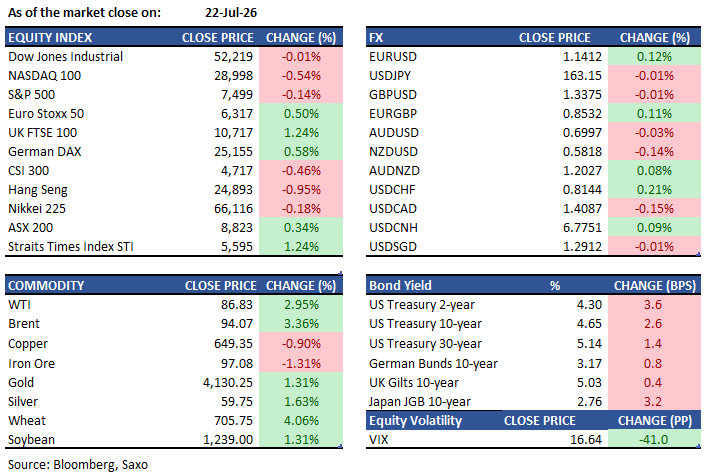
- US — The S&P 500 slipped 0.1% to 7,498.96 on Wednesday, its fourth loss in five sessions, as declines in Big Tech offset gains in energy and utilities. The Nasdaq 100 fell 0.5%; the Dow was essentially flat at 52,218. GE Vernova shares fell after the company only modestly raised its full-year revenue outlook and kept its adjusted Ebitda margin guidance unchanged. Microsoft dropped 1.9%, while Nvidia gained 3.2% and utilities surged 2.3%, led by NRG Energy (+6.4%) and Constellation Energy (+4.8%). In after-hours trade, Alphabet slid more than 3% after raising 2026 capex guidance to potentially above $200 billion. Tesla missed Q2 EPS estimates significantly (33c vs 51c expected) on negative free cash flow. IBM slipped after cutting its full-year sales outlook. United Rentals surged ~14% post-market after a strong beat and raised guidance. Rollins fell ~11% after missing Q2 adjusted EPS.
- EU — European equities advanced broadly on Wednesday, with the Stoxx 600 rising 0.6% to 646.93, the FTSE 100 gaining 1.2% to 10,716.97 — its fifth-highest close ever — and the DAX up 0.6% to 25,155.41. Airbus was the standout, surging 7% after unveiling robust financial targets and a €5 billion buyback plan. Randstad jumped 14% on improving revenue momentum. Santander edged higher after a Q2 profit beat, boosted by the TSB acquisition adding four million clients. Basic resources, utilities and banks led sector gains; technology lagged, falling 0.5%.
- Asia — The STI gained 1.2% to 5,595.42 and closed at record high on Wednesday, led by Yangzijiang Shipbuilding (+5.6%), DBS and Seatrium as global chip stocks rebounded. Kospi 200 futures closed up 1.7% at 1,104.0, with SK Hynix and Samsung Electronics flagged as stocks to watch given Alphabet's raised capex guidance — SK Hynix derives 7.3% of sales from Alphabet. Japanese cablemakers Fujikura and Furukawa Electric are in focus as AI infrastructure plays. China rolled out further state-backed measures to stem a tech-led selloff, including mobilising insurers and asset managers. ASX 200 futures pointed to a 0.6–0.8% gain at the open. Alphabet's capex raise is expected to be a positive catalyst for Asian AI infrastructure and memory chip names at Thursday's open.
Earnings this week:
- Thursday: American Airlines, Blackstone, Intel
- Friday: Verizon, American Express
FX:
- USDJPY surged past 163 for the first time since 1986, touching 163.24 before briefly recovering to ~162.70 on the BOJ faster-hike report. The bounce faded quickly, with the pair settling back above 163. Japanese Finance Minister Katayama issued verbal warnings but markets remain sceptical of near-term intervention efficacy.
- EURUSD posted modest gains, up 0.12% to 1.1412 in a tight 1.1397–1.1422 band, supported by a strong German ZEW sentiment print and ahead of the ECB decision.
- GBPUSD was effectively flat at 1.3375 (range 1.3355–1.3395) as softer‑than‑expected UK June CPI weighed on sterling, with additional pressure from lower gilt yields and concerns over fiscal spending, which also dragged GBPEUR.
- USDCHF rose 0.21% to 0.8144 (0.8114–0.8148), making the franc the day’s weakest major, while a broader currency scorecard showed CHF down 0.23% versus the dollar.
- AUDUSD edged 0.03% lower to 0.6997 after briefly trading above 0.70, and broader antipodean sentiment was soft as the NZD was flagged as the worst performer among 14 major currencies, falling 0.61%.
- The yuan slipped modestly, with USDCNH at 6.7752 . The PBOC set a weaker-than-expected daily fixing at 6.7933 vs the 6.7746 estimate, signalling no appetite for yuan strength.
Commodities:
- WTI surged to near $88/bbl and Brent spiked above $95 in post-settlement trading after the Houthi tanker attacks in the Red Sea. Oil has now rallied nearly 30% this month. The US-Iran conflict, Houthi blockade of the Bab el-Mandeb Strait, and Iran's dismissal of peace talks are collectively sustaining the bid. WTI extended gains into the Asia session.
- Gold rose above $4,100/oz, extending a nearly 2% gain from the prior session as dip-buyers returned despite escalating Middle East tensions. Asian gold mining stocks rallied in sympathy, with Evolution Mining up 5.1%, Regis Resources +5.3% and Sumitomo Metal Mining +4.9% in Japan.
- Copper: Copper edged toward its highest close since mid-June on signs of continued supply tightening in China. European mining stocks outperformed, with Glencore, KGHM and Antofagasta all posting solid gains on Tuesday, reflecting tightening physical market conditions.
Fixed income:
- The 10-year yield rose 3bps to 4.66% on Wednesday, approaching its 2026 intraday high of 4.687% set on May 19. The 2- and 5-year yields hit fresh 2026 highs above 4.30% and 4.40% respectively. The 30-year yield held above 5.135%, marking 12 consecutive sessions and 27 total days above 5% in 2026 — the longest such run since 2007, raising alarm about fiscal sustainability and sticky inflation.
- The Treasury sold $13 billion in 20-year bonds at a yield of 5.163% — the second-highest result for the tenor since its 2020 reintroduction and the highest since October 2023 — stopping 0.5bps above the when-issued yield, indicating demand fell slightly short of expectations. Bid-to-cover was 2.64, just below the one-year average, though indirect participation of 69.1% was above typical levels.
- US junk bonds lost momentum on Wednesday as yields climbed across the ratings spectrum. CCC yields surged to a new 15-month high, with spreads lingering near 800bps and marking a fourth consecutive session of losses. Rising oil prices revived inflation concerns and speculation of a Fed rate hike as soon as September, dampening primary market activity.
For a global look at markets – go to Inspiration.
This content is marketing content and should not be considered investment advice. Trading financial instruments carries risks and historic performance is not a guarantee for future performance.
The instrument(s) mentioned in this content may be issued by a partner, from which Saxo receives promotion, payment or retrocessions. While Saxo receives compensation from these partnerships, all content is conducted with the intention of providing clients with valuable options and information.