
Access all our platforms from a single account.

Asia Market Quick Take – 22 June, 2026

Key points:
- Macro: Trump threatens strikes on Iran during talks between US and Iran
- Equities: Futures fell as Trump threatens Tehran
- FX: USD firm on softer risk; yen weak, intervention risk elevated, BOJ divided
- Commodities: Brent gaps up to $81 and gains for a fourth consecutive day
- Fixed income: US Treasuries yield fell across the curve with 10 year touching 4.5%
------------------------------------------------------------------
Disclaimer: Past performance does not indicate future performance.
Macro:
- Trump threatened new military action if Hezbollah keeps attacking Israel and warned Iran against closing the Strait of Hormuz, prompting Iranian media to claim Tehran had suspended talks, though sources said negotiations were still ongoing.
- Canada’s retail sales are estimated to have risen 1% in May 2026, a fifth straight gain. April sales grew 0.5% to C$73 billion. Gasoline and fuel sales jumped 5.1% to C$7.51 billion on higher prices and a 0.8% volume rise. Sales also increased for health and personal care, building materials, and furniture/electronics/appliances, while food and beverage store sales fell 2% to C$13.27 billion.
- German producer prices rose 2.2% year-on-year in May 2026, the fastest since May 2023 but below the 2.5% forecast, driven by higher intermediate goods (4.2%) and energy (2.5%), especially mineral oil (34.9%). Capital and durable consumer goods increased 2.0%, while non-durables fell 1.7% on cheaper food. Excluding energy, prices were up 2.3%. Month-on-month, producer prices rose 0.3%, down from 1.2% and below the 0.7% forecast.
Equities:
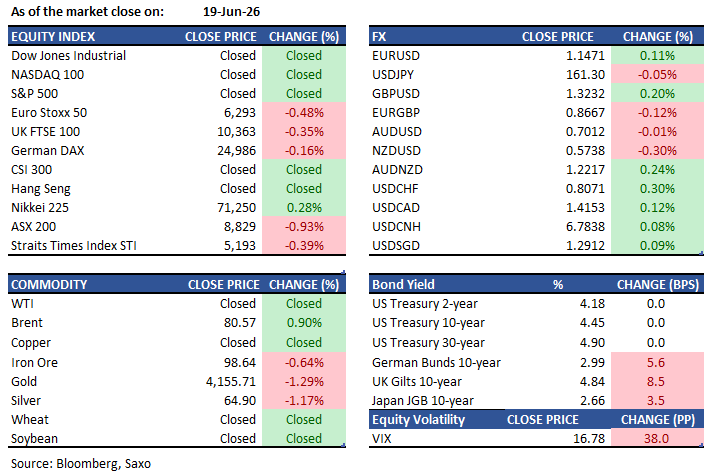
- US - US equity futures fell in early Asia on Monday as Trump’s renewed Iran strike threat hit sentiment. US cash markets were shut Friday for a holiday. Last week, the S&P 500 rose, led by tech and consumer discretionary, with AI names driving gains. Micron’s earnings on Wednesday are the key stock event this week.
- EU - The Stoxx Europe 600 hit a record last week, rising 0.4% as the US-Iran interim peace deal and lower oil prices lifted sentiment. The Euro Stoxx 50 gained 1.71%, its fifth weekly advance. Novo Nordisk jumped 4.6% Friday on a broker upgrade, while ASML and Reply fell 1.1% and 6.1%. The FTSE 100 faces earnings headwinds due to its energy tilt, with Rio Tinto and Fresnillo among recent laggards.
- Asia - Asian markets started the week weaker. The MSCI Asia Pacific Index is down 0.3%. The Nikkei 225 recovered to trade 0.8% higher, helped by a 5.6% jump in Hokuhoku Financial Group. The Kospi fell 1.1% after last Thursday’s record, with SK Hynix still the main driver. The ASX 200 is down 0.4%, as EQT Holdings slumped 9% on a strategic refocus. Trading in Hong Kong, Japan and Singapore was thinned or closed Friday due to holidays.
Earnings this week:
- Tuesday: Cerebras, Sanrio, Carnival
- Wednesday: Micron Technology, Trip.com
FX:
- USD broadly mixed but with a firm tone. Risk sentiment is softer after Trump’s renewed Iran threats. The earlier bearish USD narrative has faded after the hawkish Warsh Fed shift, and markets now see scope for further dollar gains into year-end.
- Near 40-year lows, with USDJPY approaching the 1986 high around 161.95. Intervention risk is elevated after Finance Minister Katayama warned Japan could act “whenever necessary,” though no level was specified. BOJ divisions over the pace of tightening are helping keep yen bears in control.
- GBPUSD briefly dropped to ~1.3180 in early Asia before recovering to 1.3210. Markets are reacting to expectations that PM Starmer will soon outline a resignation timetable following Andy Burnham’s by-election victory.
- Softer despite being the best G10 FX YTD (around +5.1%). AUDUSD is capped by the 100-day moving average near 0.7085, and sentiment is turning more bearish. A daily close below the 11 June low at 0.6979 would signal a near‑term downtrend.
- EUR is slightly weaker after its worst week in over a month (−0.8% last week). EUR/USD is pressured by a hawkish Fed vs. ECB cut expectations. This week’s US PCE data is seen as the next major driver.
- USDSGD is marginally higher, but analysts remain constructive on the Singapore dollar. Consensus looks for USDSGD around 1.26 by year-end, supported by MAS policy and Singapore’s strong external position.
Commodities:
- Brent crude surged as much as 2.2% at the Asia open to $82.30 a barrel, while WTI advanced above $78, as Trump's renewed threat to strike Iran clouded the peace process in Switzerland. Brent is now up for a fourth consecutive day. Net long oil positions are at their lowest this year, leaving the market vulnerable to a further short-squeeze higher. Oil continues to flow through the Strait of Hormuz despite Iran's claim of closure, with US Central Command confirming 17 million barrels transited over the weekend. European natural gas futures also rose as much as 3.9% to €43.75/MWh on continued Hormuz uncertainty.
- Gold is trading near $4,160 an ounce after dropping for a third consecutive session on Friday, weighed down by a stronger dollar and rising real yields following the Fed's hawkish pivot. The global bear-flattening trend in government bonds is acting as a headwind for gold, with the Fed's reassertion of an inflation-fighting mandate driving the dollar bid. ETFs have recorded net sales of 1.81 million troy ounces year-to-date, with holdings at their lowest since November 2025.
- The biggest near-term question for the copper market is whether Trump will proceed with tariffs on refined copper, with a Commerce Secretary review due at the end of June expected to inform the decision. LME 3-month copper closed at $13,595 per tonne on Friday, down $95.50 on the day. Capstone Copper has scaled back operations at its Mantoverde SX-EW plant in Chile to preserve sulfuric acid supplies disrupted by the Middle East conflict, while the global ore shortage continues to push treatment charges to deeply negative levels of around -$220 per tonne.
Fixed income:
- US Treasuries fell across the curve on Monday as cash markets returned from Friday's Juneteenth holiday, with the 2-year yield adding 4bps to 4.22% and the 10-year rising 5bps to 4.50%. Higher oil prices are fanning inflation concerns and reinforcing the post-Warsh hawkish repricing. Treasury futures had already pointed to weakness heading into the open, with 10-year note futures falling 3/8 to 109-1/4 in overnight trade.
- UK 10-year gilt yields rose 8bps to 4.84% and German 10-year Bund yields up 5bps to 2.98% on Friday, as money markets priced in 38bps of ECB hikes and 35bps of BOE hikes by year-end. UK gilts face additional pressure from political uncertainty following Andy Burnham's by-election win and reports that PM Starmer is setting a timetable for his departure.
- Bond traders are looking to Thursday's May PCE print — the Fed's preferred inflation gauge — for confirmation of whether the market's newly hawkish stance is warranted. PCE is expected to show acceleration on both a monthly and year-over-year basis. Traders have fully priced a 25bp Fed hike by September, up from just 8bps earlier last week. JPMorgan has revised its year-end 10-year yield forecast to 4.7%, while the 5-year TIPS auction last Wednesday drew the highest yield since December 2024 at 1.955%, reflecting elevated real rate expectations.
For a global look at markets – go to Inspiration.
This content is marketing content and should not be considered investment advice. Trading financial instruments carries risks and historic performance is not a guarantee for future performance.
The instrument(s) mentioned in this content may be issued by a partner, from which Saxo receives promotion, payment or retrocessions. While Saxo receives compensation from these partnerships, all content is conducted with the intention of providing clients with valuable options and information.