
Access all our platforms from a single account.

Asia Market Quick Take – 20 July, 2026
Key points:
- Macro: Iran–US ceasefire attacks escalate; US consumer sentiment improves, inflation eases
- Equities: US stocks fell Friday; semiconductor sector entered bear market from recent highs
- FX: USD strengthens on safe-haven flows; USDJPY above 162.50, pressuring risk currencies
- Commodities: Brent crude surges above $90 while gold hovers around $4,000
- Fixed income: USTs twist-flattened as the front end underperformed; 2Y yields rose
------------------------------------------------------------------
Disclaimer: Past performance does not indicate future performance.
Macro:
- Iran said its ceasefire with the US has collapsed and reported intercepting four vessels in the Strait of Hormuz. The US confirmed a third service member killed in two days as attacks spread to infrastructure, including an Iranian strike on a Kuwait Petroleum oil facility.
- The University of Michigan’s Consumer Sentiment Index rose to 54.4 in July 2026, its highest since February and above expectations, helped by lower gas prices and broad-based gains in buying conditions and business expectations. Sentiment remains 12% below a year ago amid high prices. One-year inflation expectations fell to 4.2%, while long-run expectations held at 3.3%.
- US industrial production rose 0.1% in June 2026, below the 0.2% forecast. Manufacturing was flat as lower durables offset higher nondurables, led by a 2.1% jump in petroleum and coal. Mining and utilities each grew 0.4%, and Q2 output rose at a 4.0% annualized rate.
- US import prices rose 0.3% m/m in June 2026, versus expectations for a 0.7% drop, after a revised 1.7% gain in May. Fuel import prices fell 0.4%, while non-fuel prices rose 0.4% for a seventh straight increase. Overall import prices were 7.1% higher than a year earlier, the fastest pace in nearly four years, excluding recent tariff hikes.
- US housing starts rose 19% to an annualized 1.427 million units in June 2026, a three‑month high and above expectations of 1.31 million. Multi-family starts jumped 76.3% to 513,000, while single-family starts slipped 0.2% to 895,000, their third monthly decline. Starts increased across all regions.
- Andy Burnham was confirmed as UK Labour leader after an uncontested race and is expected to become prime minister next week. He pledged to unite the party and build on Keir Starmer’s foundations. Markets are focused on his choice of Chancellor, with Shabana Mahmood seen as frontrunner, easing fears of a looser fiscal stance.
Equities:
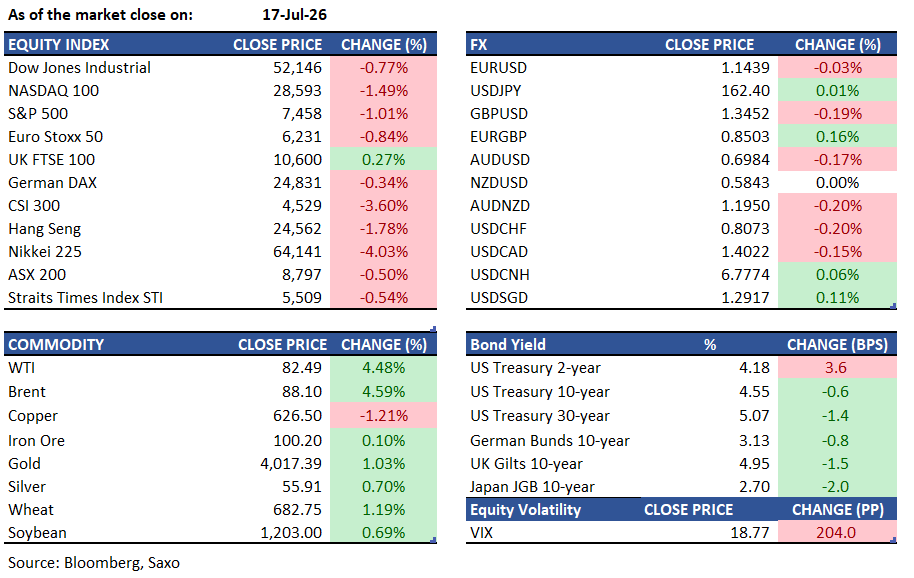
- US — US equities ended the week of 18 July lower, with the S&P 500 falling 1% on Friday — its first losing week in three — led by Communication Services and Consumer Discretionary. The Nasdaq 100 dropped 1.5% and the Dow fell 0.8%. The Philadelphia Semiconductor Index entered bear market territory, down 20% from its record. Nvidia, Broadcom and Micron were among the hardest hit. S&P 500 futures were down 0.1% in early Asian hours on Monday as the US-Iran escalation weighed on sentiment. The VIX closed up 25% on the week at 18.77. Looking ahead, Alphabet, Tesla, AMD and GE Vernova headline a heavy earnings week. SpaceX shares (SPCX) remain approximately 30% below their mid-June peak.
- EU — The Stoxx Europe 600 was roughly flat over the week ending 18 July, pausing its record-setting rally as a cooling AI trade, higher oil prices and geopolitical flare-ups weighed on sentiment. The index remained within its short-term rising channel but below its earlier July peak. Samsung Biologics launched an all-cash tender offer for Swiss peptide manufacturer PolyPeptide at CHF 44.31 per share, implying an equity value of approximately CHF 1.46 billion and a 40% premium to its unaffected share price.
- Asia — Asian markets opened sharply lower on Monday, compounded by the US-Iran escalation and the ongoing chip selloff. The Kospi fell as much as 4.5% at the open — now down 28% from its June peak — as Samsung Electronics, SK Hynix and SK Square led losses after the index was closed on Friday for a public holiday and missed the global rout. Japan is closed today for a public holiday, with the Nikkei 225 having already shed 4% on Friday (17 July) and 6.4% over the prior week, its steepest weekly decline since April 2025. Taiwan's Taiex fell into a technical correction last week, dropping 6.5% on Friday after TSMC's results stoked concerns over heavy capex spending. The Hang Seng Tech Index was also among the hardest hit regionally on Friday. Beijing-backed state funds tapped over CNY 50 billion via the PBOC's swap facility over the weekend to stabilise Chinese equity markets, and the CSRC is convening brokers and fund managers on Monday. No data was available for the STI at the time of writing.
Earnings this week:
- Tuesday: Alaska Air Group, General Motors, 3M, Schwab
- Wednesday:IBM, Tesla, Alphabet, GE Vernova
- Thursday: American Airlines, Blackstone, Intel
- Friday: Verizon, American Express
FX:
- The USD is broadly stronger this morning on safe-haven demand after escalating US–Iran strikes, pressuring risk‑sensitive FX.
- USDJPY has climbed above 162.50, near a four‑decade high, with intervention risk amplified by thin holiday liquidity in Japan.
- EURUSD is modestly softer around 1.1430 ahead of Thursday’s ECB meeting, where rates are expected to be held but a September hike is increasingly priced. Sterling remains a relative outperformer, with GBPUSD is around 1.3450 slightly off recent two‑month highs amid improved UK sentiment and political focus on Andy Burnham’s choice of Chancellor.
- AUD and NZD are down despite strong year‑to‑date gains for AUD and a sharply narrower NZ trade surplus.
- Asian FX is mostly steady: CNH is supported by sizeable state‑fund equity support, while KRW is weaker as the Kospi catches up with Friday’s sell‑off; SGD tracks the stronger USD.
- Key events this week include US, eurozone and UK flash PMIs, Thursday’s ECB decision, all of which could shift risk sentiment and FX direction.
Commodities:
- Brent rose as much as 3.8% to above $91 a barrel in early Monday trade — the highest level since 11 June — after the US-Iran conflict escalated sharply over the weekend. Iran halted vessels transiting the Strait of Hormuz, a key oil chokepoint, and a vital oil facility in Kuwait was struck. WTI was near $85. Separately, a drone strike suspended loadings at the Caspian Pipeline Consortium terminal on Russia's Black Sea coast, adding further supply disruption risk.
- Bullion was trading around $3,995 an ounce in early Monday trade, having slid more than 2% last week. The counterintuitive decline reflects rising bets that the Fed may need to hike rates to contain oil-driven inflation, lifting the opportunity cost of holding gold. ETFs have been net sellers of gold throughout July.
- Nickel hit a three-week high last week on fading rate-hike expectations and Indonesia supply uncertainty. Copper LME withdrawal orders surged in mid-July, driven by demand from Taiwan, South Korea and Singapore. However, Rio Tinto reported a 7% quarter-on-quarter decline in copper output due to a Kennecott smelter outage, and BHP's copper production fell 5% year-on-year in Q4 FY26.
Fixed income:
- Treasury futures sold off in early Monday Asian trading — a rare statement of intent — as oil prices surged on the Iran escalation. The front end of the curve is under particular pressure, with speculative net shorts on 10-year contracts elevated but not at the extremes seen in mid-June or January.
- Treasuries twist flattened with the front end underperforming as 2-year yields rose sharply alongside oil gains, while intermediate-to-long end yields ended lower. The 10-year yield closed at approximately 4.547%.
- Traders have fully priced a 25bp BOE hike by September, followed by another before year-end, as surging oil prices reignite inflation fears. The ECB is similarly expected to hike 25bp in September to 2.5%, with another increase by year-end all but fully priced in money markets.
For a global look at markets – go to Inspiration.
This content is marketing content and should not be considered investment advice. Trading financial instruments carries risks and historic performance is not a guarantee for future performance.
The instrument(s) mentioned in this content may be issued by a partner, from which Saxo receives promotion, payment or retrocessions. While Saxo receives compensation from these partnerships, all content is conducted with the intention of providing clients with valuable options and information.