
Access all our platforms from a single account.

Asia Market Quick Take – 17 September 2026

Key points:
- Macro: US and HK raise rates. Saudi to restore half of East-West pipeline in days.
- Equities: S&P 500 closed down 0.4% after rate hike; Lumentum gained 9.6%
- FX: Fed rate hike strengthens dollar; USDJPY surges ahead of Friday’s BOJ meeting
- Commodities: Oil pulls back on Saudi pipeline restoration
- Fixed income: Treasury curve flattens sharply post-Fed
------------------------------------------------------------------
Disclaimer: Past performance does not indicate future performance.
Macro:
- The Fed raised the funds rate 25 bps to 3.75%–4.00% in September 2026, its first hike since 2023, citing elevated inflation and the need to move back toward 2%. Most officials see at least one more hike this year. Growth forecasts for 2026–27 were nudged up, inflation projections for 2026 are slightly higher, and the unemployment outlook was lowered to 4.1% for both 2026 and 2027.
- The HKMA raised its base rate 25 bps to 4.25% on September 17, 2026, its first hike since 2023, in line with the Fed under Hong Kong’s currency peg. The move comes amid solid trade but could pressure the fragile property market and sentiment, already cautious on China’s capital outflow controls.
- Saudi Arabia expects to restore about half of its East-West pipeline capacity within days and full flows in six weeks after drone damage, and is temporarily shipping more crude through the Strait of Hormuz with US military support. Earlier this week, 18 million barrels of crude and products moved through Hormuz, according to US Energy Secretary Chris Wright.
- New Zealand’s GDP grew 0.2% qoq in Q2 2026, slightly above forecasts but down from 0.9% in Q1, the weakest pace since Q2 2025. Growth was supported by goods-producing industries and exports, while primary industries contracted and domestic demand was soft. GDP rose 2.6% yoy, beating expectations.
- US retail sales rose 1.2% m/m in August 2026, the strongest in five months, after a 0.5% drop in July and above the 0.8% forecast. Gains were broad-based, led by gas stations and online retailers, while building materials/garden stores slipped. Core retail sales jumped 1.4%, far above the 0.4% consensus.
Equities:
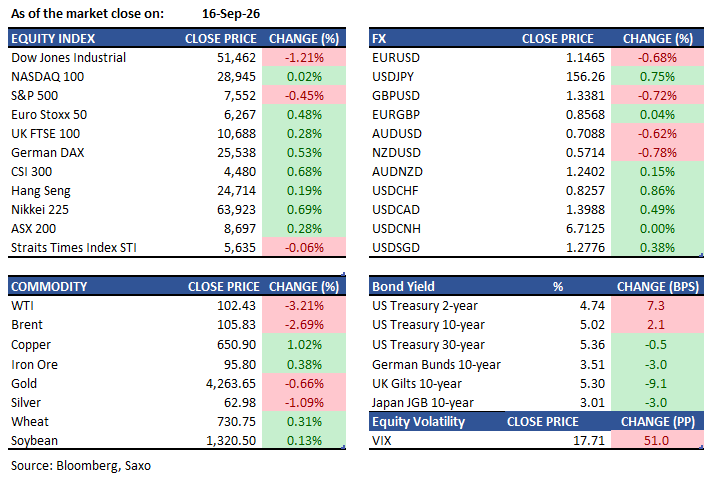
- US: US equities fell after the Fed's rate hike and Warsh's hawkish press conference. The S&P 500 closed down 0.4% at 7,551.81 — its sixth consecutive decline on a Fed decision day, the longest such streak since 2018. The Dow Jones Industrial Average lost 1.2%, while the Nasdaq 100 ended flat. Financials underperformed, falling 1.6%, with Huntington Bancshares (HBAN) down 5.6%. Optical networking stocks bucked the trend: Lumentum (LITE) surged 9.6% and Coherent (COHR) gained 6.9% on AI data-centre demand optimism. In after-hours trading, Fluence Energy (FLNC) plunged 16% after cutting its full-year sales forecast, citing delays in its manufacturing ramp-up. J.B. Hunt Transport (JBHT) fell 13% during the session after warning that record diesel prices would knock Q3 profit 5–10% below Q2 levels.
- EU: European equities closed higher ahead of the Fed decision, with the Stoxx Europe 600 rising 0.5% to 637.09, led by industrial goods and services stocks. The DAX gained 0.5% to 25,537.75, with Siemens Energy the top mover, up 3.1%. The FTSE 100 rose 0.3% to 10,688.47, with Barratt Redrow the standout, surging 11.7%. The SMI added 0.4%, led by ABB (+2.1%). Turkish equities were a notable outlier, falling 6% and triggering a market-wide circuit breaker.
- Asia: Asian equities are trading mixed in early Thursday trade, digesting the Fed's hawkish hike and dollar strength. The Nikkei 225 is up 0.85% to 64,466 as tech stocks provide support, though yen weakness and the looming BOJ decision on Friday are keeping gains in check. The Kospi is up 0.49% to 6,750, with Apple supplier stocks in focus following the iPhone Duo foldable launch. The Hang Seng (24,713) and STI (5,635) are little changed in early trade. Asian sovereign bonds are under pressure, tracking the post-Fed move in Treasuries, with Australian and New Zealand government bonds slipping in early trade.
Events this week:
- Thursday: BOE rate decision
- Friday: BOJ rate decision
FX:
- The Fed’s first rate hike since 2023 (25 bps) under Chair Kevin Warsh drove broad USD strength on Wednesday, as markets priced in two more hikes by year-end amid concerns that inflation remains persistently high. All G-10 currencies weakened against the dollar, with the Bloomberg Dollar Spot Index up over 0.5% on the day and about 1.1% on the week.
- JPY was the most notable mover, with USDJPY surging sharply post-FOMC. Strategists warned the currency could weaken further ahead of the Bank of Japan's policy meeting on Friday, unless the BOJ signals more tightening.
- GBP fell 0.6% to below a key level during Warsh's press conference.
- USDCAD climbed for a sixth consecutive day — its longest winning streak since June 24 — breaking above its 100-day moving average at 1.3936.
Commodities:
- WTI crude fell toward $101.54/bbl (-0.87%) and Brent is near $105.13/bbl (-0.66%) in early Asia trade, extending Wednesday's decline of over 3% — the largest single-day drop since August 4. Saudi Arabia is reportedly seeking to restore approximately half the capacity of its damaged East-West pipeline within days, easing the supply disruption fears that had driven Brent above $108/bbl earlier this month.
- Gold is trading at $4,282/oz (+0.43%), finding modest support despite the post-Fed dollar rally. The metal has been caught between competing forces — rising Middle East tensions providing a safe-haven bid, while a stronger dollar and higher real yields act as headwinds. US 10-year real yields stand at approximately 2.59%.
Fixed income:
- The 2s10s spread flattened by more than 5bps as the front end bore the brunt of the post-Fed selloff. The 2-year yield touched 4.74% — its highest since 2024 — before settling at 4.72% in early Asia. The 10-year yield briefly returned above 5% before pulling back to 4.996%, while the 30-year yield is at 5.334%. All three tenors are modestly lower in early Thursday Asia trade as some relief buying emerges. Bond traders signal growing confidence in Warsh's inflation-fighting credibility, with markets now pricing three additional hikes by mid-2027.
- Australian and New Zealand government bonds slipped in early Thursday trade, tracking the post-Fed move in Treasuries. Asian investment-grade credit spreads, however, tightened as the Fed's pivot to tightening was seen as a credibility-enhancing move. The China-US 10-year yield gap has widened to a record, with the US 10-year at ~5% versus China's 10-year at approximately 1.68%, a spread of over 320bps.
For a global look at markets – go to Inspiration.
This content is marketing content and should not be considered investment advice. Trading financial instruments carries risks and historic performance is not a guarantee for future performance.
The instrument(s) mentioned in this content may be issued by a partner, from which Saxo receives promotion, payment or retrocessions. While Saxo receives compensation from these partnerships, all content is conducted with the intention of providing clients with valuable options and information.