
Access all our platforms from a single account.

Asia Market Quick Take – 17 August, 2026

Key points:
- Macro: US consumer sentiment falls. Trump warns of high fuel prices.
- Equities: Nvidia disclosed $21b stake in SpaceX and $22b stake in Intel
- FX: NOK tops G10 FX, AUD second as softer USD tracks fading Fed tightening
- Commodities: Copper near record at $14,160/ton on LME
- Fixed income: 2Y yield fell a third straight week, briefly below 4.10%
------------------------------------------------------------------
Disclaimer: Past performance does not indicate future performance.
Macro:
- The US-Iran ceasefire ends today, after Israel’s deadly strike in southern Lebanon, as new US sanctions on Iran loom and geopolitical uncertainty rises.
- Japan’s Q2 2026 GDP grew 0.3% q/q, slowing from Q1 and missing expectations of 0.5%. This compares with a long-term average of 0.42% since 1980.
- US Michigan consumer sentiment fell to 51 in early August from 55.2, below expectations, with broad-based declines and slightly higher year-ahead inflation expectations at 4.3%.
- US retail sales fell 0.6% m/m in July, missing expectations for a 0.1% rise and marking the first drop since October 2025, with core control group sales (used for GDP) down 0.4%, the most since early 2025.
- Trump called Iran “very evil” at a rally Friday and warned Americans to expect sustained high fuel prices, saying the war’s cost was justified to prevent Iran from obtaining a nuclear weapon.
Equities:
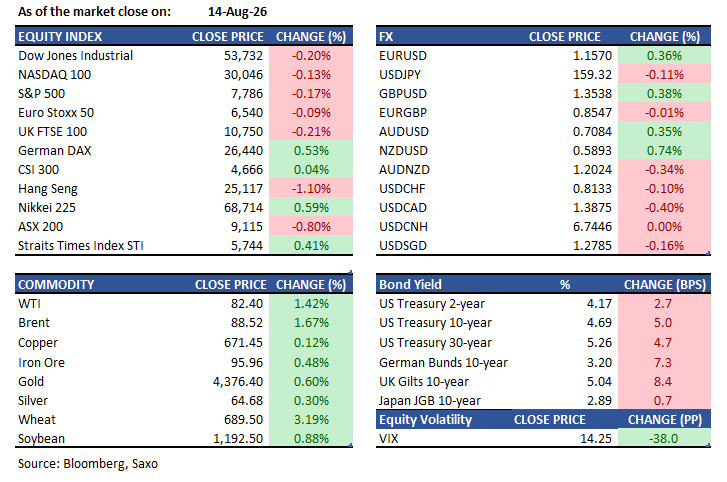
- US — US equities ended last Friday with modest losses after soft consumer data, with the S&P 500 closing down 0.2% at 7,785.76, the Nasdaq Composite at 26,729.16, and the Dow Jones at 53,732.41. S&P 500 nonetheless notched a third straight week of gains — its longest winning streak since May — having touched 7,800 for the first time. VIX fell to its lowest level since December 29. S&P 500 Q2 earnings growth of 31% year-on-year is the best outside of recession recoveries since 1992. Financial stocks fell 0.1% on Friday, with JPMorgan reportedly debanked by Polymarket over regulatory concerns. Nvidia disclosed a $21b stake in SpaceX at end of Q2 and an Intel stake now worth $22b
- EU — European equities ended last week slightly lower, with the Stoxx 600 slipping 0.4% on the week to close at 657.86, snapping a four-week winning streak but remaining just below record highs. The FTSE 100 fell 0.2% on Friday to 10,750.11, with AstraZeneca the largest drag, down 2.1%, and Antofagasta falling 4.6%. The DAX rose 0.5% on Friday to 26,440.31, led by Rheinmetall, up 3.2%. Adyen jumped 16% on Thursday after raising its revenue outlook. European equity funds attracted $1.2 billion in inflows last week, the largest in six months.
- Asia — Asian markets are opening this Monday morning with index levels as follows: Hang Seng at 25,116.85, Nikkei 225 at 68,713.80, Kospi at 6,977.94, and STI at 5,743.59. The Kospi has been a standout performer, rallying approximately 23% from its July 30 low, driven by a revival in the global AI trade with Samsung Electronics and SK Hynix each jumping more than 5% at various points last week. Singapore's STI has surged 23% YTD, supported by robust tech export growth and a "Goldilocks" economic backdrop, per JPMorgan. In Japan, MS&AD Insurance rose 5% in early trading after reporting Q1 net income of ¥328.62 billion versus ¥246.37 billion a year earlier. The Topix is little changed. The Nikkei remains supported by AI-related tailwinds, with Japanese stocks seen as a key beneficiary of the next leg of the AI trade.
Earnings this week:
- Tuesday - Home Depot, BHP, Xiaomi, Baidu
- Wednesday - Lowe’s, Target, TJX, Estee Lauder, Analog Devices, HKEX, Kuaishou Technology
- Thursday - Walmart, Deere & Co., Ross Stores, Alibaba, Ping An Insurance, Pop Mart
- Friday - BJ’s Wholesale Club
FX:
- USD eased modestly overnight, slipping against the EUR, GBP, AUD, and the JPY, while holding steady versus the Chinese yuan. The move reflected a mild, broad-based USD softening rather than a strong directional shift.
- In G10, the focus remained on the JPY, where rising expectations of a Bank of Japan rate hike have yet to translate into a sustained USDJPY break lower, with spot still trading around 159 and capped by its 100-day moving average and resistance near 161.
- AUD outperformed slightly, edging toward 0.71 as markets further priced out additional Fed hikes, while GBP also firmed despite increasing concerns that UK growth will slow in the second half of 2026 after a robust start to the year.
- NOK is the top G10 performer in 2026, up 6.81% versus the dollar at 9.44 against USD, while AUDUSD at 0.7092 is up 6.16% year-to-date and 0.11% on the day, making the AUD the second-strongest G10 currency, supported by commodity strength and risk-on sentiment.
- USDCNH was unchanged on the day, though softer-than-expected July M2 money supply growth in China (7.7% YoY vs 7.9% expected) may weigh on sentiment toward the yuan going forward.
Commodities:
- Brent crude edged up as much as 0.5% to nearly $89 a barrel in early Asian trading, with WTI at $82.22 (down 0.22%), as geopolitical uncertainty around the expiry of the US-Iran ceasefire and renewed Israeli strikes on Lebanon keep supply risk elevated. Oil is increasingly driving long-end bond yields, with the Brent-30-year yield correlation near this year's previous peaks.
- Copper remains near record territory at $14,160 per ton on the LME, with the August-to-September spread hitting its widest backwardation since 2021 at $370, prompting the LME to introduce emergency measures. Supply concerns persist following reports of a Democratic Republic of Congo export ban on copper and cobalt concentrates, alongside stockpiling ahead of potential US tariffs on refined imports.
- Gold trades at $4,377.54 per ounce, up 0.03% on the day, consolidating near recent highs. Analysts note short-term gamma risk is building in the options market, and gold's failure to break meaningfully higher despite softer oil suggests some near-term exhaustion.
Fixed income:
- US Treasury yields are modestly lower in early Asian trading: the 2-year at 4.15% (-1.8 bps), the 10-year at 4.68% (-1.0 bp), and the 30-year at 5.26% (-0.6 bps). The 2-year yield fell for a third straight week last week, briefly dipping below 4.10% — its lowest since June 30 — before rebounding on a UK gilt selloff.
- The US yield curve has steepened materially, with the 2s10s spread widening to around 52 bps last week — the widest since May 21 and near the 200-day moving average. The 5s30s spread also widened. BofA now recommends 5-year Treasuries and a steeper curve following softer employment and inflation data.
- A $16 billion 20-year auction on Wednesday is expected to price around 5.27%, which would be the highest yield for that tenor since its 2020 reintroduction. Foreign central banks are reportedly reducing Treasury holdings in favour of gold, adding to structural demand concerns.
For a global look at markets – go to Inspiration.
This content is marketing content and should not be considered investment advice. Trading financial instruments carries risks and historic performance is not a guarantee for future performance.
The instrument(s) mentioned in this content may be issued by a partner, from which Saxo receives promotion, payment or retrocessions. While Saxo receives compensation from these partnerships, all content is conducted with the intention of providing clients with valuable options and information.