Access all our platforms from a single account.

Asia Market Quick Take – 12 June, 2026
Key points:
- Macro: Trump cancels planned strikes. US PPI hotter than expected
- Equities: Tech stocks led the rally ahead of SpaceX’s $75B IPO
- FX: Dollar weakens on Iran deal hopes; euro jumps after ECB’s first hike since 2023
- Commodities: Oil at 2‑month low; gold +3.4%, biggest daily jump in 2 months
- Fixed income: Treasuries rally; 30Y auction tails
------------------------------------------------------------------
Disclaimer: Past performance does not indicate future performance.
Macro:
- US-Iran peace deal signals: President Trump canceled planned military strikes against Iran and said a deal could be signed as soon as this weekend, triggering a sharp cross-asset reversal — oil fell, equities surged, yields dropped and the dollar weakened. Iran's state media subsequently reported that a source said the country had not yet approved any agreement text, leaving the situation fluid.
- US PPI (May): Producer prices rose 1.1% month-on-month and 6.5% year-on-year, the fastest pace since November 2022, driven by Iran war-related energy pressures. Core PPI ex-food and energy rose 0.4% month-on-month, below the 0.5% estimate, providing a modest offset.
- US jobless claims: Initial claims rose 4,000 to 229,000 in the week ended June 6, above the 220,000 consensus, the highest reading since February. Continuing claims also rose to 1.795 million.
- ECB rate hike: The European Central Bank raised its deposit rate by 25 basis points to 2.25%, the first hike since 2023, citing inflation pressures from the Iran war and prolonged Strait of Hormuz disruptions. The ECB reiterated it will not pre-commit to future action; markets are pricing another 25bp move in September.
- US tariff refunds: The US Treasury refunded nearly $22 billion in tariff revenue in May — roughly equal to duties collected during the month — following a Supreme Court ruling that struck down a major component of Trump's trade policy.
- USMCA uncertainty: Trump said he is "not looking to renew" the US-Mexico-Canada Agreement, upending expectations for a July review milestone. Canada's trade minister said side deals would eventually resolve disputes.
- Turkey holds rates: Turkey's central bank kept its one-week repo rate at 37% for a third consecutive meeting, signaling comfort with the current stance amid a cooling economy.
Equities:
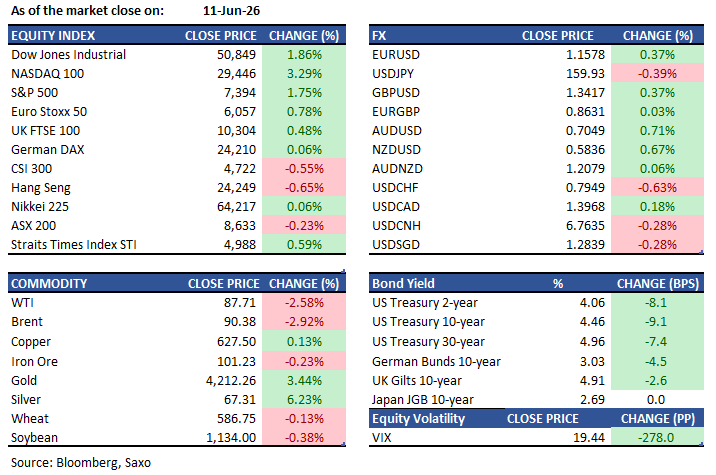
- US - US stocks jumped Thursday, with the S&P 500 up 1.8%, the Nasdaq 2.5%, and the Dow 930 points, as oil prices fell after Trump cancelled strikes on Iran and hinted at a regional deal. Tech shares led gains ahead of SpaceX’s IPO: Micron rose 11%, AMD 8%, Lam Research 12.7%, and Intel over 10% after a BofA upgrade. Oracle fell nearly 9% on cloud revenue and AI cost concerns. Adobe beat fiscal Q2 2026 estimates, driven by strong demand for its AI tools, however, departs company. Stock down 5.5% post-market. Hotter PPI data reinforced expectations of Fed rate hikes this year.
- Europe - The DAX 40 ended slightly higher at 24,210 on Thursday as traders weighed renewed Middle East tensions and the ECB’s rate hike with higher inflation and lower growth forecasts. SAP fell over 6% after Oracle’s slide, and Deutsche Telekom dropped 3.7% on a reported T-Mobile US merger push. Siemens Energy, RWE, and Infineon gained 6.7%, 3.4%, and 3.1%, respectively.
- Asia - Asian markets were mixed Thursday amid Iran war tensions before late US peace signals. The Nikkei rose 0.1% as tech stabilized, and the Kospi rebounded 0.4% after a 4.5% drop, led by SK Hynix and Hanwha Ocean. The MSCI Asia Pacific Index pared a 1.7% intraday loss, while Hong Kong and mainland China fell, with Alibaba and Samsung dragging. The Kospi is set to jump about 6.5% Friday as chip stocks follow the US semiconductor rally and Iran deal optimism.
Earnings this week:
- Friday: SpaceX IPO
FX:
- USD weakened broadly Thursday as optimism over a potential US–Iran peace deal spurred risk-on sentiment. After President Trump called off planned strikes and hinted an agreement was near, Dollar Index fell 0.31% to 96.27—its sharpest drop since May 6.
- USDJPY dropped 0.37% to 159.96 before nudging back to around 160.06 in Asia as the initial risk-on move faded; the break below early‑May trend support turns momentum bearish with the 50‑day moving average now a key downside focus.
- EURUSD rose 0.37% to 1.1581, its strongest daily gain since May 8, helped by the ECB’s first rate hike since 2023. GBPUSD also advanced, riding the broader “peace rally” in risk assets.
- USDCAD was a notable outlier, rising 0.16% to 1.3968, its highest close since December 2025, despite general dollar softness.
- USDMXN fell 1.0% to 17.2479, the steepest one‑day drop since April 8 and its fourth straight decline, reflecting the risk-on tone.
Commodities:
- Oil drops to two-month low: WTI crude tumbled almost 3% to around $85.13 a barrel — the lowest since April 17 — after Trump canceled planned Iran strikes and signaled a peace deal was near. Brent had earlier whipsawed above $93 when Trump threatened to seize Iran's Kharg Island oil terminal before reversing sharply lower. In late US hours, WTI slid further to around $86.
- Gold surges on Iran deal hopes: Bullion rose 3.4% to $4,212.26 an ounce, its biggest single-day gain in more than two months, as the dollar and Treasury yields fell following Trump's comments. Gold remains down approximately 5.7% year-to-date, with ETF holdings at their lowest since early December 2025 after three consecutive days of outflows.
- Copper supply squeeze intensifies: Global traders are bidding for mined copper concentrate at record-negative treatment charges — around minus $220 per ton — as an acute ore shortage forces smelters to compete aggressively. SHFE brokers hold net-short positions of 30,861 copper contracts across the front seven months, reflecting near-term caution despite the structural supply tightness.
Fixed income:
- Treasuries rally on Iran deal signals: The 10-year Treasury yield fell 8 basis points to 4.47% after Trump canceled Iran strikes, reversing earlier pressure from the hot PPI print. In late US hours, yields fell further as oil slid, with bond traders unwinding some of the rate-hike bets that had built up following last Friday's strong jobs report.
- 30-year auction tails: The Treasury sold $22 billion of 30-year bonds at a yield of 5.020%, tailing the 5.008% when-issued yield at the bidding deadline, indicating demand came in slightly below expectations. The bid-to-cover ratio was 2.33, modestly above the prior auction's 2.30. Indirect bidders took 59.95% of the takedown. The 30-year yield remains above 5%, a level that continues to attract attention given elevated inflation expectations.
- Fed hike bets remain in play: Bond traders continue to hold options positions targeting multiple Federal Reserve rate hikes in coming months, with some positioning for a move as early as September. BNY's chief investment officer has warned that persistently elevated inflation — even after the war-driven energy shock fades — will keep rates higher for longer and weigh on bonds over the coming years.
For a global look at markets – go to Inspiration.
This content is marketing content and should not be considered investment advice. Trading financial instruments carries risks and historic performance is not a guarantee for future performance.
The instrument(s) mentioned in this content may be issued by a partner, from which Saxo receives promotion, payment or retrocessions. While Saxo receives compensation from these partnerships, all content is conducted with the intention of providing clients with valuable options and information.