Outrageous Predictions
Carry trade unwind brings USD/JPY to 100 and Japan’s next asset bubble
Charu Chanana
Chief Investment Strategist
A Trump-driven Fed pivot crashes the carry trade, hurling USD/JPY to 100 and unleashing Japan’s wild...



AUD/USD is holding near recent highs, supported by softer USD sentiment, stronger commodity momentum and the broader hunt for cyclical FX exposure.
The rally is no longer one-way. RBA pricing may be too hawkish if growth data softens, and stretched positioning could make the pair vulnerable to pullbacks.
For traders, the cleanest approach is scenario-based: chase only on confirmation, buy dips only at support, and respect a break below key moving-average support.
Current setup
AUD/USD is trading around 0.7165, after testing the upper end of its recent range. The pair remains above its key moving averages, with the 50-day SMA near 0.7098, 100-day SMA near 0.7030 and 200-day SMA near 0.6800. That keeps the broader trend constructive, but the pair is also close to resistance after a strong run.
The macro story is split. The positives are clear: USD weakness on hopes of a US-Iran deal, improving risk sentiment, and the commodity supercycle narrative as copper, silver and broader industrial metals stay supported. But the negatives are also building: the RBA may already be priced too hawkishly, Australian growth risks are rising, and any rebound in the USD could quickly test AUD longs.
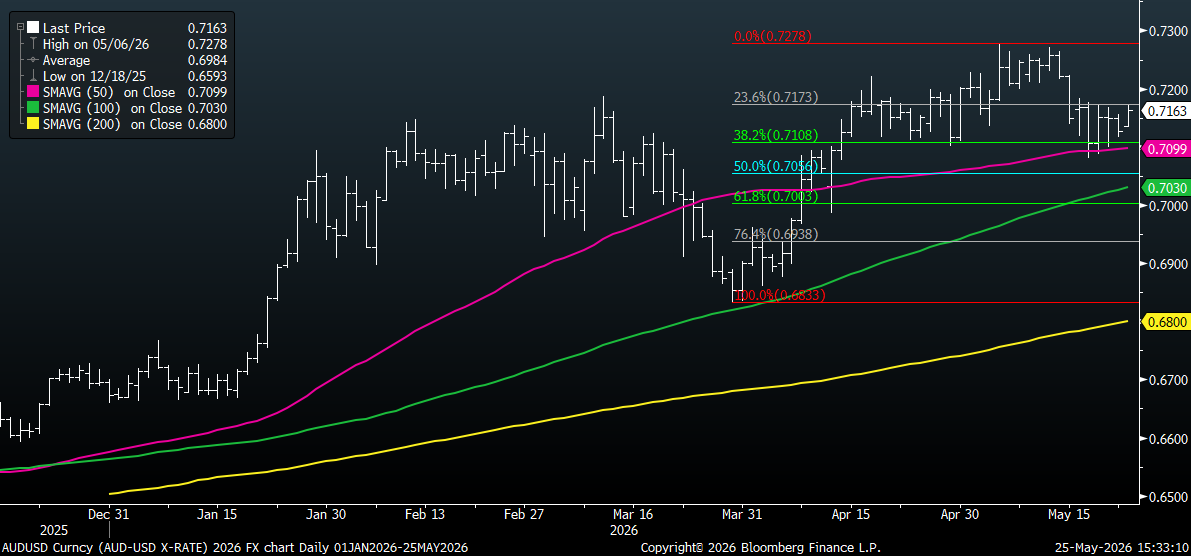
Source: Bloomberg
Levels to watch
0.7180: near-term resistance and recent supply zone.
0.7280: May high and the next major upside target.
0.7300: psychological level if momentum accelerates.
What drives it
USD weakens further if US-Iran deal optimism lowers oil, inflation and safe-haven demand.
Commodity strength broadens, especially across copper and industrial metals.
Risk appetite remains supported, keeping high-beta FX in demand.
RBA pricing stays firm because inflation concerns remain sticky.
Positioning lens
Momentum traders may prefer waiting for a clean daily close above 0.7180 rather than chasing inside the range.
A confirmed break could put 0.7280 back in focus, with 0.7300 as a stretch target.
Risks to the view
A failed US-Iran deal could lift oil and the USD, turning the risk mood quickly.
If Australian data weakens, markets may question whether the RBA can stay hawkish.
Levels to watch
0.7056: lower end of the tactical range and 50% retracement support.
0.7200: upper end of the tactical range and resistance bulls need to reclaim.
What drives it
USD weakness persists, but not enough to trigger a fresh breakout.
Commodities stay supported, but the AUD stops responding aggressively.
Traders wait for stronger confirmation from RBA speakers, inflation data or China demand signals.
Positioning lens
This is the “buy dips, don’t chase highs” setup.
Dips toward 0.7100–0.7110 may attract buyers as long as the pair holds above the 50-day SMA.
A failure to clear 0.7200 keeps the pair in a tactical range.
Risks to the view
Range trades can break quickly if US yields, oil or risk sentiment move sharply.
Stretched longs could reduce dip-buying appetite if momentum fades.
Levels to watch
0.7099: 50-day SMA; first warning line.
0.7056: 50% retracement area.
0.7030: 100-day SMA and key trend support.
0.7003: 61.8% retracement; a break would damage the bullish structure.
What drives it
RBA pricing unwinds if growth or labour-market data disappoints.
China demand concerns return, weighing on commodity-linked FX.
USD rebounds if the US-Iran deal becomes complicated or if Fed pricing turns less dovish.
Risk sentiment cools after a strong equity and commodity run.
Positioning lens
A daily close below 0.7099 would suggest momentum is fading.
Short-term traders may then look for a move toward 0.7056, with 0.7030 as the bigger support test.
A break below 0.7003 would shift the debate from pullback to trend reversal risk.
Risks to the view
Commodity strength can still cushion AUD downside.
Any renewed USD weakness could make downside breaks short-lived.
US-Iran deal headlines: A credible deal could keep oil, inflation expectations and safe-haven USD demand under pressure; any setback could reverse that quickly.
27 May: Australia April CPI. This is the near-term test of whether RBA hawkish pricing can survive the recent labour-market wobble.
28 May: US April PCE inflation. Important for USD direction and whether markets keep leaning toward a softer Fed path.
3 June: Australia Q1 GDP. A weaker print would strengthen the growth-risk argument against chasing AUD higher.
5 June: US May nonfarm payrolls. A softer jobs print could weigh on the USD; a strong print could challenge AUD/USD upside.
10 June: US May CPI. This is a key Fed-pricing event and a major USD risk for AUD/USD.
16 June: RBA decision and press conference. The market focus will be whether the RBA validates hawkish pricing or pushes back.
16–17 June: FOMC meeting. A dovish Fed tone would support AUD/USD upside; a sticky-inflation message could revive the USD.
AUD/USD still has a constructive bias, but it needs fresh confirmation to extend the rally. The pair is no longer just a USD weakness story; it is also a test of whether commodity momentum, risk appetite and RBA pricing can all stay aligned. Above 0.7200, bulls could regain control. Below 0.7099, the rally could start to look tired. The big line in the sand is 0.7030–0.7003 — hold there, and the uptrend could survive; break it, and the market may need to reassess the Aussie’s momentum.
Outrageous Predictions
Chief Investment Strategist
Outrageous Predictions
Chief Investment Strategist
Outrageous Predictions
Chief Investment Strategist
Outrageous Predictions
Chief Investment Strategist
Outrageous Predictions
Global Head of Investment Strategy
Outrageous Predictions
Investor Content Strategist
Outrageous Predictions
Global Head of Macro Strategy
Outrageous Predictions
Global Head of Macro Strategy
Outrageous Predictions
Saxo Group
Outrageous Predictions
Global Head of Macro Strategy