
You can access all of our platforms from a single Saxo account.

Asia Market Quick Take – 19 February, 2026

Asia Market Quick Take – 19 February, 2026
Key points:
- Macro: Axios reports Trump is closer to a major war with Iran
- Equities: Nvidia up 1.6% after Meta said it would deploy millions of their chips
- FX: NZDUSD led G10 losses after RBNZ kept OCR at 2.25%
- Commodities: Oil had biggest one-day jump since October on US Iran action reports
- Fixed income: Treasuries fell; long yields hit session highs after a weak 20-year auction
------------------------------------------------------------------
Disclaimer: Past performance does not indicate future performance.
Macro:
- Fed officials are split on interest rates: some favor cuts if inflation drops, others support holding or raising rates if inflation persists. Employment risks are reduced, but inflation concerns remain. Rates are unchanged at 3.5%-3.75% after last year's cuts.
- UK inflation eased to 3.0% in January 2026, the lowest since March 2025, driven by slower transport and food price rises. Core inflation fell to 3.1%, its lowest since August 2021. Monthly, consumer prices dropped by 0.5%.
- Japan's core machinery orders surged 19.1% in December 2025 to ¥1,052.5 billion, beating expectations after an 11% drop in November. Manufacturing orders rose 25.1%, non-manufacturing 8.2%. Significant rises were seen in petroleum, metals, real estate, and machinery industries. Private-sector orders climbed 16.8% year-on-year.
- According to Axios, Trump has escalated tensions with Iran, raising worries about a potential major conflict in the region.
- US housing starts rose 6.2% in December 2025 to 1.404 million, exceeding forecasts. Single-family starts increased, and multi-family starts surged. Activity rose in the West, Northeast, and Midwest but fell in the South. In 2025, 1,358,700 units were started, a 0.6% decline from 2024.
- US manufacturing output rose 0.6% in January 2026, surpassing expectations. Durable goods increased 0.8%, including motor vehicles, while nondurable goods went up 0.4%. Capacity utilization hit 75.6%, below the long-term average.
- US durable goods orders fell 1.4% in December 2025, mainly due to transportation equipment. Orders excluding transportation rose 0.9%, while those excluding defense fell 2.5%. Non-defense capital goods excluding aircraft rose 0.6%. In 2025, orders increased 7.8% year-over-year.
- The NY Fed's business activity index dropped to -25.7 in February 2026, showing sharp contraction. Employment fell, wage growth rose, and supply worsened. Costs stayed high, but firms expect modest improvement in six months.
Equities:
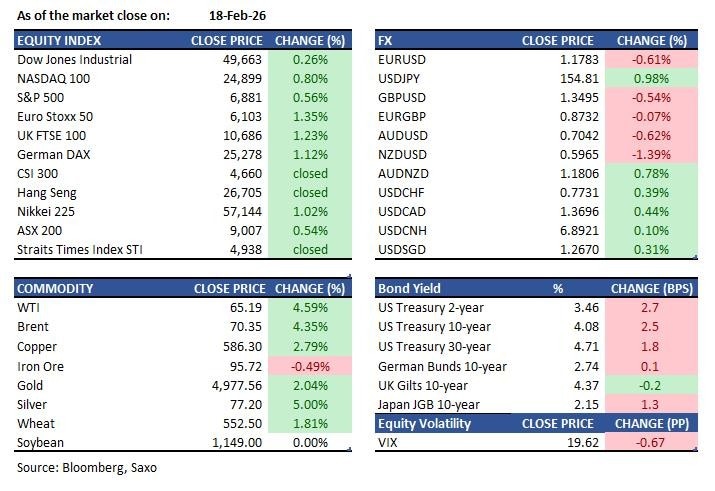
- US - Nasdaq 100 gained 0.8%, the S&P 500 added 0.5%, and the Dow rose 0.2%. Traders still anticipated multiple cuts this year, though Fed minutes showed concern that disinflation could remain slow. Nvidia advanced 1.6% after Meta said it would deploy millions of its chips, helping offset recent doubts about AI spending. Amazon and Micron climbed 1.8% and 5.3%, respectively, on increased institutional holdings, while Palo Alto Networks fell 6.8% on weak forecasts.
- EU - European stocks climbed Wednesday, nearing record highs, supported by strong defense-sector gains and speculation about leadership changes at the ECB. The Stoxx 50 rose 0.4% to 6,050 and the Stoxx 600 added 0.5% to 625. Defense shares gained over 2%, led by BAE Systems’ nearly 6% jump after stronger‑than‑expected profit. Sentiment improved further on reports that Germany may take a minority stake in KNDS ahead of its listing. The FT also reported Christine Lagarde may step down before France’s 2027 election. Carrefour dropped 5% after weaker operating profit as investors awaited Fed minutes.
- HK - Hang Seng Index rose 0.5% on Monday to 26,706, rebounding after two days of losses as all sectors advanced. Trading remained light ahead of the Spring Festival, but sentiment improved following signs of easing US‑China tensions after Washington delayed key tech security measures ahead of the April Trump–Xi meeting. Hopes for post‑holiday stimulus also grew after weak January CPI and continued producer deflation. Hong Kong markets close Tuesday to Thursday, with mainland bourses already shut for the week. Top gainers included China Hongqiao (3.9%), Techtronic (3.5%), AIA (2.6%), Nongfu Spring (1.9%), and Pop Mart (1.5%).
Earnings this week:
FX:
- USD gained strength as US bond yields rose following a durable goods report that was better than expected. Rising oil prices and increased geopolitical risks, particularly concerning US-Iran tensions, also boosted the dollar. The FOMC Minutes reinforced recent Fed commentary, clarifying USDJPY rate checks were requested by the US Treasury amid dollar weakness.
- NZD led G10 currency declines after the RBNZ held the OCR at 2.25%, with Governor Breman signaling no rate hikes soon. This caused NZDUSD to drop from 0.6042 to 0.5962.
- In the UK, mixed CPI results saw GBP weaken due to USD strength, while CHF and JPY didn’t benefit from geopolitical risk. NOK was resilient against USD, showing notable strength against EUR.
Commodities:
- Oil steadied after its biggest one-day jump since October amid reports US military action against Iran could come sooner than anticipated and may be a weeks-long campaign, with Israel pushing for regime change. West Texas Intermediate traded above $65 a barrel after a 4.6% rise on Wednesday, while Brent closed above $70 for the first time in more than two weeks.
- Gold steadied after a 2% jump on Wednesday as some Asian markets were closed for Lunar New Year and traders focused on the Federal Reserve’s next move on interest rates, with bullion near $4,975 in early trading amid dip-buying after a two-day decline and unusually choppy price action since a historic rout at the turn of the month pulled it back from an all-time high above $5,595.
Fixed income:
- Treasuries fell with long-dated yields hitting session highs after a weak 20-year auction and a surge in oil prices on the prospect of US military action in Iran, as the move higher began in the US morning following stronger-than-expected data (December durable goods orders, housing starts and January industrial production), while FOMC January minutes had little impact on expectations for two 25bp cuts by year-end even as “several” policymakers were open to further increases if inflation fails to abate; in Japan, 20-year government bonds edged higher for a third day ahead of the Ministry of Finance’s auction of a December 20, 2045 note totalling ¥800 billion; and Treasury Department data showed foreign purchases of US financial assets accelerated in 2025, with a net $1.55 trillion of long-term assets bought—including $658.5 billion in equities and $442.7 billion in Treasury notes and bonds—while China was a notable net seller at $208.6 billion and Europe accounted for $872.8 billion of the net inflow.
For a global look at markets – go to Inspiration.
This content is marketing content and should not be considered investment advice. Trading financial instruments carries risks and historic performance is not a guarantee for future performance. The instrument(s) mentioned in this content may be issued by a partner, from which Saxo receives promotion, payment or retrocessions. While Saxo receives compensation from these partnerships, all content is conducted with the intention of providing clients with valuable options and information.