Quick Take Asia

Asia Market Quick Take – 19 February, 2026

Macro 6 minutes to read
Saxo Be Invested
APAC Research

Asia Market Quick Take – 19 February, 2026

Key points:

  • Macro: Axios reports Trump is closer to a major war with Iran
  • Equities: Nvidia up 1.6% after Meta said it would deploy millions of their chips
  • FX: NZDUSD led G10 losses after RBNZ kept OCR at 2.25%
  • Commodities: Oil had biggest one-day jump since October on US Iran action reports
  • Fixed income: Treasuries fell; long yields hit session highs after a weak 20-year auction

------------------------------------------------------------------

qt 1902

Disclaimer: Past performance does not indicate future performance.

Macro: 

  • Fed officials are split on interest rates: some favor cuts if inflation drops, others support holding or raising rates if inflation persists. Employment risks are reduced, but inflation concerns remain. Rates are unchanged at 3.5%-3.75% after last year's cuts.
  • UK inflation eased to 3.0% in January 2026, the lowest since March 2025, driven by slower transport and food price rises. Core inflation fell to 3.1%, its lowest since August 2021. Monthly, consumer prices dropped by 0.5%.
  • Japan's core machinery orders surged 19.1% in December 2025 to ¥1,052.5 billion, beating expectations after an 11% drop in November. Manufacturing orders rose 25.1%, non-manufacturing 8.2%. Significant rises were seen in petroleum, metals, real estate, and machinery industries. Private-sector orders climbed 16.8% year-on-year.
  • According to Axios, Trump has escalated tensions with Iran, raising worries about a potential major conflict in the region.
  • US housing starts rose 6.2% in December 2025 to 1.404 million, exceeding forecasts. Single-family starts increased, and multi-family starts surged. Activity rose in the West, Northeast, and Midwest but fell in the South. In 2025, 1,358,700 units were started, a 0.6% decline from 2024.
  • US manufacturing output rose 0.6% in January 2026, surpassing expectations. Durable goods increased 0.8%, including motor vehicles, while nondurable goods went up 0.4%. Capacity utilization hit 75.6%, below the long-term average.
  • US durable goods orders fell 1.4% in December 2025, mainly due to transportation equipment. Orders excluding transportation rose 0.9%, while those excluding defense fell 2.5%. Non-defense capital goods excluding aircraft rose 0.6%. In 2025, orders increased 7.8% year-over-year.
  • The NY Fed's business activity index dropped to -25.7 in February 2026, showing sharp contraction. Employment fell, wage growth rose, and supply worsened. Costs stayed high, but firms expect modest improvement in six months.

Equities:

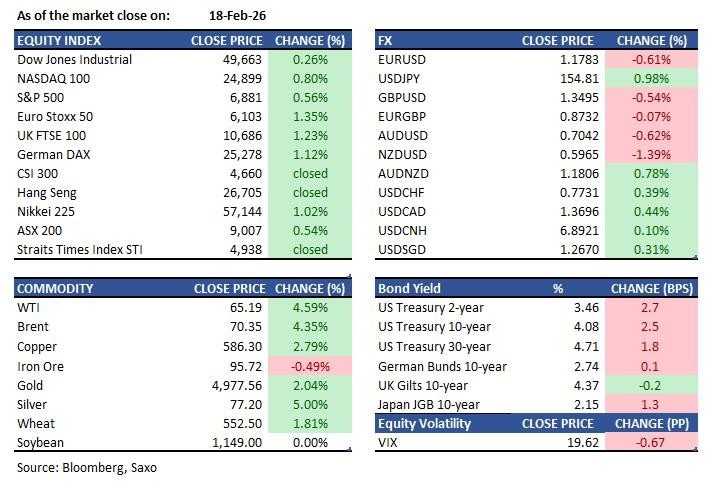
  • US - Nasdaq 100 gained 0.8%, the S&P 500 added 0.5%, and the Dow rose 0.2%. Traders still anticipated multiple cuts this year, though Fed minutes showed concern that disinflation could remain slow. Nvidia advanced 1.6% after Meta said it would deploy millions of its chips, helping offset recent doubts about AI spending. Amazon and Micron climbed 1.8% and 5.3%, respectively, on increased institutional holdings, while Palo Alto Networks fell 6.8% on weak forecasts.
  • EU - European stocks climbed Wednesday, nearing record highs, supported by strong defense-sector gains and speculation about leadership changes at the ECB. The Stoxx 50 rose 0.4% to 6,050 and the Stoxx 600 added 0.5% to 625. Defense shares gained over 2%, led by BAE Systems’ nearly 6% jump after stronger‑than‑expected profit. Sentiment improved further on reports that Germany may take a minority stake in KNDS ahead of its listing. The FT also reported Christine Lagarde may step down before France’s 2027 election. Carrefour dropped 5% after weaker operating profit as investors awaited Fed minutes.
  • HK - Hang Seng Index rose 0.5% on Monday to 26,706, rebounding after two days of losses as all sectors advanced. Trading remained light ahead of the Spring Festival, but sentiment improved following signs of easing US‑China tensions after Washington delayed key tech security measures ahead of the April Trump–Xi meeting. Hopes for post‑holiday stimulus also grew after weak January CPI and continued producer deflation. Hong Kong markets close Tuesday to Thursday, with mainland bourses already shut for the week. Top gainers included China Hongqiao (3.9%), Techtronic (3.5%), AIA (2.6%), Nongfu Spring (1.9%), and Pop Mart (1.5%).


Earnings this week:

FX:

  • USD gained strength as US bond yields rose following a durable goods report that was better than expected. Rising oil prices and increased geopolitical risks, particularly concerning US-Iran tensions, also boosted the dollar. The FOMC Minutes reinforced recent Fed commentary, clarifying USDJPY rate checks were requested by the US Treasury amid dollar weakness.
  • NZD led G10 currency declines after the RBNZ held the OCR at 2.25%, with Governor Breman signaling no rate hikes soon. This caused NZDUSD to drop from 0.6042 to 0.5962.
  •  In the UK, mixed CPI results saw GBP weaken due to USD strength, while CHF and JPY didn’t benefit from geopolitical risk. NOK was resilient against USD, showing notable strength against EUR.

Commodities:

  • Oil steadied after its biggest one-day jump since October amid reports US military action against Iran could come sooner than anticipated and may be a weeks-long campaign, with Israel pushing for regime change. West Texas Intermediate traded above $65 a barrel after a 4.6% rise on Wednesday, while Brent closed above $70 for the first time in more than two weeks.
  • Gold steadied after a 2% jump on Wednesday as some Asian markets were closed for Lunar New Year and traders focused on the Federal Reserve’s next move on interest rates, with bullion near $4,975 in early trading amid dip-buying after a two-day decline and unusually choppy price action since a historic rout at the turn of the month pulled it back from an all-time high above $5,595.

Fixed income:

  • Treasuries fell with long-dated yields hitting session highs after a weak 20-year auction and a surge in oil prices on the prospect of US military action in Iran, as the move higher began in the US morning following stronger-than-expected data (December durable goods orders, housing starts and January industrial production), while FOMC January minutes had little impact on expectations for two 25bp cuts by year-end even as “several” policymakers were open to further increases if inflation fails to abate; in Japan, 20-year government bonds edged higher for a third day ahead of the Ministry of Finance’s auction of a December 20, 2045 note totalling ¥800 billion; and Treasury Department data showed foreign purchases of US financial assets accelerated in 2025, with a net $1.55 trillion of long-term assets bought—including $658.5 billion in equities and $442.7 billion in Treasury notes and bonds—while China was a notable net seller at $208.6 billion and Europe accounted for $872.8 billion of the net inflow.

For a global look at markets – go to Inspiration.

This content is marketing content and should not be considered investment advice. Trading financial instruments carries risks and historic performance is not a guarantee for future performance. The instrument(s) mentioned in this content may be issued by a partner, from which Saxo receives promotion, payment or retrocessions. While Saxo receives compensation from these partnerships, all content is conducted with the intention of providing clients with valuable options and information.


Quarterly Outlook

01 /

  • Q1 Outlook for Traders: Five Big Questions and Three Grey Swans.

    Quarterly Outlook

    Q1 Outlook for Traders: Five Big Questions and Three Grey Swans.

    John J. Hardy

    Global Head of Macro Strategy

    Strap yourself in for key market questions that must be answered in 2026.
  • Q1 Outlook for Investors: “AI” party hangover needs discipline and diversification

    Quarterly Outlook

    Q1 Outlook for Investors: “AI” party hangover needs discipline and diversification

    Charu Chanana

    Chief Investment Strategist

    2026 is a high-valuation, high-dispersion year: the AI story matures, policy becomes less predictabl...
  • Q4 Outlook for Investors: Diversify like it’s 2025 – don’t fall for déjà vu

    Quarterly Outlook

    Q4 Outlook for Investors: Diversify like it’s 2025 – don’t fall for déjà vu

    Jacob Falkencrone

    Global Head of Investment Strategy

  • Q4 Outlook for Traders: The Fed is back in easing mode. Is this time different?

    Quarterly Outlook

    Q4 Outlook for Traders: The Fed is back in easing mode. Is this time different?

    John J. Hardy

    Global Head of Macro Strategy

    The Fed launched a new easing cycle in late Q3. Will this cycle now play out like 2000 or 2007?
  • Q3 Investor Outlook: Beyond American shores – why diversification is your strongest ally

    Quarterly Outlook

    Q3 Investor Outlook: Beyond American shores – why diversification is your strongest ally

    Jacob Falkencrone

    Global Head of Investment Strategy

  • Q3 Macro Outlook: Less chaos, and hopefully a bit more clarity

    Quarterly Outlook

    Q3 Macro Outlook: Less chaos, and hopefully a bit more clarity

    John J. Hardy

    Global Head of Macro Strategy

    After the chaos of Q2, the quarter ahead should get a bit more clarity on how Trump 2.0 is impacting...
  • Equity outlook: The high cost of global fragmentation for US portfolios

    Quarterly Outlook

    Equity outlook: The high cost of global fragmentation for US portfolios

    Charu Chanana

    Chief Investment Strategist

  • Commodity Outlook: Commodities rally despite global uncertainty

    Quarterly Outlook

    Commodity Outlook: Commodities rally despite global uncertainty

    Ole Hansen

    Head of Commodity Strategy

  • Upending the global order at blinding speed

    Quarterly Outlook

    Upending the global order at blinding speed

    John J. Hardy

    Global Head of Macro Strategy

    We are witnessing a once-in-a-lifetime shredding of the global order. As the new order takes shape, ...
  • Asset allocation outlook: From Magnificent 7 to Magnificent 2,645—diversification matters, now more than ever

    Quarterly Outlook

    Asset allocation outlook: From Magnificent 7 to Magnificent 2,645—diversification matters, now more than ever

    Jacob Falkencrone

    Global Head of Investment Strategy

Disclaimer

The Saxo Group entities each provide execution-only service and access to Analysis permitting a person to view and/or use content available on or via the website is not intended to and does not change or expand on this. Such access and use are at all times subject to (i) The Terms of Use; (ii) Full Disclaimer; (iii) The Risk Warning; (iv) the Rules of Engagement and (v) Notices applying to Saxo News & Research and/or its content in addition (where relevant) to the terms governing the use of hyperlinks on the website of a member of the Saxo Group by which access to Saxo News & Research is gained. Such content is therefore provided as no more than information. In particular no advice is intended to be provided or to be relied on as provided nor endorsed by any Saxo Group entity; nor is it to be construed as solicitation or an incentive provided to subscribe for or sell or purchase any financial instrument. All trading or investments you make must be pursuant to your own unprompted and informed self-directed decision. As such no Saxo Group entity will have or be liable for any losses that you may sustain as a result of any investment decision made in reliance on information which is available on Saxo News & Research or as a result of the use of the Saxo News & Research. Orders given and trades effected are deemed intended to be given or effected for the account of the customer with the Saxo Group entity operating in the jurisdiction in which the customer resides and/or with whom the customer opened and maintains his/her trading account. Saxo News & Research does not contain (and should not be construed as containing) financial, investment, tax or trading advice or advice of any sort offered, recommended or endorsed by Saxo Group and should not be construed as a record of our trading prices, or as an offer, incentive or solicitation for the subscription, sale or purchase in any financial instrument. To the extent that any content is construed as investment research, you must note and accept that the content was not intended to and has not been prepared in accordance with legal requirements designed to promote the independence of investment research and as such, would be considered as a marketing communication under relevant laws.

Please read our disclaimers:
- Notification on Non-Independent Investment Research (https://www.home.saxo/legal/niird/notification)
- Full disclaimer (https://www.home.saxo/en-hk/legal/disclaimer/saxo-disclaimer)

None of the information contained here constitutes an offer to purchase or sell a financial instrument, or to make any investments. Saxo does not take into account your personal investment objectives or financial situation and makes no representation and assumes no liability as to the accuracy or completeness of the information nor for any loss arising from any investment made in reliance of this presentation. Any opinions made are subject to change and may be personal to the author. These may not necessarily reflect the opinion of Saxo or its affiliates.


Hong Kong

Contact Saxo

Hong Kong S.A.R
Hong Kong S.A.R

Saxo Capital Markets HK Limited (“Saxo”) is a company authorised and regulated by the Securities and Futures Commission of Hong Kong. Saxo holds a Type 1 Regulated Activity (Dealing in Securities); Type 2 Regulated Activity (Dealing in Futures Contract); Type 3 Regulated Activity (Leveraged Foreign Exchange Trading); Type 4 Regulated Activity (Advising on Securities) and Type 9 Regulated Activity (Asset Management) licenses (CE No. AVD061). Registered address: 19th Floor, Shanghai Commercial Bank Tower, 12 Queen’s Road Central, Hong Kong.

Trading in financial instruments carries various risks, and is not suitable for all investors. Please seek expert advice, and always ensure that you fully understand these risks before trading. Trading in leveraged products may result in your losses exceeding your initial deposits. Saxo does not provide financial advice, any information available on this website is ‘general’ in nature and for informational purposes only. Saxo does not take into account an individual’s needs, objectives or financial situation. Please click here to view the relevant risk disclosure statements.

The Saxo trading platform has received numerous awards and recognition. For details of these awards and information on awards visit www.home.saxo/en-hk/about-us/awards.

The information or the products and services referred to on this site may be accessed worldwide, however is only intended for distribution to and use by recipients located in countries where such use does not constitute a violation of applicable legislation or regulations. Products and services offered on this website are not directed at, or intended for distribution to or use by, any person or entity residing in the United States and Japan. Please click here to view our full disclaimer.

Apple, iPad and iPhone are trademarks of Apple Inc., registered in the US and other countries. AppStore is a service mark of Apple Inc. Android is a trademark of Google Inc.