
You can access both of our platforms from a single Saxo account.

LVMH through results season: what mini options change for a smaller portfolio

Summary: A single LVMH option contract commits nearly EUR 49,000. The mini contract commits a tenth of that, which changes who can act on a view before the 27 July results.
One standard option contract on LVMH covers about EUR 48,700 of stock. A mini contract covers a tenth of that, and for many investors the difference decides whether these tools are usable at all.
LVMH closed at EUR 486.85 on Monday 20 July 2026 (Source: Bloomberg and SaxoTrader, 21 July 2026). For many European investors it is a long-term holding whose case has become more of a debate. First-quarter revenue was EUR 19.1 billion with organic growth of 1%, below consensus, held back by a currency drag the company put at 7% of reported revenue. Fashion and Leather Goods fell 2% organically while Watches and Jewellery grew 7% (Source: LVMH Q1 2026 results release, 13 April 2026). The shares trade on a forward price-to-earnings ratio near 21.9 against a peer median around 17.5 (Source: Bloomberg, 21 July 2026).
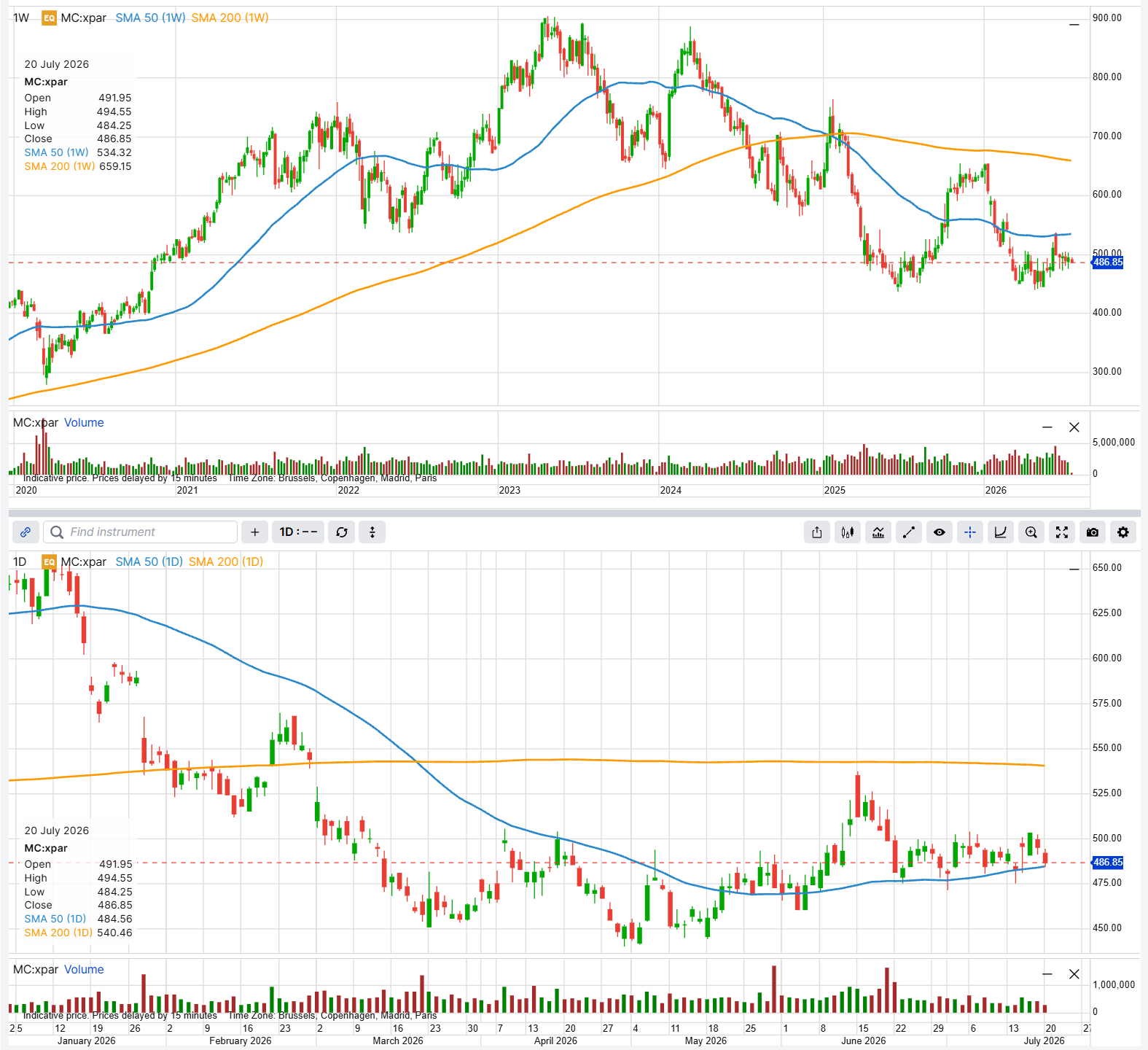
LVMH (MC:xpar) weekly since 2020 and daily year-to-date, closing at EUR 486.85 on 20 July 2026. The shares sit below both the 50-week and 200-week moving averages and well below their 2023 peak. Source: SaxoTrader, 20 July 2026. Illustrative and educational only, not predictive. Past performance is not indicative of future results.
Half-year results are expected on 27 July 2026 (Source: LVMH financial calendar). Someone who already owns the shares, or who has been waiting for a lower entry, mostly has to sit through that date rather than trade it. Options can add structure to a view the investor already has, though on a share priced near EUR 500 contract size has been the obstacle.
What a mini contract actually changes
A standard Euronext single stock option covers 100 shares, about EUR 48,700 of LVMH exposure per contract at the 20 July close, which is more than many private portfolios hold in the name. A mini contract covers 10 shares, so the same structure sits against roughly EUR 4,870 (Source: Euronext mini stock options; SaxoTrader, 20 July 2026). LVMH has both monthly and weekly mini contracts listed in Paris, all covering 10 shares and all American-style, meaning a short leg can be exercised against the seller at any point before expiry.
The examples below use the standard monthly expiry of 21 August 2026, the third Friday of the month, falling 25 days after the results date. The reporting date and the expiry date are different, and a position held over 21 August spans the announcement and the weeks after it.
One way to gauge what the market is pricing is to add the at-the-money call premium to the at-the-money put premium for the expiry covering the event. At the 490 strike for 21 August, the call was marked at EUR 19.57 and the put at EUR 20.59, a combined EUR 40.16, about 8.2% of the share price (Source: SaxoTraderPRO option chain, 20 July 2026 close). That points to a range of roughly EUR 450 to EUR 530 by expiry, which is worth holding in mind against the strikes below. Future outcomes are uncertain and may result in losses.
Important note: The strategies and examples provided in this article are purely for educational purposes. They are intended to assist in shaping your thought process and should not be replicated or implemented without careful consideration. Every investor or trader must conduct their own due diligence and take into account their unique financial situation, risk tolerance, and investment objectives before making any decisions. Remember, investing in the stock market carries risk, and it’s crucial to make informed decisions.
The following examples are hypothetical and for educational use only; they are not advice or trade recommendations.
Income approach: the covered call
An investor holding 10 LVMH shares who thinks the stock may drift rather than run higher may consider selling a call against the position, agreeing to sell those shares at the strike if the stock is above that level at expiry. The premium is received today and kept regardless. The 510 strike below sits inside the upper end of the range the chain is pricing.
Example structure (illustrative only – not a trade recommendation)
- Hold 10 LVMH shares at EUR 486.85, a position value of EUR 4,868.50
- Sell 1 mini call, 21 August 2026 expiry, 510 strike, at a mid price of EUR 11.60 per share (bid 11.06, ask 12.14; implied volatility about 35%, delta about 0.36; open interest 11 contracts)
- Premium received: EUR 116.00 (11.60 multiplied by 10 shares)
- Maximum gain if the shares are called away: EUR 347.50, combining the EUR 116.00 premium and EUR 231.50 of share appreciation
- Maximum loss: EUR 4,752.50, the full position value less the premium, if the shares fell to zero
- Break-even at expiry: EUR 475.25
- Risk: the investor retains full downside exposure to the shares; the premium offsets only about 2.4% of a decline, and the short call carries early-assignment risk
- All figures are hypothetical and for education only. Past performance is not indicative of future results; figures are illustrative and not predictive.
- Costs and charges apply to each leg; see Saxo pricing for full details.
The investor retains the full downside risk of holding the shares, and the premium provides a partial offset but does not protect against a significant decline. Against that, EUR 116.00 represents about 2.4% of the position value over 32 days. Upside is capped as well: above EUR 510 the shares may be called away, and gains beyond roughly 4.8% would not be captured.
The most likely single outcome is the dullest one. If LVMH finishes anywhere below 510 on 21 August, the call expires worthless, the investor keeps both the shares and the EUR 116.00, and nothing else happens. Theta measures time decay, the small amount of value an option loses each day, which works in favour of the seller.
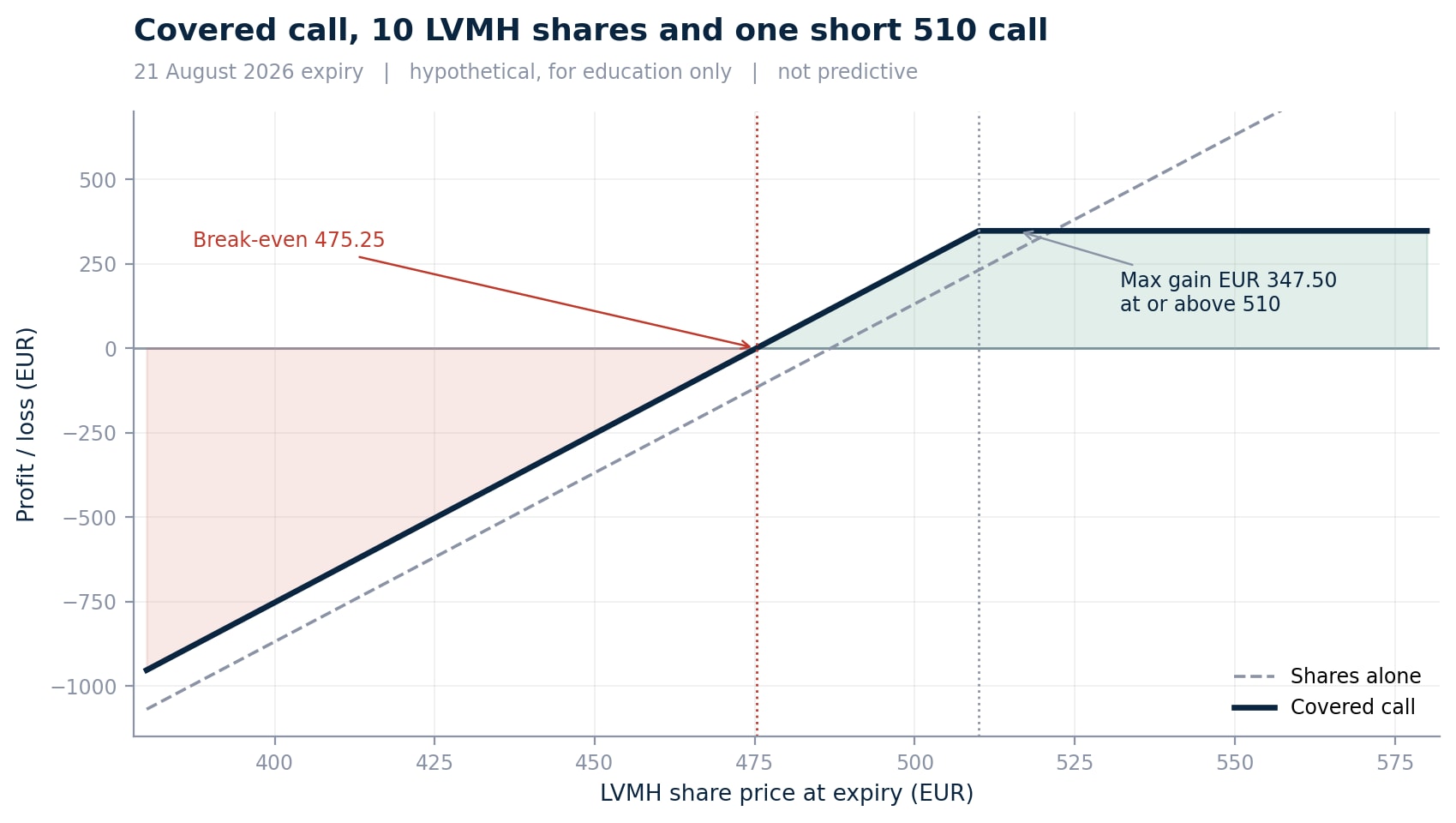
Covered call payoff at expiry, 10 LVMH shares against one short 510 call, 21 August 2026. Source: Saxo option chain, 20 July 2026 close. Illustrative and educational only, not predictive. Past performance is not indicative of future results; figures are illustrative and not predictive.
Getting paid to wait: the cash-secured put
An investor who wants to own LVMH but finds EUR 486.85 too high may consider selling a put at a lower strike, agreeing to buy 10 shares at that strike if the stock falls there by expiry, with the cash set aside to do so. The 450 strike below sits close to the lower edge of the range the chain is pricing.
Example structure (illustrative only – not a trade recommendation)
- Sell 1 mini put, 21 August 2026 expiry, 450 strike, at a mid price of EUR 6.25 per share (bid 5.76, ask 6.74; implied volatility about 36%, delta about -0.20; open interest 8 contracts)
- Premium received: EUR 62.50
- Cash set aside: EUR 4,500
- Maximum loss: EUR 4,437.50 if the shares fell to zero
- Effective purchase price if assigned: EUR 443.75, about 8.9% below the 20 July close
- Risk: assignment may occur at any time because the contract is American-style, and the obligation to buy at 450 stands however far below that the shares trade
- All figures are hypothetical and for education only. Past performance is not indicative of future results; figures are illustrative and not predictive.
- Costs and charges apply to each leg; see Saxo pricing for full details.
If LVMH falls well below 450, the investor is obliged to buy at 450 while the market price is lower, and the loss could considerably exceed the premium collected. At 400 a share, for instance, the obligation costs EUR 500 against EUR 62.50 collected. Set against that, EUR 62.50 is about 1.4% of the cash committed over 32 days. This may only make sense for an investor content to own the shares at that level, and it offers no benefit at all if the shares simply rise.
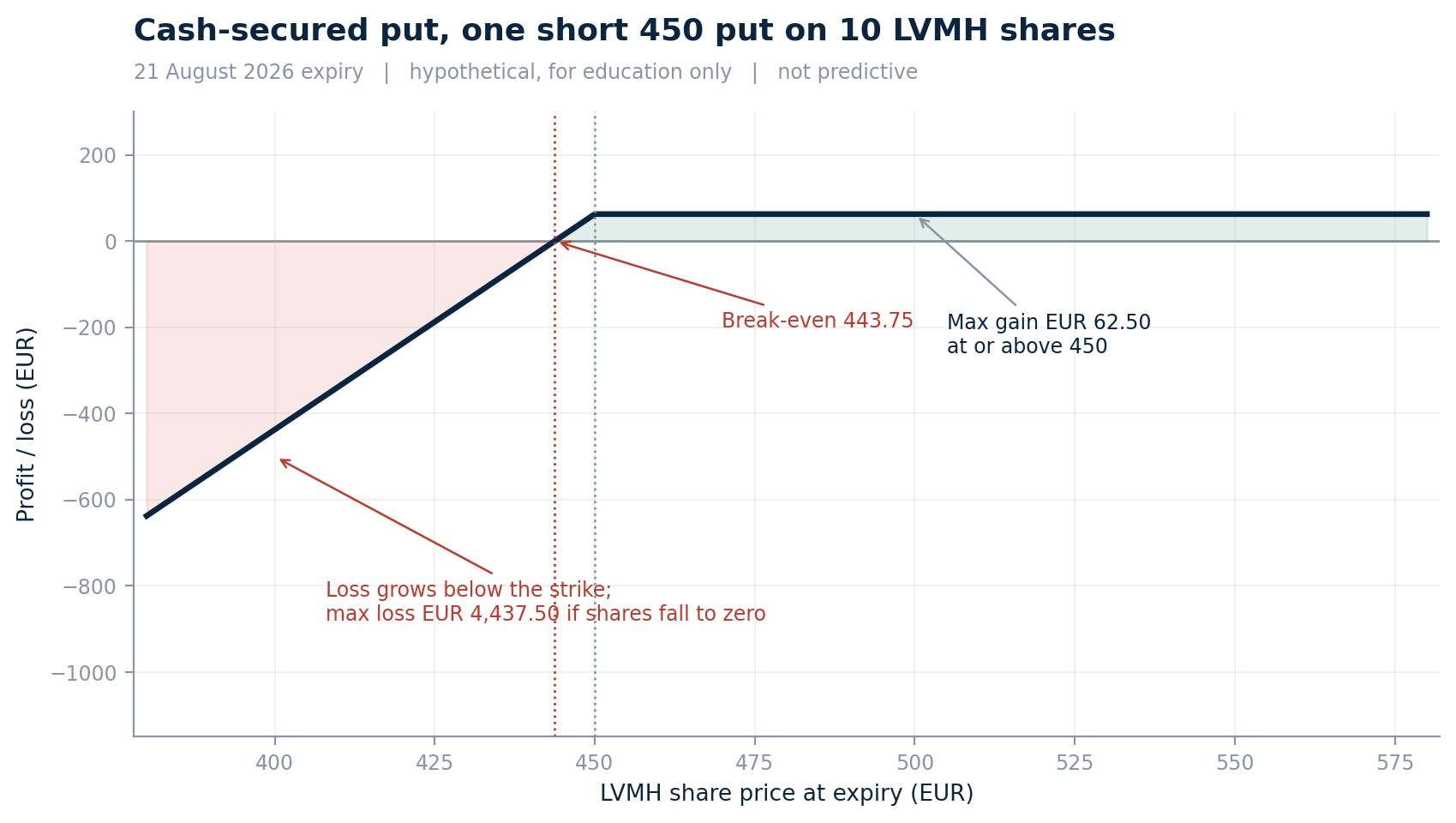
Cash-secured put payoff at expiry, one short 450 put on 10 LVMH shares, 21 August 2026. Source: Saxo option chain, 20 July 2026 close. Illustrative and educational only, not predictive. Past performance is not indicative of future results; figures are illustrative and not predictive.
If the view changes before expiry
Neither position has to be held to 21 August. A short option can be bought back during market hours at whatever it is worth then, which closes the obligation. An investor who no longer wants to sell their LVMH at 510 can buy the call back, though if the shares have risen it will cost more than the EUR 116.00 collected, and that difference is a realised loss set against the gain on the shares. The same applies to the put.
What the spread costs at entry
Mini contracts on LVMH appear considerably less traded than the standard series, and in our view that shows up in the prices. In the 21 August chain the 450 put was quoted 5.76 bid against 6.74 offered at the 20 July close (Source: SaxoTraderPRO option chain, 20 July 2026). That gap of EUR 0.98 is about 16% of the mid. Selling at the bid rather than working toward the 6.25 mid gives up about EUR 4.90 on a 10-share contract, roughly 8% of the premium; crossing the full spread both ways costs about EUR 9.80. Open interest at the strikes above stands at 11 contracts for the 510 call and 8 for the 450 put, thin enough that a market order is a poor idea and an early exit may be harder than the entry.
That does not make these contracts unusable, but the entry price may matter as much as the strategy choice. Options carry a high risk of rapid loss and are not suitable for every investor. See Saxo pricing for costs and applicable charges: pricing overview.
Before placing the trade, check
- Bid and ask spreads, since wide spreads can remove the theoretical benefit at entry
- Volume and open interest at the specific strike and expiry chosen
- Whether the expiry is a standard monthly or a weekly, as liquidity can differ substantially
- Implied volatility relative to how much the stock has actually been moving
- An exit plan, defined before entering rather than after
- Assignment risk on any short leg that moves into the money
Assignment risk note: Because LVMH options are American-style, short legs can be assigned before expiry if they move in the money, particularly close to expiration or around ex-dividend dates. LVMH paid the EUR 7.50 balance of its 2025 dividend on 30 April 2026 and no further payment is scheduled before the August expiry, which may reduce one common trigger for early assignment (Source: LVMH financial calendar). The buyer of a put or call faces no assignment risk; only the seller does.
Final thoughts
Neither structure makes results season profitable. What they may offer is a way to act on a view the investor already holds, a willingness to sell at 510 or buy at 450, and to be paid EUR 116.00 or EUR 62.50 for committing to it. Options carry a high risk of rapid loss and are not suitable for every investor, and both leave the investor exposed to a substantial fall in the shares.
Contract size decides whether any of this is available to a portfolio at all. At 100 shares a single LVMH contract commits about EUR 48,700; at 10 shares it commits under EUR 5,000, and the strategies become usable for a portfolio of ordinary size. What that buys is a wider spread and thinner open interest, which is the trade the investor is actually making. Past performance is not indicative of future results.
This content is marketing material and should not be regarded as investment advice. Trading financial instruments carries risks and historic performance is not a guarantee of future results.
The author does not hold positions in any of the instruments mentioned in this article.
The Author is permitted to wait at least 24 hours from the time of the publication before they trade the instruments themselves.
The instrument(s) referenced in this content may be issued by a partner, from whom Saxo receives promotional fees, payment or retrocessions. While Saxo may receive compensation from these partnerships, all content is created with the aim of providing clients with valuable information and options.
This content will not be changed or subject to review after publication.
| Related articles/content |
|---|
| Options on leveraged ETFs how investors actually use them | 7 Jul 2026 Adding options to your portfolio what actually changes | 26 Jun 2026 Protecting your gains without selling how to hedge a tech portfolio with options | 19 Jun 2026 What investors misunderstand about covered calls | 10 Jun 2026 Covered call or cash-secured put | 2 Jun 2026 From shareholder to options user | 26 May 2026 What is a cash-secured put Using Oracles post-earnings pullback as an example | 12 Jun 2026 Micron before earnings - using a covered call after a strong rally | 29 May 2026 Alphabet after earnings - how a covered call can help investors manage a strong rally | 30 Apr 2026 Tesla shares after earnings could a covered call make sense | 27 Apr 2026 A structured way to buy IWDA at a lower price using options | 20 Mar 2026 How to improve the yield on a long-term IWDA holdings | 12 Mar 2026 |
| More from the author |
|---|