
You can access both of our platforms from a single Saxo account.

Asia Market Quick Take – 30 March, 2026

Asia Market Quick Take – 30 March, 2026
Key points:
- Macro: Iran backed Houthis joins US-Iran conflict
- Equities: S&P down 1.7% on Friday in fifth consecutive week of decline on war
- FX: JPY near 160 against USD, intervention fears rise as global risk-off deepens
- Commodities: Brent rallies 3% on record-month pace; WTI >$100
- Fixed income: Treasuries up; 2s10s yield curve twist steepening to 50bp.
------------------------------------------------------------------
Disclaimer: Past performance does not indicate future performance.
Macro:
- As the Iran war entered its fifth week, investor doubts about a quick resolution grew after Iran‑backed Houthis joined the conflict, fired missiles at Israel, and threatened further attacks, while the US reportedly prepared for weeks of ground operations with more troops deployed to the region.
- Despite repeated warnings from Tokyo, including Finance Minister Satsuki Katayama’s pledge to take “bold actions” against excessive FX moves, the yen remained under pressure from surging Middle East–driven oil prices that threaten Japan’s recovery, prompting the Finance Ministry to reportedly explorepossible intervention in crude futures.
- The Michigan Consumer Sentiment Index fell to 53.3 in March from 56.6 in February, near late‑2025 lows, amid higher gas prices and market volatility linked to the Iran conflict. Short-term economic and personal finance expectations weakened sharply, while long-term views slipped slightly. Year-ahead inflation expectations rose to 3.8% and long-term expectations dipped to 3.2%.
Equities:
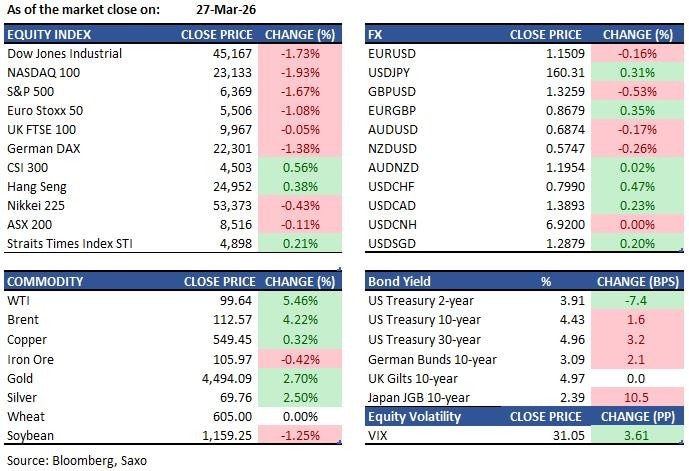
- US: US stocks fell sharply on Friday with the S&P 500 down 1.7% to 6,368.85, marking its fifth consecutive weekly decline - the longest losing streak since 2022. Both the Nasdaq 100 and Dow Jones entered correction territory, trading more than 10% below recent highs, as fears intensified that surging oil prices will cripple the global economy. The VIX index closed above 30 for the first time since April. Dow futures fell 300 points overnight as investors braced for potential US ground assault on Iran. Mega‑cap tech remained under pressure, with Nvidia, Microsoft and Alphabet down over 2% and Meta falling 4%.
- EU: European equities ended sharply lower on Friday as rising energy prices reinforced stagflation concerns across the region. The STOXX 50 fell 1.1% to 5,508 and the STOXX 600 dropped 0.9% to 575. While President Trump extended the pause on strikes on Iran’s energy facilities until April 6, higher oil prices are already feeding into inflation. Spain’s March inflation hit its highest level since 2024. Banks slid on rising yields, and industrials extended losses.
- Asia: Asian markets opened sharply lower on Monday as the Iran conflict intensified. Japan's Nikkei plunged 5.0% to 50,712 in early trading, while South Korea's Kospi tumbled 4.4% to 5,236, extending Friday's losses. The Hang Seng closed Friday unchanged at 24,952 after weekend developments. China's CSI 300 was flat at 4,503. Singapore's STI finished Friday at 4,898, up 0.2%.SoftBank Group is down 8.3% after $40 bridge loan for Open AI investment.
Earnings this week:
- Monday: Agricultural Bank of China, Bank of China
- Tuesday: Nike, Beyond Meat
- Wednesday: SAIC Motor
FX:
- Currency markets are mixed in early Asia amid risk-off sentiment and geopolitical tensions, with USDJPY around 160 as the yen hovers near intervention levels following strong warnings from Japan’s top FX official about potential “bold” action. USD remains firm, hitting a 20‑month high against the yen, while EURUSD 1.1506 and GBPUSD 1.3251 edge lower on Middle East concerns.
- Asian FX shows a varied picture with a slightly weaker yuan at USDCNY 6.9112, and a firmer Singapore dollar at USDSGD 1.2891, and commodity-linked currencies are under pressure, led by the Australian dollar at AUDUSD 0.6850, down 0.35 percent and the weakest performer among majors.
Commodities:
- Oil rose as Iran-backed Houthi militants in Yemen joined the Middle East conflict and more US troops were deployed, heightening fears for energy markets. Brent—on course for a record monthly gain—surged more than 3% at the open to $116.43 after the Houthis fired missiles at Israel and vowed to continue operations until attacks on Iran and its proxies cease, while WTI climbed above $100.
- Gold logged its first weekly gain since the Middle East war began as bargain hunters stepped in, with bullion near $4,490 an ounce in early trading after a 2.7% rise, as opportunistic buying followed the steepest sell-off in years even amid worries that a prolonged conflict could prompt central banks to sell holdings or raise interest rates to curb inflation.
Fixed income:
- Treasuries ended Friday mixed with a twist steepener around a near‑unchanged 7‑year sector as the front end outperformed—2‑year yields topped 4% in the morning amid a dovish tone in SOFR futures/options and a large 2‑year note futures block—most yields retreating from year‑to‑date highs and the 2s10s spread breaching 50bp for its biggest widening since 1 August.
For a global look at markets – go to Inspiration.
This content is marketing content and should not be considered investment advice. Trading financial instruments carries risks and historic performance is not a guarantee for future performance. The instrument(s) mentioned in this content may be issued by a partner, from which Saxo receives promotion, payment or retrocessions. While Saxo receives compensation from these partnerships, all content is conducted with the intention of providing clients with valuable options and information.