
Un seul compte Saxo suffit pour accéder à nos plateformes.

Tesla shares after earnings – could a covered call make sense?
Options 10 minutes to read

Tesla shares after earnings – could a covered call make sense?
Tesla remains one of the most widely followed stocks in the market. For long-term shareholders who already own 100 shares, a covered call can be a practical way to generate option premium from an existing position. The trade-off is clear: you receive income today, but you may have to sell your shares if Tesla rises above the agreed strike price.
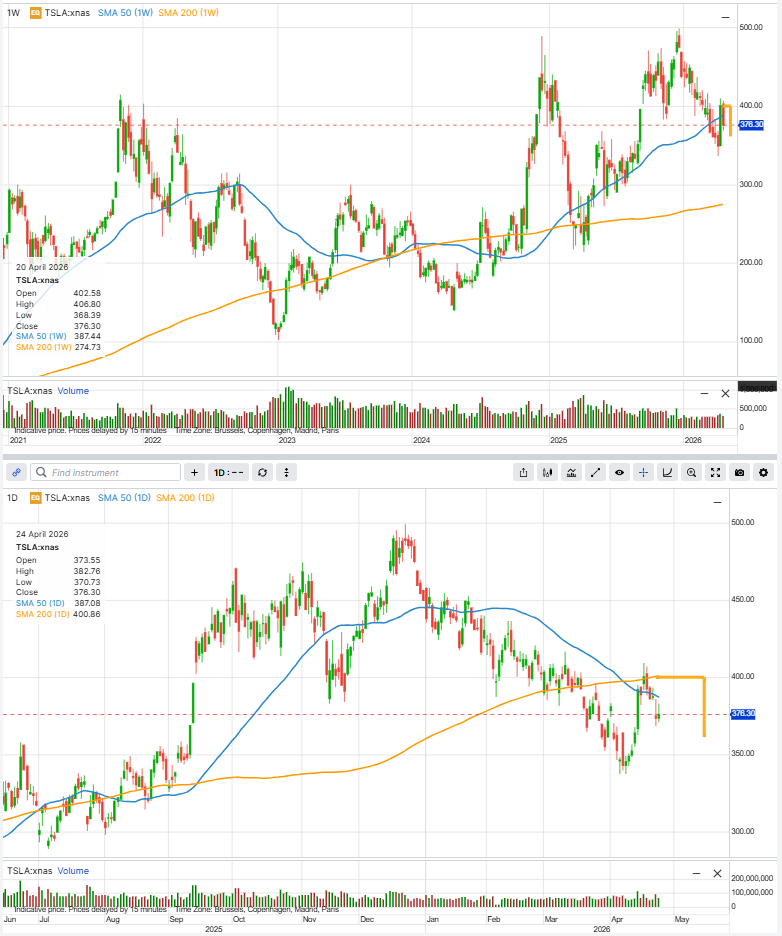
Tesla shares are shown at USD 376.30 after the latest earnings period, below recent highs but above the April low. This creates a practical example for shareholders considering whether they would be comfortable selling at a higher price. Source: SaxoTrader
Why Tesla is a useful example
Tesla’s latest earnings kept the stock in focus, with investors still weighing vehicle demand, margins, artificial intelligence investment, robotics, and future capital spending. In short, the Tesla story remains exciting, but not exactly calm. Tesla rarely does calm.
For shareholders, that volatility can be uncomfortable. A covered call is one way to use some of that volatility, but it does not remove the risk of owning Tesla shares. It changes the balance between income, upside, and flexibility.
This example is aimed at investors who already own at least 100 Tesla shares and have never sold a covered call before.
What is a covered call?
A covered call means selling a call option against shares you already own. A call option gives the buyer the right to buy shares at a fixed price, called the strike price, before or at expiry. Because you already own the shares, the position is called “covered”.
The seller receives a premium for selling the option. In return, the seller accepts a limit on potential upside above the strike price. Put simply: a covered call can generate income from shares you already own, but it may also require you to sell those shares at a pre-agreed price.
The Tesla example
In the screenshots used for this article, Tesla is trading at USD 376.30. The investor already owns 100 Tesla shares, worth approximately USD 37,630 before fees and taxes.
Important note: The strategies and examples provided in this article are purely for educational purposes. They are intended to assist in shaping your thought process and should not be replicated or implemented without careful consideration. Every investor or trader must conduct their own due diligence and take into account their unique financial situation, risk tolerance, and investment objectives before making any decisions. Remember, investing in the stock market carries risk, and it’s crucial to make informed decisions.
The example uses the Tesla call option expiring on 15 May 2026, with a strike price of USD 400. The option chain shows the 400 call with a bid price of USD 6.45 and an ask price of USD 6.55. That means the option is quoted around USD 6.50 per share, or around USD 650 for one standard 100-share option contract before fees.
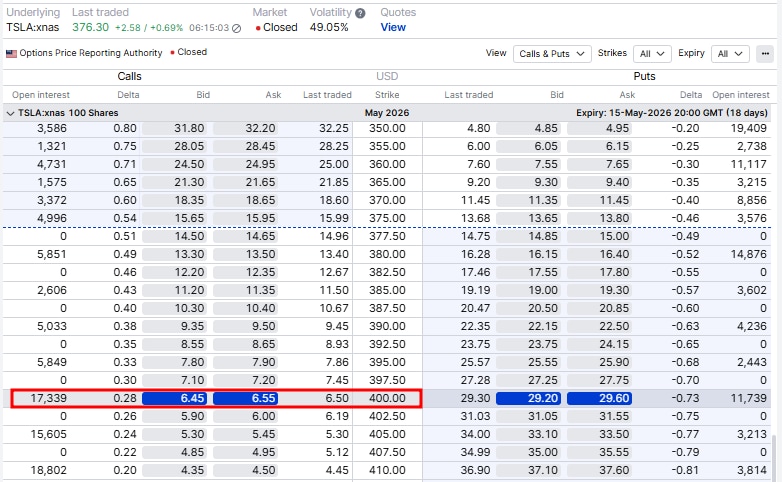
The Tesla 15 May 2026 option chain shows the 400 call with a bid of USD 6.45 and an ask of USD 6.55. For one standard option contract covering 100 shares, that equals roughly USD 645–655 in premium before fees. Source: SaxoTrader
What could happen by expiry?
The USD 400 strike is above the current Tesla share price. That means the investor is not agreeing to sell at today’s price, but at a higher price. The strike is therefore not just a number in the platform. It is the price at which the investor must be prepared to sell the shares. That does not mean assignment is unavoidable, but it should be an acceptable outcome before the trade is opened.
The option expires on 15 May 2026, giving the trade 18 days in the example shown.
- Below USD 400: The option likely expires worthless and the investor keeps the shares. The investor keeps the premium.
- Above USD 400: The shares may be sold at USD 400. The investor keeps the premium but gives up gains above USD 400.
- Sharply lower: The option likely expires worthless, but the shares lose value. The premium cushions the fall, but does not protect the position fully.
Using the USD 6.50 example premium, the investor receives about USD 650 before fees if the option is sold and filled at that price. If Tesla stays below USD 400, the investor keeps the premium and still owns the shares.
If Tesla rises above USD 400, the shares may be called away. From the current price of USD 376.30, selling at USD 400 would represent a share price gain of USD 23.70 per share. Add the USD 6.50 option premium, and the total before fees would be USD 30.20 per share, or USD 3,020 for 100 shares.
That can be a strong outcome if the investor was already willing to sell Tesla at USD 400. The drawback is that any gain above USD 400 is no longer captured. If Tesla jumped to USD 430, the covered call seller would still be selling at USD 400 if assigned.
If Tesla falls, the premium helps but does not solve the problem. For example, if Tesla falls from USD 376.30 to USD 350, the shares lose USD 26.30 per share. The USD 6.50 premium reduces the net loss to USD 19.80 per share before fees, but the investor still has a loss.
That is why a covered call should not be described as protection. It is better understood as a small cushion in exchange for capped upside.
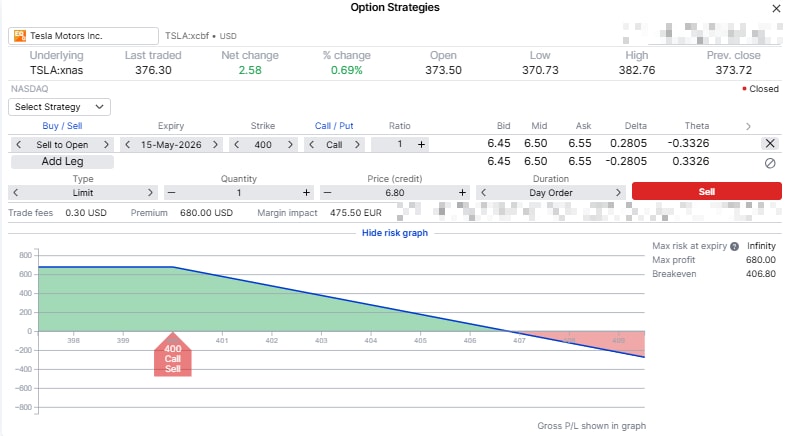
The order ticket shows a covered call example: sell 1 Tesla 400 call expiring on 15 May 2026 against 100 Tesla shares already held in the portfolio. In this example, the assumed premium received is USD 6.50, equal to USD 650 for one contract before fees. Source:SaxoTrader
When might this make sense?
A covered call may be worth considering when an investor already owns 100 shares, is comfortable holding the shares, but would also be willing to sell them at a higher price.
In this Tesla example, the key question is simple: would you be comfortable selling 100 Tesla shares at USD 400 before or at 15 May 2026? If the answer is yes, the premium may be useful. If the answer is no, selling this call may still be possible, but the investor should understand that keeping the shares could require an adjustment later.
That makes the covered call less of a prediction and more of a portfolio decision. The investor is not saying Tesla cannot go higher. They are saying that, for this part of the position, USD 400 plus the premium is an acceptable outcome.
Main risks to understand
The first risk is that Tesla falls. The premium reduces the loss, but only by the amount received. A volatile stock can move far more than the option premium.
The second risk is that Tesla rises strongly. If the shares are called away, the investor no longer participates in gains above USD 400. A good outcome can still feel disappointing if the investor did not really want to sell. Investors who want to keep the shares may be able to close the option position before expiry, potentially at a loss, or roll it to a later expiry and higher strike. These adjustments can help avoid assignment, but they also add cost, timing risk, and complexity.
The third risk is execution. Option prices move quickly, and the bid-ask spread matters. The option chain shows a market around USD 6.45–6.55, so the actual premium received may differ from the USD 6.50 assumption if market prices move before the order is filled.
There may also be tax consequences if shares are sold or option premium is received. Those depend on the investor’s location and personal situation.
Bottom line
A covered call can be a practical first options strategy for shareholders who already own 100 shares and want to generate premium from an existing position. In the Tesla example, selling the 15 May 2026 400 call could generate roughly USD 650 before fees using the option-chain midpoint shown.
The trade-off is clear. The investor keeps the premium, but must be prepared to sell Tesla at USD 400 and would not benefit from gains above that level unless the option is adjusted or closed. For buy-and-hold investors, that makes the covered call less about chasing income and more about making a conscious decision: what price would make you willing to sell, and what would you do if the stock rises faster than expected?
This content is marketing material and should not be regarded as investment advice. Trading financial instruments carries risks and historic performance is not a guarantee of future results.
The Author is permitted to wait at least 24 hours from the time of the publication before they trade the instruments themselves.
The instrument(s) referenced in this content may be issued by a partner, from whom Saxo receives promotional fees, payment or retrocessions. While Saxo may receive compensation from these partnerships, all content is created with the aim of providing clients with valuable information and options.
This content will not be changed or subject to review after publication.
| Related articles/content |
|---|
| A structured way to buy IWDA at a lower price using options | 20 Mar 2026 How to improve the yield on a long-term IWDA holdings | 12 Mar 2026 How to use a collar to protect stock gains - a Tesla case study | 20 Feb 2026 Palantir after earnings - using options to define a potential entry price | 4 Feb 2026 Golds pullback - thinking beyond buy or sell | 3 Feb 2026 Why options got so popular in recent years | 28 Jan 2026 Netflix earnings - using a cash-secured put to set a lower entry price | 16 Jan 2026 Micron covered call - harvesting extra income after a strong rally | 13 Jan 2026 The Venezuela oil shock - Trading the reconstruction without chasing the hype | 6 Jan 2026 |
| More from the author |
|---|