
Access all our platforms from a single account.

Global Market Quick Take: Asia – March 28, 2025

Key points:
- Macro: US Q4 GDP revised to 2.4%; core PCE below expectations at 2.6%
- Equities: 25% car tariff heightens trade tensions; GM down 7.3%, Ford fell 3.9%
- FX: USD weakened on auto tariffs and mixed data; USDJPY rose above 151
- Commodities: Gold surged to a record high driven by trade war worries
- Fixed income: 5y30y yield curve reached widest level since early 2022
------------------------------------------------------------------
Disclaimer: Past performance does not indicate future performance.
Macro:
- US Q4 GDP (QoQ) was revised higher to 2.4%, above the estimated 2.3% while core PCE prices came in slightly below expected at 2.6% vs 2.7% est.
- US Initial jobless claims remained stable at 224k, with the 4-week average dipping to 224k. Despite storms, claims stayed low, but Pantheon Macroeconomics predicts an increase due to hiring and firing trends. Continuing claims fell to 1.856 million, suggesting a potential unemployment rate drop to 4.0%.
- Tokyo March CPI came in higher at 2.9% yoy vs 2.7% est, while the core core figure printed 2.2% vs 1.9% est.
Equities:
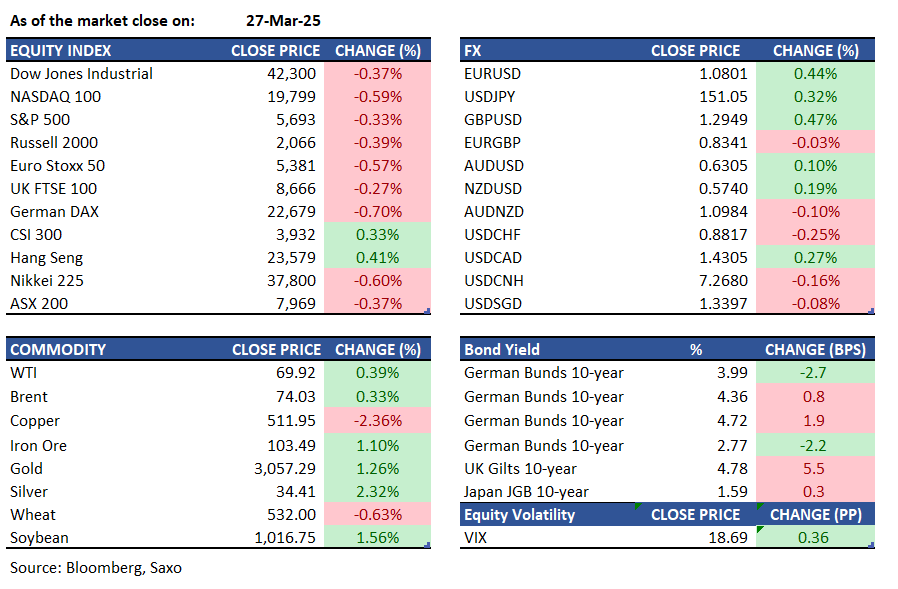
- US - US stocks fell on Thursday due to President Trump announcing new tariffs on imported autos, raising fears of a trade war. The S&P 500 dropped 0.3%, Dow Jones decreased by 155 points, and Nasdaq 100 fell over 0.5%. A 25% tariff on foreign cars starting in April intensified trade tension worries, especially with the EU and Canada. Automaker stocks declined, with General Motors down 7.3% and Ford losing 3.9%, while Tesla rose 0.4% due to its domestic production. Investors also saw Q4 GDP growth revised up to 2.4% and core PCE inflation rising less than expected. Initial jobless claims met expectations, but the goods trade deficit was higher than predicted, adding to market uncertainty.
- EU - The DAX fell 0.8% to 22,664 on Thursday, its lowest since mid-March, affected by Trump's 25% tariff on car imports. With a high concentration of automotive stocks, the DAX underperformed other indexes. Mercedes-Benz AG, Porsche AG, and BMW fell 2.6%, while Volkswagen dropped 1.5%. Concerns about possible tariffs on pharmaceuticals and tech further pressured stocks. The Stoxx 50 fell 0.8% and the Stoxx 600 dropped 0.5%, with the auto sector down 1.1% while Stellantis slid 4.6%. European Commission President Ursula von der Leyen expressed disappointment but affirmed the EU's pursuit of a diplomatic resolution to safeguard its economy.
- HK - HSI gained 0.4% to 23,579 on Thursday, continuing its upward trend. Sentiment improved after Trump hinted at reducing China tariffs to facilitate TikTok’s sale by ByteDance. Chinese industrial profits dropped 0.3% year-on-year for the first two months of 2025, better than the 3.3% decline in 2024, providing support. Most sectors rose, with JPMorgan joining Wall Street banks in a more bullish outlook on China, raising its Q4 2025 MSCI China Index target by 7% to 95. Despite trimming early gains due to caution ahead of China's March PMI, tech and auto stocks led gains, shrugging off U.S. car tariff concerns. Pharma stocks surged, with Innovent Biologics up 18.4%, and Wuxi Biologics and Hansoh Pharmaceutical rising over 6%.
- After Market - Lululemon is down 10% postmarket on weak outlook and US spending concerns. FY sales forecast at $11.15B-$11.3B, below expectations. Expanding product range to boost demand. Inventory up 9% YoY. Aims for $12.5B sales by 2026 despite competition.
Earnings this week:
Friday: LpA, Katapult, Super League, zSpace, LiqTech
FX:
- USD weakened after President Trump confirmed auto tariffs starting April 2nd. Mixed economic data showed upward revisions for Q4 GDP and sales, but downward revisions for core PCE prices, GDP deflator, and consumer spending. Initial claims were stable, while continued claims fell more than expected. Focus shifts to monthly Core PCE data. DXY fell to 104.3.
- EUR strengthened, briefly reaching the 1.08 level against the softer USD. Tariffs were the main focus, with an EU Commission spokesperson stating that the EU is preparing a timely, robust, and well-calibrated response to new import tariffs, though no timeline is provided.
- GBP gained as the UK is perceived to be less affected by tariffs, although GBPUSD faced resistance near the 1.30 level.
- JPY continued to weaken, with USDJPY rising above 151. Focus now turns to Tokyo CPI data, which serves as a leading indicator for national price trends.
- NOK traded around 10.48. Norges Bank kept its Key Policy Rate at 4.50% as expected, indicating a likely reduction in 2025, with the Q4-2025 Repo Path projected at 4.21% (previously 3.80%).
- Major economic data: UK Retail Sales, France Inflation Rate, Germany GFK Consumer Confidence, US PCE Price Index
Commodities:
- Gold hit a record high amid trade war concerns after Trump imposed tariffs on all auto imports. Bullion rose 0.2% to over $3,061 an ounce, and was poised for a fourth weekly gain due to increased haven demand.
- Oil was poised for a third weekly increase with new Trump tariffs expected next week. WTI stayed below $70, and Brent closed near $74. Tariffs on Venezuelan crude begin April 2, affecting global markets.
Fixed income:
- Treasuries ended mixed, with a notably steeper yield curve. Longer-dated yields reached their highest in a month. The 5s30s spread hit its widest since early 2022, narrowing after weak 7-year note auction demand. Block trades in futures supported the steepening. The yield curve pivoted around stable 5- to 7-year sectors, widening the 5s30s spread to 62.5bp. The 2s10s spread widened to a two-month high of 37bp.
For a global look at markets – go to Inspiration.