
Access all our platforms from a single account.

Global Market Quick Take: Asia – January 21, 2025

Key points:
- Macro: Trump avoids tariffs on day 1, focus on tax cuts, energy and deregulation
- Equities: US stock futures rose post-Trump inauguration; optimism amid uncertainty
- FX: USD weakened most against EUR, GBP, AUD, CAD and CNH
- Commodities: Oil remains under selling pressure
- Fixed income:Treasuries surge as cash trading restarts
------------------------------------------------------------------
Disclaimer: Past performance does not indicate future performance.
Macro:
- Donald Trump assumed office as the 47th US President but refrained from announcing any tariffs on his first day. This led to a broad-based risk-on sentiment in the G10 and emerging markets, temporarily pushing the DXY below 108.00.
- Instead, President Trump signed a trade action that will instruct federal agencies to review trade policy and suggest follow-up actions, emphasizing USMCA, Buy American policies, IP rules, and establishing a new External Revenue Service.
- Data for this week - BoJ, PBoC, PMI data, UK jobs, Inflation data from Canada, Japan and NZ.
Equities:
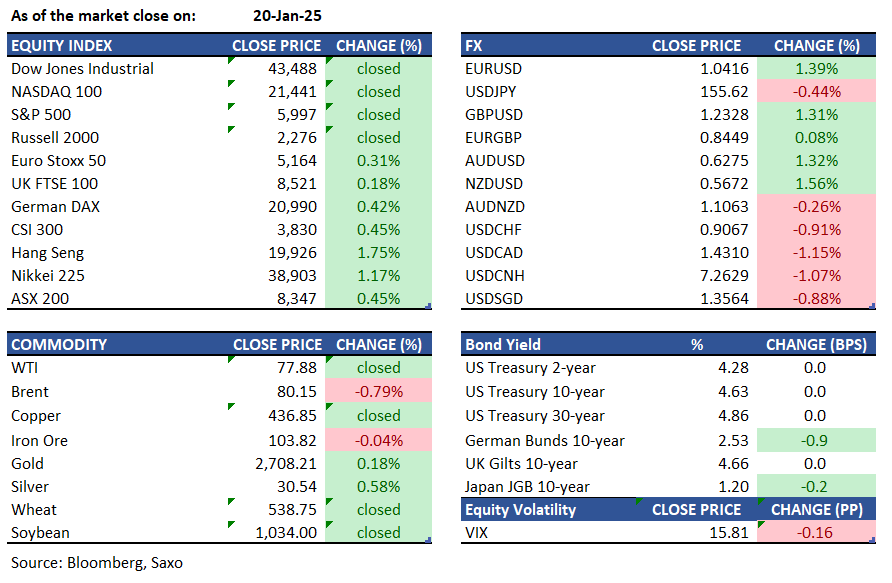
- US – US stock market closed on Monday. US stock futures rose after Trump's inauguration, driven by his pro-business agenda and energy-boosting orders, despite uncertainty from his unpredictable leadership style.
- Europe - FTSE 100 closed at a record high of 8,521, and the DAX gained ground to close at a new record high of 21,005 on Monday, buoyed by Trump's inauguration and reassurance of no immediate trade tariffs, with attention also on the World Economic Forum in Davos.
- Hong Kong – HSI rose 1.8% to 19,926, its highest since early 2025, driven by sector-wide gains after a call between Trump and Xi Jinping. Chinese VP Han Zheng's meeting with Elon Musk and TikTok's resumed operations also boosted sentiment, while PBoC maintained lending rates.
- Earning for this week – Netflix, Interactive Broker, Charles Schwab, P&G, Johnson & Johnson, Abbott, Texas Instruments, American Airlines, American Express, and Verizon.
FX:
- USD experienced a decline following a Wall Street Journal report before President Trump's inauguration, leading to a risk-on sentiment in both G10 and emerging markets. The DXY briefly dropped below 108 to a low of 107.940. The dollar weakened broadly, with notable losses against the EUR, AUD, and CAD.
- EURUSD reaching a high of 1.0430, aided by ECB's Schnabel indicating the bank's consideration of future interest rate cuts. GBPUSD strengthened by over 1% to 1.23.
- CADUSD strengthened by over 1% to 1.42, its highest in about a month, after news that US President Donald Trump plans to have federal agencies study trade relations with China and neighbouring countries without imposing new tariffs on his first day in office.
- MXN rose past 20.50 against USD, recovering from its March 2022 low, driven by a weaker USD and anticipated policy announcements post-Trump's inauguration. Meanwhile, the CNH hit its highest since December as Trump delayed China tariffs, leading USDCNH to drop 1.1% to its lowest since December 12th.
Commodities:
- Oil prices stayed low as the market awaited President Trump's executive orders. West Texas Intermediate fell to around $76 a barrel, and Brent closed near $80. Trump plans to address unfair trade practices, threatened tariffs on Canada and Mexico, and will declare a national energy emergency to boost domestic production and reverse climate policies.
- Copper rose 0.9% on Trump's inauguration day, while gold edged up 0.2% to $2,708.21 an ounce. Silver and platinum also increased, but palladium fell. Copper closed at $9,275 a metric ton on the London Metal Exchange, with other industrial metals also rising.
Fixed income:
- Treasury futures and bonds in Australia and New Zealand rose after US President Trump didn't announce China tariffs on his first day. Japan plans to auction a 40-year bond. US Treasury 10-year note futures went up, causing yields to drop by about 6 basis points. The US 10-year yield fell to 4.55% due to a holiday. There's now a 72% chance the Federal Reserve will cut rates more than once this year. Australia's 10-year yield dropped to 4.46%. New Zealand's 10-year yield decreased to 4.63%. Japan's 10-year note futures ended slightly down. The Ministry of Finance will auction ¥700 billion of a March 2064 bond, with its yield dropping to 2.71%.
For a global look at markets – go to Inspiration.