
Access all our platforms from a single account.

Global Market Quick Take: Asia – February 24, 2025

Key points:
- Macro: US long-term inflation expectations hit 30-year high
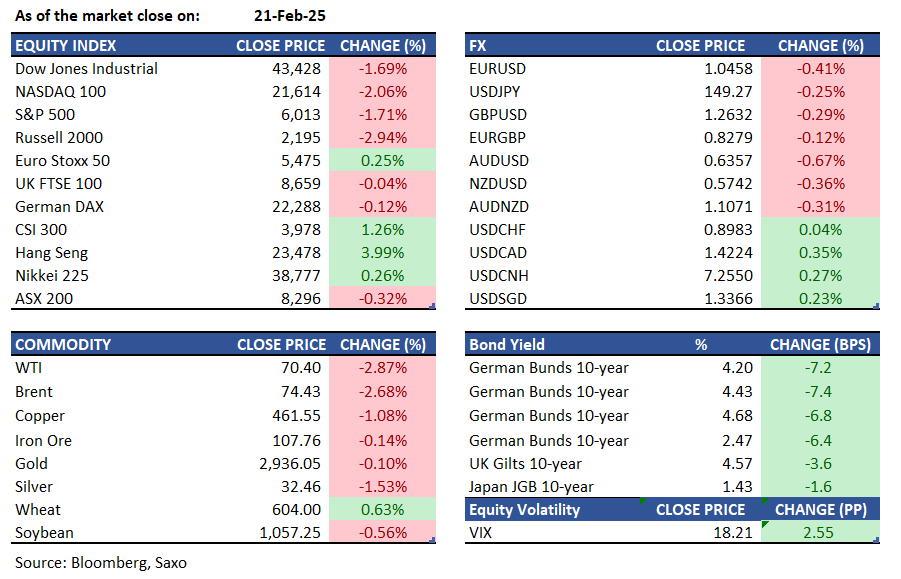
- Equities: US stocks fell sharply on economic concerns; Nasdaq 100 slipped 2.1%
- FX: EUR rose after Germany's Christian Democrats' election win
- Commodities: Gold recorded its eighth week of consecutive gains
- Fixed income: Treasuries advance amid safe-haven demand
------------------------------------------------------------------
Disclaimer: Past performance does not indicate future performance.
Macro:
- US business activity grew this month at its slowest rate since September 2023, primarily due to the service sector. The S&P Global preliminary composite index for services and manufacturers fell to 50.4, a 17-month low, amid uncertainty about the Trump administration's policies. Values above 50 indicate growth.
- US consumers' long-term inflation expectations have peaked at a nearly 30-year high, due to concerns over Trump's tariffs. The University of Michigan's February reading shows an expected annual price rise of 3.5% over the next five to ten years, the highest since 1995, mainly driven by Democratic respondents.
- The S&P Global UK Manufacturing PMI dropped to 46.4 in February 2025 from 48.3 in January, below the expected 48.4. This indicates the sector's steepest contraction since December 2023, with declining output, sales, employment, and unfinished business. Input cost inflation rose, leading to the highest factory gate price increase since April 2023.
- Germany’s conservative leader, Friedrich Merz, intends to quickly form a coalition government after winning the federal election. His CDU/CSU bloc secured 28.8% of the votes, while the far-right Alternative for Germany got 20.2%, according to ARD. Chancellor Olaf Scholz’s Social Democrats finished third with 16.2%, their worst since World War II.
Equities:
- US - US stocks fell on Friday due to concerns about a slowing economy and inflation. The S&P 500 dropped 1.7%, Nasdaq 100 fell 2.1%, and Dow Jones plunged 748 points. UnitedHealth shares fell 7.2% amid a DOJ investigation. Consumer sentiment dropped, with inflation expected to rise to 4.3% next year. The decline followed Walmart's disappointing outlook and tariff concerns.
- Berkshire Hathaway's annual operating profit rose 27% to $47.44 billion, with quarterly profit up 71%. Net income was $89 billion, aided by Apple and American Express investments. The cash stake increased due to high valuations and continued stock sales.
- China - HSI rose 4% on Friday, driven by strong earnings and a PBoC liquidity injection of CNY 84 billion. The tech index rose 6.5% amid AI sector optimism. This marks its sixth consecutive weekly rise.
Earnings this week:
- Monday: Zoom, Diamondback, Chegg, Trip.com
- Tuesday: Home Depot, Planet Fitness, Keurig Dr Pepper, DigitalOcean, Lucid
- Wednesday: Lowe's, NVIDIA, Snowflake, Salesforce, Stellantis
- Thursday: Vistra Energy, Norwegian Cruise Line, Dell, Viatris, Clover
- Friday: FuboTV, Terawulf, Chart Industries, AES, Frontline
FX:
- USD regained some strength after Thursday's decline, which was influenced by optimistic comments from President Trump regarding a trade deal with China, weaker US economic data, and lower US yields following remarks by Treasury Secretary Bessent.
- EUR rose 0.4% towards $1.05 after Germany's Christian Democrats won the election. Focus shifts to coalition formation, with leader Friedrich Merz targeting two months. Strong leadership is crucial for fiscal reforms amid economic challenges. Eurozone PMI remained steady at 50.2, slightly below expectations.
- JPY fluctuated as Japan's January CPI reached 4%. USDJPY rose to 150.73 after BoJ's Ueda pledged to counter rate spikes. Soft US data later supported the Yen, dropping USDJPY to 148.93.
- Canada's retail sales jumped 2.5% in December, boosting the CAD. However, USD strength and softer crude prices offset gains. BoC's Macklem warned US tariffs could slash Canadian exports by 8.5% and output by nearly 3%, risking 2025-2026 growth.
- Major economic data: Germany IFO business climate, Eurozone inflation rate, Canada BoC Gravelle speech, US Chicago Fed National activity
Commodities:
- Oil prices stayed low amid potential increased Iraqi supply and US efforts on the Ukraine conflict. Brent stabilised near $75, while West Texas Intermediate briefly dipped below $70. Iraq may export 185,000 barrels per day from Kurdistan if a pipeline to Turkey reopens, with no timeline set.
- Gold remained just below last week's peak, supported by weak economic data and rising inflation expectations, enhancing its safe-haven appeal. At around $2,937 an ounce, it achieved its eighth straight weekly gain, the longest since 2020, with a notable rise in bullion-backed ETF demand, marking the largest holdings increase since 2022.
Fixed income:
- Treasury futures rose further due to a flight-to-quality bid following a report on a new bat coronavirus study. Earlier, weak US data, including soft PMI services and a disappointing University of Michigan sentiment reading, had already boosted Treasuries. Yields were richer by 8 to 9.5 basis points, with the 10-year at 4.41%. Hedge funds reduced net short positions in 10-year and 5-year note futures, as per CFTC data for the week ending 18th February.
For a global look at markets – go to Inspiration.