
Access all our platforms from a single account.

Asia Market Quick Take – 20 March, 2026

Key points:
- Macro: Israel PM Netanyahu says war could end sooner than expected
- Equities: Alibaba ADRs fell 7.1% on a sales miss; quarterly earnings plunged 67%
- FX: USD down as ECB, BoE, SNB hold rates; JPY strengthened, USDJPY below 158
- Commodities: Oil pulls back; gold on track for its biggest weekly drop in six years
- Fixed income: Treasuries caught a late bid, driving a bull‑flattening move
------------------------------------------------------------------
Disclaimer: Past performance does not indicate future performance.
Macro:
- Israeli Prime Minister Netanyahu said Israel is helping the US reopen the Strait of Hormuz, easing stagflation fears as investors considered comments from President Trump and Treasury Secretary Bessent on diplomatic efforts to restore energy supply chains.
- PM Netanyahu stated Iran lacks the capacity to enrich uranium or make ballistic missiles, sparking optimism for nearing goals and suggesting the war may end soon. However, he noted the continued pursuit of IRGC leaders, indicating the campaign may take time.
- The ECB maintained rates in March 2026 to stabilise inflation at 2%. The Middle East war raises inflation risks and growth uncertainties. Inflation is forecast at 2.6% in 2026, while GDP growth is expected at 0.9% due to the war's impact.
- The Bank of England held the Bank Rate at 3.75% in March 2026 due to rising energy and commodity prices from the Middle East conflict. February's inflation was 0.1%, but CPI could reach 3%-3.5% soon. The MPC monitors potential wage and price effects, ready to adjust policy for stability and growth.
- Swiss National Bank maintained its policy rate at 0% in March 2026, with a 0.25% discount above a threshold for sight deposits. It may intervene in currency markets to prevent Swiss franc appreciation amid Middle East conflict. Inflation rose to 0.1% in February, with forecasts of 0.5% for 2026-2027 and 0.6% for 2028. Rising energy costs and geopolitical tensions increase uncertainty, though Switzerland's GDP rebounded in Q4 and is expected to grow 1% in 2026.
- US new home sales dropped 17.6% to 587,000 units in January 2026, the sharpest decline since 2013 and lowest since 2022, despite low mortgage rates. Aggressive winter storms hindered viewings, affecting sales in the Northeast (-44%), Midwest (-33.9%), West (-21.6%), and South (-8.1%).
- US initial jobless claims dropped by 8,000 to 205,000 in mid-March, against expectations of a rise. Continuing claims slightly increased to 1,857,000, continuing their decline since November. Federal employee claims rose by 26 to 643 amid government shutdown impact assessments.
- US bank regulators proposed new rules easing large bank capital requirements. The Fed's revised GSIB surcharge would lower the biggest banks' capital by 3.8%, with overall changes reducing capital by 4.8%.
Equities:
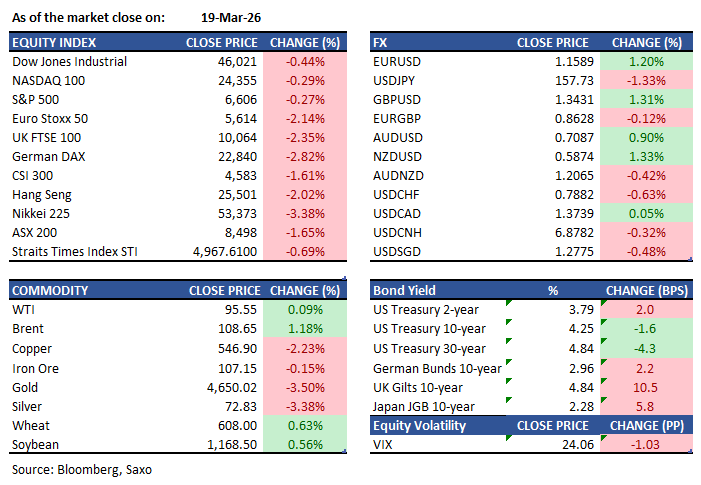
- US - US equities pared heavy early losses on Thursday, with the S&P 500 and Nasdaq closing down just 0.2% and the Dow slipping 0.3%, rebounding from four‑month lows. Volatility eased as US oil retreated toward $94 per barrel after Israeli Prime Minister Netanyahu said Israel was helping the US reopen the Strait of Hormuz, easing earlier stagflation fears. Micron fell 3.8% despite strong guidance, while Meta and Nvidia declined. Treasury yields recovered as bonds bounced off session lows. In after hours, Fedex gained 9.5% after earnings eat estimates with upward revision in guidance.
- EU - The STOXX 50 dropped 2.1% to 5,616 and the STOXX 600 slid 2.4% to 584, both hitting year‑to‑date lows. Natural gas and power prices surged after Iran struck Qatari and Saudi energy facilities, prompting US threats against Iranian gas fields. Rising energy costs pushed the ECB to hold rates but revise inflation higher, with markets now pricing two hikes this year. Banks tumbled over 4%, while industrials such as Schneider, Safran, and Airbus fell around 3.5%.
- Asia - Asian markets fell sharply due to Middle East tensions and rising oil prices, increasing inflation concerns. Key indices dropped: Nikkei 225 by 3.4%, Kospi by 2.7%, Hang Seng by 2.0%, ASX 200 by 1.6%, and Shanghai Composite by 1.4%. Tencent fell 6.8% after planning to reduce share buybacks to fund AI investments. Alibaba reported earnings before the US open that showed revenue missing estimates, with the US ADR closing 7% lower.
Earnings this week:
- Friday: Xpeng, Meituan
FX:
- USD fell as the ECB and BoE maintained rates, flagging inflation risks. The Dollar Index dropped 0.7%, its largest fall since January 27. BMO's Mark McCormick attributes this to repositioning rather than any change in economic narrative.
- In the G10 FX market, currencies strengthened, led by the JPY. BoJ maintained rates at 0.75% with an 8-1 vote, sparking movement in USDJPY during Governor Ueda's press conference discussing wage data momentum at smaller firms. USDJPY dropped to 157.51 from earlier highs of 159.87.
- The ECB kept rates unchanged, hinting at potential rate hikes by June amidst upgraded inflation forecasts, pushing EURUSD above 1.1600, approaching the 21 DMA of 1.1650.
- The BoE held rates in a hawkish 9-0 decision, removing language suggesting cuts. GBPUSD rose 1.3% to 1.3427.
- SNB also maintained its rate at 0.00%, expressing increased willingness to intervene against rapid currency appreciation. USDCHF traded around 0.7888.
Commodities:
- Oil retreated from its highest close since July 2022, with Brent near $106 a barrel and May WTI around $94, as President Donald Trump said he is “not putting troops anywhere” and Israeli Prime Minister Benjamin Netanyahu said Israel would refrain from further attacks on Iranian energy facilities.
- Gold was set for its biggest weekly loss in six years, with bullion near $4,640 an ounce on Friday and down almost 8% for the week, as the Middle East conflict boosted energy prices, stoked inflation concerns and cut the odds of central bank rate reductions, a negative for gold since it pays no interest.
Fixed income:
- Treasuries caught a late bid, fully unwinding earlier front‑end and belly losses after a report that the US had authorised delivery and sale of Russian crude pushed oil lower and lifted Treasury futures to session highs, leaving yields 1bp–5bp richer in a bull‑flattening move, following a volatile start in which stop‑outs drove a swift hawkish repricing at the US front end after a BoE‑sparked sell‑off that left UK 2‑year yields about 30bp cheaper at 4.4%.
For a global look at markets – go to Inspiration.
This content is marketing content and should not be considered investment advice. Trading financial instruments carries risks and historic performance is not a guarantee for future performance.
The instrument(s) mentioned in this content may be issued by a partner, from which Saxo receives promotion, payment or retrocessions. While Saxo receives compensation from these partnerships, all content is conducted with the intention of providing clients with valuable options and information.