
Access all our platforms from a single account.

Asia Market Quick Take – 04 November, 2026

Asia Market Quick Take – 4 November, 2026
Key points:
- Macro: RBA lifts rates. Swiss inflation rises to 1.5% vs 1.3% expected.
- Equities: AMD +5.5%; Super Micro +8% on strong guidance
- FX: Yuan snapped 13-session win streak, longest since 1996
- Commodities: Copper futures -2.1% to $14,043.50/t, 11-week low
- Fixed income: USTs bear-steepened ahead of Treasury’s quarterly refunding
------------------------------------------------------------------
Disclaimer: Past performance does not indicate future performance.
Macro:
- RBA lifted its benchmark rate to 4.85%, an 18-year high, in a split decision, while Governor Bullock’s wait-and-see stance was seen as dovish by markets.
- Switzerland's inflation rate accelerated to 1.5% vs 1.3% expected, driven by rising imported energy costs and a weaker CHF. Core inflation remains stable at 0.5%, keeping price pressures within SNB's 0% to 2% target range.
- The ISM manufacturing index climbed to 55.5 in October, its second-highest in over four years, driven by the strongest production growth since late 2021.
- Job openings unexpectedly jumped to 7.52 million in September, a four-month high, beating all estimates. Layoffs fell to the lowest level in over a year, signalling firm labour demand heading into Q4.
- US quits rose by 321,000 to 3.37 million in September, the highest since March 2025, pushing the quits rate up to 2.1%, led by accommodation and food services and broad regional increases, especially in the West.
- US September factory goods orders rose 1.8% month-on-month, beating the 1.2% estimate. Orders ex-transport rose 1.3%.
- Investors remained uncertain as US–Iran peace talks progressed, with Tehran deeming Washington’s response unsatisfactory and recent limited US strikes on Iranian missile systems suggesting no immediate escalation.
- Australia’s services PMI fell to 48.5 in October, below the 50 neutral level but above forecasts, as slower new business and operational constraints weighed on activity. Foreign demand and tourism supported orders, hiring resumed, and despite rising costs and prices, business sentiment remained positive.
- Polls closed across multiple states with early results showing Democratic momentum; Jon Ossoff is projected to win as Democrats seek the Senate and are favored to take the House. Senate control remains uncertain, and final results may take time due to vote-counting rules.
Equities:
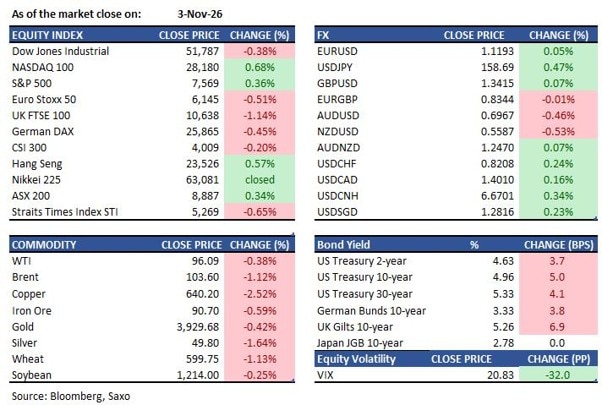
- US — S&P 500 closed up 0.4% at 7,568.92 on Tuesday, led by tech, while the Dow fell 0.4% to 51,786.72 and the Nasdaq 100 gained 0.7% to 28,184, rebounding from Monday's correction entry. Nvidia surged 2.9% and overtook Apple as the world's most valuable company. Apple fell 1.9% after a margin warning for the December quarter (45–46% vs 46.3% expected). Shopify fell 13.6% after it misses revenue expectations and GMV from merchant transactions rose 30% to $119.2b but still fell short of estimates. After hours: Arista Networks surged ~13% on a strong Q4 revenue forecast; AMD +5.5% and Super Micro +8% as both rallied on strong guidance, with Super Micro forecasting Q2 revenue of $19.5–21.5 billion. S&P 500 and Nasdaq 100 futures are up 0.1% and 0.2% respectively in early Asian trade.
- EU — European stocks fell on Tuesday, with the Stoxx 600 closing down 0.6% at 645.66 and the DAX off 0.45% at 25,864.62. The FTSE 100 dropped 1.1% to 10,638.43, its biggest single-day loss since 1 October, with HSBC the largest drag, falling 2.0%. ASML led Stoxx 600 declines, down 1.6%, as the chip selloff extended from the US. Zalando dropped 6.3% on disappointing gross margins. Bayer was a bright spot, raising its full-year EBITDA outlook after a Q3 beat. Mid-session gains on Iran deal optimism quickly faded.
- Asia — Asian markets were broadly lower on Tuesday, driven by the chip selloff. The MSCI Asia Pacific Index fell 1.1%. The Kospi slid more than 3.6%, with Samsung down as much as 5.2% and SK Hynix off 5.8% as Korea's semiconductor-heavy market bore the brunt of AI trade repricing. Taiwan's Taiex entered correction territory. The Hang Seng Tech Index bucked the trend, gaining for a third session as funds rotated into non-AI consumer names — JD.com +4.5%, Xiaomi +2.9%, Alibaba +2.2%. China's Star 50 Index tumbled more than 4% as state support tools were met with skepticism. The ASX 200 closed up 0.3% after the RBA hike, though it is down 0.4% in early Wednesday trade. This morning, the Kospi is up 2.9% on AMD's strong results, and the MSCI Asia Pacific Index is up 0.3%. Japanese markets were closed Tuesday for a holiday.
Earnings this week:
- Wednesday – UOB, Qualcomm, Novo, Uber, Macdonalds, Coherent, Cava, ARM
- Thursday – DBS, Lumentum, Toyota, Sony, Airbnb, Marriott International, Booking, Expedia
- Friday – OCBC, Macquarie, HKEX
FX:
- The yuan snapped a 13-session winning streak — its longest since 1996 — after the PBOC raised the foreign-currency reserve requirement ratio by 2 percentage points effective 15 November. USDCNY rose as much as 0.4% to 6.6760. Goldman Sachs said the PBOC is "increasingly uncomfortable" with rapid yuan appreciation.
- The Australian dollar came under pressure despite the RBA's fifth rate hike of the year, as Bullock's dovish tone signalled the hiking cycle may be nearing its end. AUD/USD clung to the 0.70 handle.
- NZDUSD dropped approximately 0.5% after a sharply weaker-than-expected New Zealand jobs report, with the unemployment rate surprising to the upside and markets paring December hike bets.
- The Korean won, Philippine peso and Thai baht outperformed Asian peers on Monday following the sharp drop in oil prices. The won received additional support from firm October inflation data, bolstering the case for further Bank of Korea hikes. Taiwan's central bank reportedly eased restrictions on exporters selling US dollars to support the TWD after record foreign stock outflows in October.
Commodities:
- Brent crude settled near $103 a barrel on Tuesday, off the day's lows, after swinging in a more than $6 range. Oil fell sharply on Monday — over 7% — on US-Iran peace talk hopes, but has partially rebounded as significant obstacles to a deal reportedly remain. WTI settled near $96.09.
- Gold futures were down 0.7% to around $3,940 per ounce on Tuesday, consolidating after a 1.9% jump on Monday driven by Iran peace optimism and lower oil. Gold has fallen from a record above $5,500 earlier this year and is now trading below its fair value for the first time since 2023, according to Bloomberg analysis. Central banks accelerated gold buying in Q3 to the fastest pace since late 2024.
- Copper futures fell 2.1% to $14,043.50 per metric ton on Tuesday, hitting an 11-week low, as the AI tech selloff clouded the demand outlook for the industrial metal.
Fixed income:
- Treasuries bear steepened. The 10-year yield rose ~3.2 basis points to close around 4.95%, and the 30-year rose ~3.1 basis points to 5.32%. An early bid driven by lower oil prices unwound through the afternoon session. The 2s10s spread steepened by approximately 2 basis points on the day.
- The Treasury's quarterly refunding announcement is due today. Wall Street expects the biggest overhaul in issuance guidance since early 2024, with many dealers anticipating a shift away from the "steady sizes for at least the next several quarters" language in place since May 2024. Questions are also emerging over T-bill demand absorption capacity. JPMorgan's Bob Michele publicly called for the Treasury to eliminate the 20-year bond.
- Traders have been adding to long Treasury positions and paring bearish wagers ahead of this week's trifecta of midterms, refunding and Friday's payrolls report. Open interest in 10-year futures saw the first meaningful liquidation since 23 October on Monday, while new longs were added in the long-bond and ultra-long bond futures. Barclays, JPMorgan and UBS all favour curve-steepening plays in the 10s30s sector.
For a global look at markets – go to Inspiration.
This content is marketing content and should not be considered investment advice. Trading financial instruments carries risks and historic performance is not a guarantee for future performance. The instrument(s) mentioned in this content may be issued by a partner, from which Saxo receives promotion, payment or retrocessions. While Saxo receives compensation from these partnerships, all content is conducted with the intention of providing clients with valuable options and information.