
Access all our platforms from a single account.

Asia Market Quick Take – 17 November, 2026

Key points:
- Macro: U.S. restricts remote access to advanced AI chips, closing China cloud loophole
- Equities: Nvidia slides 4.1%, dragging tech lower. Nasdaq 100 –2.7%
- FX: USD stays firm near highs; EUR, GBP, AUD, CAD broadly weaken
- Commodities: Copper hits lowest in over four months
- Fixed income: Tech selloff spurred modest safe-haven gains in Treasuries
------------------------------------------------------------------
Disclaimer: Past performance does not indicate future performance.
Macro:
- US AI chip export curbs: The Commerce Department issued a sweeping new rule restricting remote access to advanced AI semiconductors, closing loopholes that allowed entities in China and other countries to access restricted chips via cloud services. Data center operators in Singapore, Malaysia, Thailand, Indonesia, and Brazil will now require US government licences to purchase Nvidia and other American AI chips. The rule rattled markets and drove a broad tech selloff.
- Fed speak — rate hike bias: Cleveland Fed President Beth Hammack said she favours small and steady interest rate increases but warned the central bank may need to consider larger moves if inflation pressures worsen. Markets are pricing in approximately 88bp of additional Fed tightening by mid-2027.
- Nvidia CEO departure fallout: Sentiment around the AI trade remains fragile following last week's resignation of Nvidia's CEO. Nvidia reports Q3 FY2027 earnings after the US close today, a key event for the AI sector.
- Anthropic IPO: Anthropic's record-breaking IPO is expected to price on 18 November at a valuation of up to ~$1.3 trillion. The deal is reportedly approximately six times oversubscribed. The listing is set to be the largest IPO in history, raising up to $90.4 billion including a $26 billion concurrent private placement.
- China macro disappointment: China's October economic data came in below expectations, with activity losing momentum across the board. Chinese A-shares fell to a 16-month low on Monday. The PBOC drained medium-term funds from the financial system for the first time in five months, signalling a tighter policy stance.
Equities:
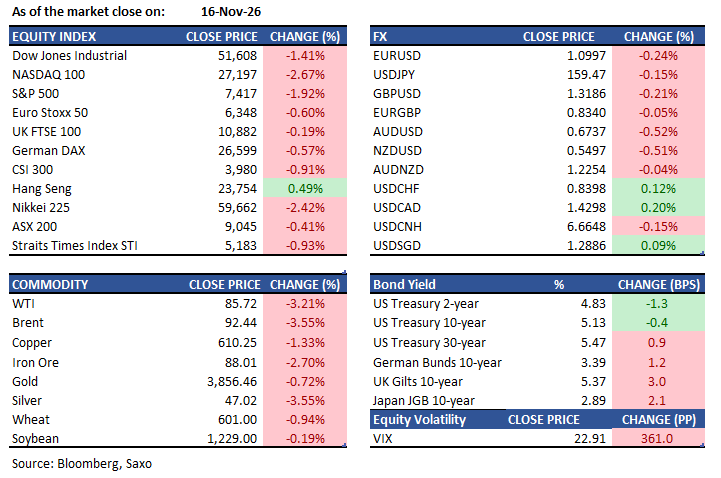
- US — US equities fell sharply on Monday for a third consecutive session, led by technology. The S&P 500 dropped 1.9% to 7,416.59, the Nasdaq 100 fell 2.7%, the Nasdaq Composite shed 2.5% to 24,509.76, and the Dow lost 1.4% to 51,608.17. Nvidia slid 4.1%, slipping behind Microsoft in market cap for the first time since May 2025. A chipmaker sector gauge sank 5.3%. Tyson Foods outperformed after strong results, posting its best one-day gain since 2022. In after-hours trading, Aecom rose 6.1% after issuing a better-than-expected fiscal 2027 outlook.
- EU — European markets entered the week in relatively calm fashion, though tech nerves and Nvidia's fallout continued to weigh on sentiment. The week ahead is busy with ECB speakers, UK inflation and labour data, and FOMC minutes. UniCredit was in focus after receiving Fed approval to complete its Commerzbank acquisition. Stoxx 600 healthcare sector earnings continued to beat, with revenue beats exceeding misses 13 to 2 in the most recent quarter.
- Asia — Asian equities are set to decline on Tuesday, tracking Wall Street's losses. Kospi futures and Nikkei contracts are both in the red in early trade, with the Kospi falling approximately 2.1% to 4,994 at the open, at risk of fully unwinding its 2026 rally. The Taiwan Stock Exchange pledged market stabilisation measures amid irrational volatility; the iShares MSCI Taiwan ETF fell 6.8% in New York on Monday. The iShares MSCI Japan ETF dropped 2.1%. The Nasdaq Golden Dragon China Index fell 1% to 5,467.31 on Monday, with Alibaba down 4%, Baidu down 5.4%, and JD.com down 1.3%. The ASX 200 fell 1.3%, dragged by BHP and Rio Tinto on copper weakness. Foreign funds sold a net $1.14 billion of South Korean equities on Monday. The new US chip licensing rules for Southeast Asian data centres added further pressure on the region's tech-linked stocks.
Earnings this week:
- Tuesday – Home Depot, Walt Disney, JD.com, Nvidia
- Wednesday – Target, Lowe’s, Tencent ADR, Palo Alto
- Thursday – PDD ADR, Walmart, Alibaba ADR, Futu, Intuit
- Friday – No key earnings
FX:
- USD strengthened, supported by hawkish Fed expectations after strong CPI/PPI. CFTC data show net long dollar positioning cut for a fifth week to the lowest since September, indicating some positioning fatigue.
- EURUSD fell 0.24% to 1.1000, breaking below the key 1.10 level on US–EU rate differentials and France fiscal worries.
- USDJPY dipped 0.15% to 159.47, with the yen steady in the mid‑159s amid ongoing intervention warnings.
- AUDUSD was the weakest G10 pair, down 0.52% to 0.6740, though RBA’s hawkish tone may temper further downside; speculative shorts increased.
- USDCAD rose 0.2% to 1.4302 as CAD hit its lowest since 2025 after sticky 3.1% CPI complicated BoC easing.
- USDCHF gained 0.3% to 0.8403 despite a supportive upside surprise in Swiss Q3 GDP.
Commodities:
- Brent crude fell 3.5% to $92.44 a barrel and WTI dropped 3.2% to $85.72, as expectations of a global supply surplus in 2027 weighed on prices. Goldman Sachs forecasts a surplus of 2 million barrels per day next year, with Brent expected to average $88 in 2027 and ease to $78 thereafter.
- Gold steadied near $3,860 an ounce after touching its lowest close since September 2025, down 0.7% on Monday, pressured by rising Fed rate hike bets and a stronger dollar. Silver fell more than 4% to its lowest level since October 2025, tracking gold's weakness.
- Copper fell to its lowest in more than four months, dragged by the tech selloff and weaker Chinese economic data darkening the demand outlook. Asian copper-linked equities slumped in early Tuesday trade, with Australian miners BHP and Rio Tinto among the biggest decliners.
Fixed income:
- US Treasuries posted modest gains on Monday, with the 10-year yield falling approximately 2bps to 5.12% and the 30-year yield little changed at 5.47%, as the tech-led equity selloff drove some safe-haven demand. The 5s30s curve steepened by 3bps on the day.
- Last week's Treasury rout was severe — five- and ten-year yields surged 32 and 28 basis points respectively, their biggest weekly increases since April 2025, following hotter-than-expected CPI and hawkish Fed commentary. US Treasuries and MBS posted their worst weekly performance since April 2025's tariff-driven selloff.
- Deutsche Bank forecasts the US 10-year yield will remain above 5% through much of 2027 and 2028, projecting 5.00% by June 2027 and 5.05% by December 2027. JPMorgan recommends positioning for two-year yields to rise relative to five-year yields, reflecting the broadly held view that the front end remains most vulnerable to further Fed hikes.
For a global look at markets – go to Inspiration.
This content is marketing content and should not be considered investment advice. Trading financial instruments carries risks and historic performance is not a guarantee for future performance.
The instrument(s) mentioned in this content may be issued by a partner, from which Saxo receives promotion, payment or retrocessions. While Saxo receives compensation from these partnerships, all content is conducted with the intention of providing clients with valuable options and information.