
Access all our platforms from a single account.

Market uncertainty: Crisis or opportunity?

Key points:
- Market uncertainty brings both risks and opportunities: Investors are facing a perfect storm of uncertainty, with slowing growth, policy risks, and geopolitical tensions fueling market volatility. Despite these headwinds, history shows that great companies tend to recover, making this an opportunity for long-term investors to buy quality stocks at a discount.
- Selectivity and diversification are critical amid uncertainty: The bull case rests on hopes of tax cuts, deregulation, and potential Fed rate cuts, which could support earnings growth. However, policy risks, elevated valuations, and global economic uncertainty make it essential to stay selective and diversified.
- Time in the market beats timing the market: Markets rarely bottom in a straight line, and trying to time the exact turning point often leads to missed opportunities. A disciplined approach – investing in fundamentally strong businesses with solid financials and institutional backing – has historically been the best way to navigate volatile markets.
The market is navigating a perfect storm of uncertainty. Investors are wrestling with concerns over slowing economic growth, rising tariffs, and geopolitical tensions. Central banks are juggling inflation risks and growth concerns, while companies face margin pressures from supply chain disruptions and wage inflation.
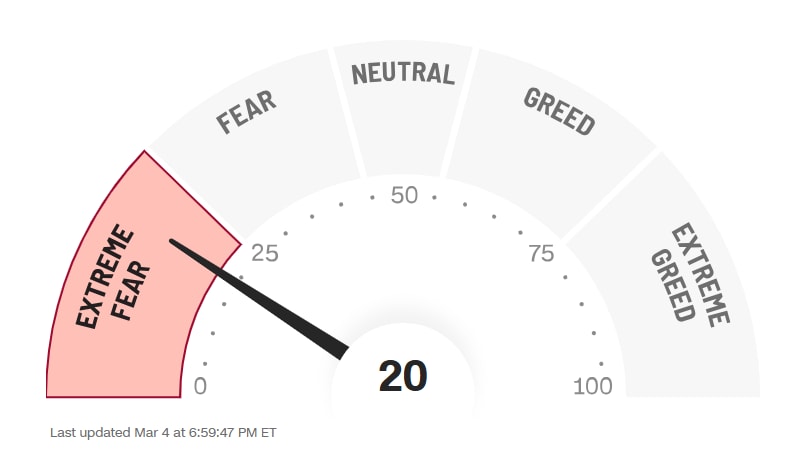
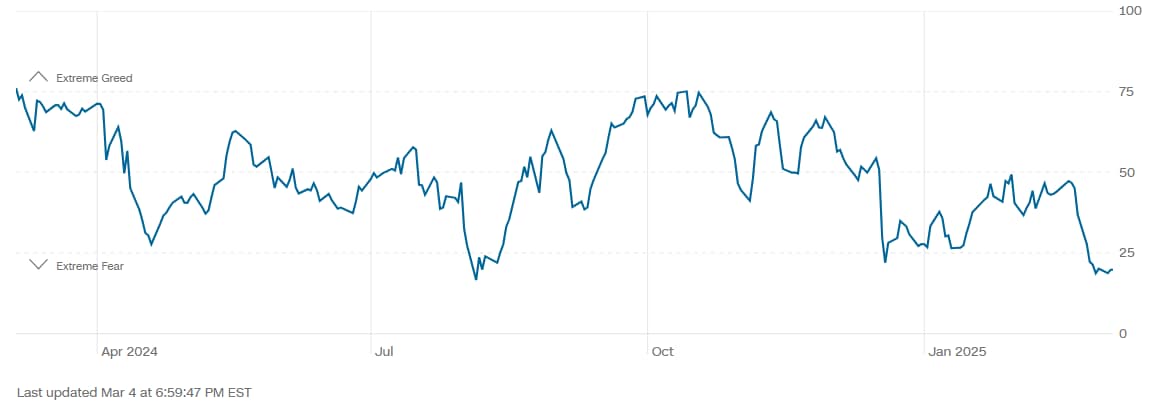
These factors have fueled volatility, leading to a sell-off in stocks. Fear is gripping financial markets, as can be seen from CNN’s Fear and Greed Index below. After dipping to 22 at the end of February, the index had fallen to 20 as of March 4, reflecting deep unease among traders and institutional investors alike.
Source: CNN
While market sentiment indicators don’t dictate future price movements, they provide insight into the emotional state of the market – often a contrarian signal for savvy investors. When fear reaches extreme levels, it has historically marked moments of potential opportunity or further market turbulence.
And history has shown that great companies tend to recover, and often come out stronger. For long-term investors, times like these present opportunities to buy quality stocks at a discount.
Bull case: Why the tide may turn for the better
Despite short-term concerns, several tailwinds could support a market recovery.
- The “Trump Put”: Markets are starting to price in the possibility of business-friendly policies, such as tax cuts and deregulation, which could boost corporate earnings.
- Federal Reserve flexibility: Inflation has moderated while rates are still restrictive, giving the Fed room to adjust monetary policy. If economic conditions weaken, rate cuts may come into play sooner rather than later, supporting equity valuations.
- Broad-based earnings strength: Q4 earnings were not just strong at the top end of the market but also showed broader improvement across multiple sectors, signaling resilience in corporate profitability.
Bear case: Lingering uncertainty and the need for selectivity
While the bull case has its merits, risks remain.
- Policy risks are not fully known: Even if tax cuts or deregulation are introduced, their scope and timing are uncertain. Meanwhile, fiscal concerns, particularly around government spending and debt, could impact long-term growth prospects.
- Valuations remain a concern: Despite the market correction, some growth stocks still trade at elevated multiples. A further earnings slowdown or delay in rate cuts could lead to another leg down in valuations.
- Geopolitical and macro risks: Rising global trade tensions, persistent inflation risks, and uneven economic growth could weigh on investor sentiment, limiting near-term upside.
In this environment, a diversified approach is critical. Instead of making aggressive bets on a market bottom, investors should focus on high-quality companies with solid financials and reasonable valuations.
Investing principles: Why timing the market is a losing game
Markets rarely bottom in a straight line, and trying to time the exact turning point is difficult. Instead of waiting for perfect conditions, focusing on time in the market – investing steadily in fundamentally strong companies – has historically been a more effective strategy.
Trying to predict the exact market bottom is nearly impossible. Many investors wait on the sidelines, hoping for more clarity, only to see stocks rebound before they get in. That’s why long-term investors focus on time in the market, not timing the market. Investors who wait for the “perfect” entry point often miss out on some of the best buying opportunities.
Consider this:
- Missing just the 10 best trading days over a 20-year period can drastically reduce long-term returns.
- Bear markets are often followed by strong recoveries, and the biggest gains tend to happen early in a rebound.
With that approach in mind, we used a structured screening process to identify growth stocks that balance strong fundamentals, reasonable valuations, and institutional support.
Screener criteria: Identifying resilient growth stocks
Given current market conditions, we focused on the following:
- Revenue & Earnings Growth
- Revenue Growth (5-Year CAGR > 10%) to ensure companies have demonstrated consistent expansion.
- EPS Growth (5-Year CAGR > 15%) to focus on companies growing profits, not just top-line revenue.
- Financial Stability & Cash Flow
- Free Cash Flow Yield > 2% to identify companies generating real cash profits. Businesses that generate cash can reinvest in future growth and weather downturns.
- Net Debt/EBITDA < 3 to filter out over-leveraged firms, as this is key to weather downturns.
- Valuation and Institutional Confidence
- PEG Ratio < 2.5 to ensure growth is reasonably priced.
- Institutional Ownership > 50% to favor stocks with strong backing from institutional investors. When big money backs a stock, it’s often a sign of confidence.
- Potential Rebound Candidates
- 52-Week High Change < -15% to capture stocks that have corrected but still have strong fundamentals.
Using these filters, we identified the below stocks:
Key takeaways
- Big Tech Resilience – Microsoft, Nvidia, Alphabet, Broadcom, Adobe and Qualcomm remain innovation leaders with strong cash flows.
- AI Beyond Big Tech: Arista Networks (ANET), Lam Research (LRCX), and Applied Materials (AMAT) provide AI exposure through cloud networking and semiconductor manufacturing, diversifying beyond Nvidia and Microsoft.
- Consumer Resilience: Crocs (CROX) and Chipotle Mexican Grill (CMG) stand out with strong growth, large institutional backing, and solid cash flow despite being in the discretionary sector.
- Ambitious Fintech Expectations: Block (XYZ) and PayPal (PYPL) have strong cash generation and compelling valuations.
- Resilient Growth – Companies like Zoom and Etsy have faced short-term challenges but continue to expand at impressive rates.
- Undervalued Quality – Newmont, Deckers, and Builders FirstSource combine strong fundamentals with attractive valuations.
- Energy and Industrials Gaining Momentum: Permian Resources (PR) boasts 38% revenue growth and 16% free cash flow yield, while Owens Corning (OC) is benefiting from pricing power in building materials.
Final thoughts: Stay invested, stay patient
Uncertainty may persist, but long-term investors know that market cycles come and go. Instead of trying to predict the bottom, focus on buying great businesses at reasonable prices and holding them through market fluctuations.
The best opportunities often appear when fear is highest. If you believe in the power of compounding and the resilience of strong businesses, now might be a great time to start building or repositioning your long-term portfolio.