
Access both platforms from your single Saxo account.

Premium leaves a Fed week - Options Brief - 27 October 2026

Summary: One quiet session took almost a fifth out of the range the option market had priced for this week. The Federal Reserve, the European Central Bank and three of the index’s largest results are all still inside it.
Monday’s rally did not only lift the index, it took premium out of the four sessions that follow it, and those sessions still hold a Federal Reserve decision.
MARKET REGIME: NEUTRAL / CHOP | VIX 18.39 | TERM STRUCTURE: CONTANGO | SKEW: ELEVATED (150.97) | FRONT-MONTH VIX FUTURES: 19.120
Today in brief
The short version. Friday’s expiry is priced at 104.90 S&P 500 points this morning, 1.37%, against 135.65 read from the same chain by the same method twenty-four hours earlier. Four sessions remain where five did, and the clock alone would have left roughly 121. About 16 points came out on top of that. The contract still contains Wednesday’s Federal Reserve decision, the European Central Bank, the Bank of Japan and the results of three of the index’s largest companies.
Markets. The S&P 500 closed at 7,676.77, up 0.70%, and the Nasdaq 100 at 29,273.40, up 1.09%, after Anthropic filed to list and revived appetite for artificial intelligence names. The equal-weighted index rose 0.35%, half the cap-weighted move, because the largest names split: Tesla gained 5.21%, Nvidia 2.39% and Microsoft 1.54%, while Meta fell 1.88%, Apple 1.10% and Alphabet 1.06%. Europe closed broadly higher and Asia followed on Tuesday, the Kospi up 3.75%.
Volatility curve. The one-day gauge dropped to 10.49, into the bottom fifth of its own range, while the three-month gauge barely moved at 19.94. The ratio between them fell to 0.57 from 0.86, so a single session is now priced at little more than half a month.
Single names. On an identical 524 underlyings the median implied-volatility rank eased to 45.9 from 47.7. The fall sat in index products rather than in operating companies, and the names that gained rank have reports attached.
Flow. Monday’s positioning leans against the calm. Index puts and index volatility calls were bought outright while the cash market rallied, and downside was bought in Meta and across semiconductors. The sector, rates and commodity tapes carried no readable direction.
This week’s range. The option market priced 137.05 points around Friday’s close for the week. One session of five is complete and 39% of that band has been used, to the upside.
Earnings and catalysts. The spread between what is priced and each name’s own eight-report history runs from 1.4x at Novo Nordisk to 0.7x at Microsoft, which reports on Wednesday. Today brings US durable goods orders and consumer confidence, and the Federal Reserve’s two-day meeting begins.
What it adds up to. Today’s expiry prices 0.49% and Friday’s 1.37%. In our view the more interesting number may be the one that moved: implied correlation fell 7.00% to 13.95, off the highest reading in our store, while dispersion rose 2.95% to 38.02. The week may therefore be priced as a set of separate company events rather than as one index event, even though the macro calendar inside it has not changed. Monday’s flow, which bought index protection into the rally, argues the other way.
That is the whole brief in one read. The sections below hold the detail behind each paragraph, with the charts, the full set of readings and the sources, for when you want to go deeper on one part.
Headline driver
Anthropic filed its listing paperwork and the artificial intelligence trade reopened. Semiconductors led, the Philadelphia index up 2.8%, and the move carried into Asia on Tuesday, where SoftBank rose around 5% and the Kospi gained more than 3% on memory demand.
Underneath the index, Monday was not one trade. Tesla rose 5.21% on a broker upgrade that pointed to a possible combination with SpaceX. Meta fell 1.88% after setting out plans to raise up to 95 billion dollars to fund its own artificial intelligence build. One name was repriced on what it might receive, the other on what it has to spend.
Away from equities, renewed Middle East diplomacy eased the crude premium and Brent traded below 115 dollars. In Brazil a surprise election result took the real down close to 9%, pulling sugar 5.6% and coffee 3.7% lower.
Market snapshot
- US (Monday 26 October close): S&P 500 7,676.77, up 0.70%. Nasdaq 100 29,273.40, up 1.09%. Dow Jones Industrial Average 52,361.58, up 0.28%. The equal-weighted S&P 500 rose 0.35%, half the cap-weighted move, because the largest names split: Tesla gained 5.21%, Nvidia 2.39% and Microsoft 1.54%, while Meta fell 1.88%, Apple 1.10% and Alphabet 1.06%. Technology gained 1.69%, while communication services fell 1.57%.
- Europe: the Stoxx 600 rose 0.77% to 640.67, the DAX 0.91% to 25,410.84, the CAC 40 0.83% and euro-zone banks 1.27%.
- Asia (Tuesday morning): the Nikkei 225 rose 1.7% and the Kospi 3.75% to 5,674.71, the Hang Seng eased 0.14% and the CSI 300 0.13%.
- Commodities and rates: Brent traded below 115 and WTI near 101 on diplomacy. Gold held just above 4,030 while silver fell to an eleven-month low at 53.75, lifting the gold to silver ratio to 75.0. The two-year Treasury yield closed near 4.72% and the ten-year near 4.99%, both easing on Tuesday. Bitcoin traded near 79,638, the largest bitcoin fund at 45.22.
- Market regime: neutral and choppy, the VIX at 18.39, the cash curve in contango and SKEW elevated at 150.97.
Index levels and volatility readings from the watchlist export taken at 05:00 CET on 27 October 2026, which carries Monday’s US closes; rates, oil and single-stock detail from the same-morning Saxo Market Quick Take. Past performance is not indicative of future results. Source: Saxo, Bloomberg, CBOE.
Volatility surface
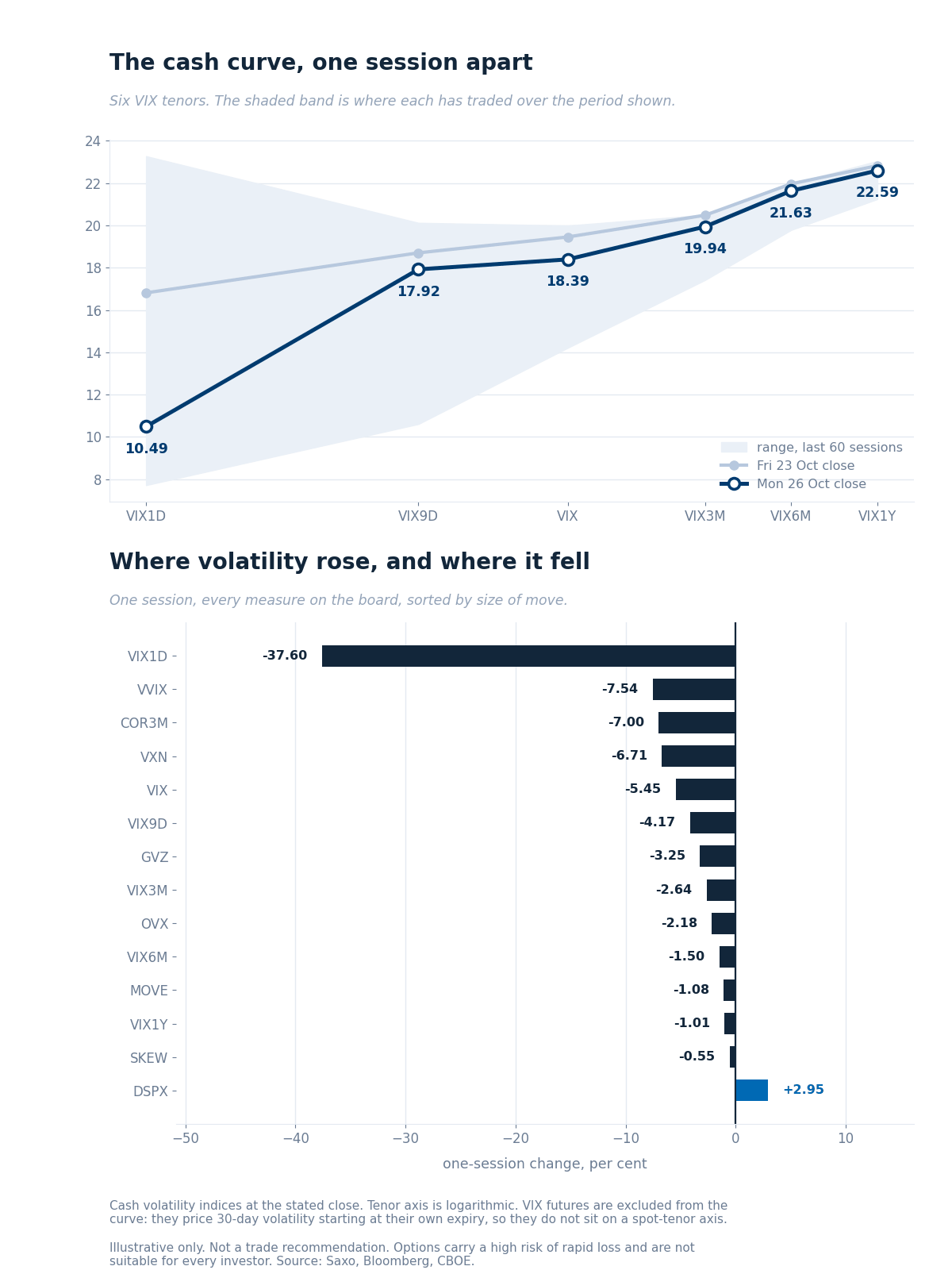
The cash curve against the previous session over each tenor’s 60-session range, with the one-session change across every measure. Source: Saxo, Bloomberg, CBOE.
The curve did not come down, the front of it did. Against the 105 sessions we hold back to 15 June, the nine-day gauge at 17.92 sits high in its range and the three-month at 19.94 above its 18.96 median, while the one-day gauge at 10.49 has dropped into the bottom fifth of its. One session has been taken out; the shape beyond it is intact.
Ratios. VIX1D/VIX reads 0.57 from 0.86, so a single session is priced at little more than half a month. VIX3M/VIX rose to 1.08 from 1.05, steepening again after last week’s flattening. VXN/VIX eased to 1.43.
VIX futures. November leads at 19.120, a premium of 0.73 to spot against a flat Friday, with December just above at 19.170. Put-call parity on the 18 November options returned 19.17 and on the 16 December options 19.20, consistent across the nearest five strikes, so contract identity holds and the November hump has flattened into shallow contango.
Correlation and tails. Implied correlation fell 7.00% to 13.95, a session after printing 15.00, the highest in our store, and dispersion rose 2.95% to 38.02. SKEW eased to 150.97, above its 145.66 median, the bond gauge held at 102.20 near the top of its range and gold volatility at 23.55 near the bottom of its own.
Single-name volatility
The index measures above did the moving again, and this time the names followed a little. On an identical universe of 524 underlyings, so none of this is a composition effect, the median implied-volatility rank eased to 45.9 from 47.7. The mean was unchanged at 48.8, and the median percentile held at 64.7, so the distribution shifted rather than the whole population.
Where rank fell, it fell in index products rather than in operating companies. The Nasdaq 100 fund lost 15.1 points of rank and the communication services fund 18.4, both of which price baskets. Where rank rose, a report explains it: T-Mobile US gained 10.7 points into Wednesday’s release, Siemens Energy 20.8 and Corbion 21.8.
That split is the correlation reading in a second dataset. Premium is leaving the instruments that price the index as one object and staying in the ones that price a single company’s afternoon.
A note on what rank measures. The typical name carries a rank of 45.9 and a percentile of 64.7 at the same time. Rank says how far implied volatility sits from the extremes of its own year; percentile says how many days in that year were lower. A name whose volatility spent most of the year in a narrow band and spiked once will read low on the first and high on the second.
Source: Saxo.
Options flow sentiment
Based on end-of-day 26 October, yesterday’s positioning, not today’s price action.
- Single-name flow leaned defensive against a rising tape. Downside was bought on the ask in Meta and across semiconductors on the session the semiconductor complex rallied, while November upside was sold on the bid in Meta and Broadcom. Most of the remaining premium was paired structure and mid-market prints with no aggressor side.
- Sector and ETF flow gave one clean reading and little else: index puts and index volatility calls were bought outright in the large index funds, which both the market and semiconductor reports label as hedging into an event week. Rates, risk-off, financials, metals and crypto tapes carried no readable direction.
Where the week's range sits
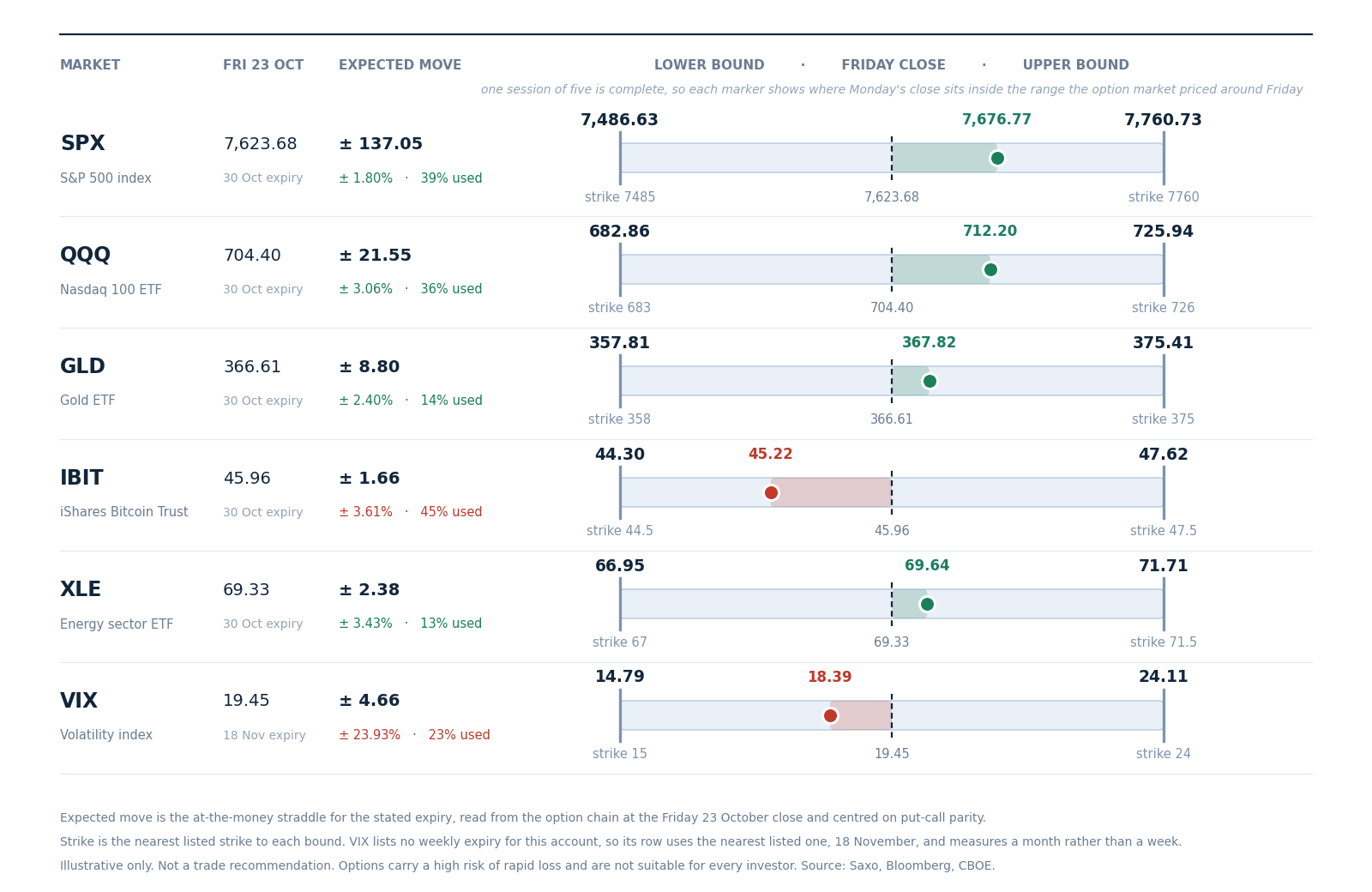
The range the option market priced for this week around Friday 23 October’s close, with Monday’s close marked inside it. Straddles are at-the-money, from the Saxo chain, centred on put-call parity. Illustrative only, not a trade recommendation. Past performance is not indicative of future results. Source: Saxo, Bloomberg, CBOE.
The S&P 500 opened the week with 137.05 points priced around Friday’s close, 1.80%, from 7,486.63 to 7,760.73. Monday’s close at 7,676.77 used 39% of that band upward, leaving 84 points to the top and 190 to the bottom.
The Nasdaq 100 fund has used 36% of its 3.06% band, also upward, while the bitcoin fund has used 44% of its 3.61% band downward, the only row leaning that way. Gold has used 14% of 2.40%, energy 13% of 3.43%. The volatility row uses the 18 November expiry, so it measures a month, and sits 23% below its anchor.
What matters now is that the band itself has since been marked down, as the pricing section sets out.
Options carry a high risk of rapid loss and are not suitable for every investor. Costs and charges apply and vary by account and venue; check the rates applicable to you.
Today's catalysts
- 13:30 CET preliminary September durable goods orders, forecast 1.5% after a flat month.
- 14:00 CET the August house price index, then at 15:00 CET the Richmond Fed manufacturing index, October consumer confidence, forecast 81.0 after 81.9, and new home sales.
- 18:00 CET the US Treasury auctions five-year notes after soft demand at the two-year sale.
- Earnings today: Visa, Coca-Cola, HSBC, Novartis, Boeing and S&P Global.
- Overnight: Australian inflation, then the Reserve Bank of New Zealand decision.
The Federal Reserve’s two-day meeting begins today. Europe left summer time on Sunday and the US has not, so the cash session runs 14:30 to 21:00 CET until 1 November: Wednesday’s decision at 19:00 CET sits two hours before the close, inside the session, with the press conference at 19:30.
Earnings scorecard
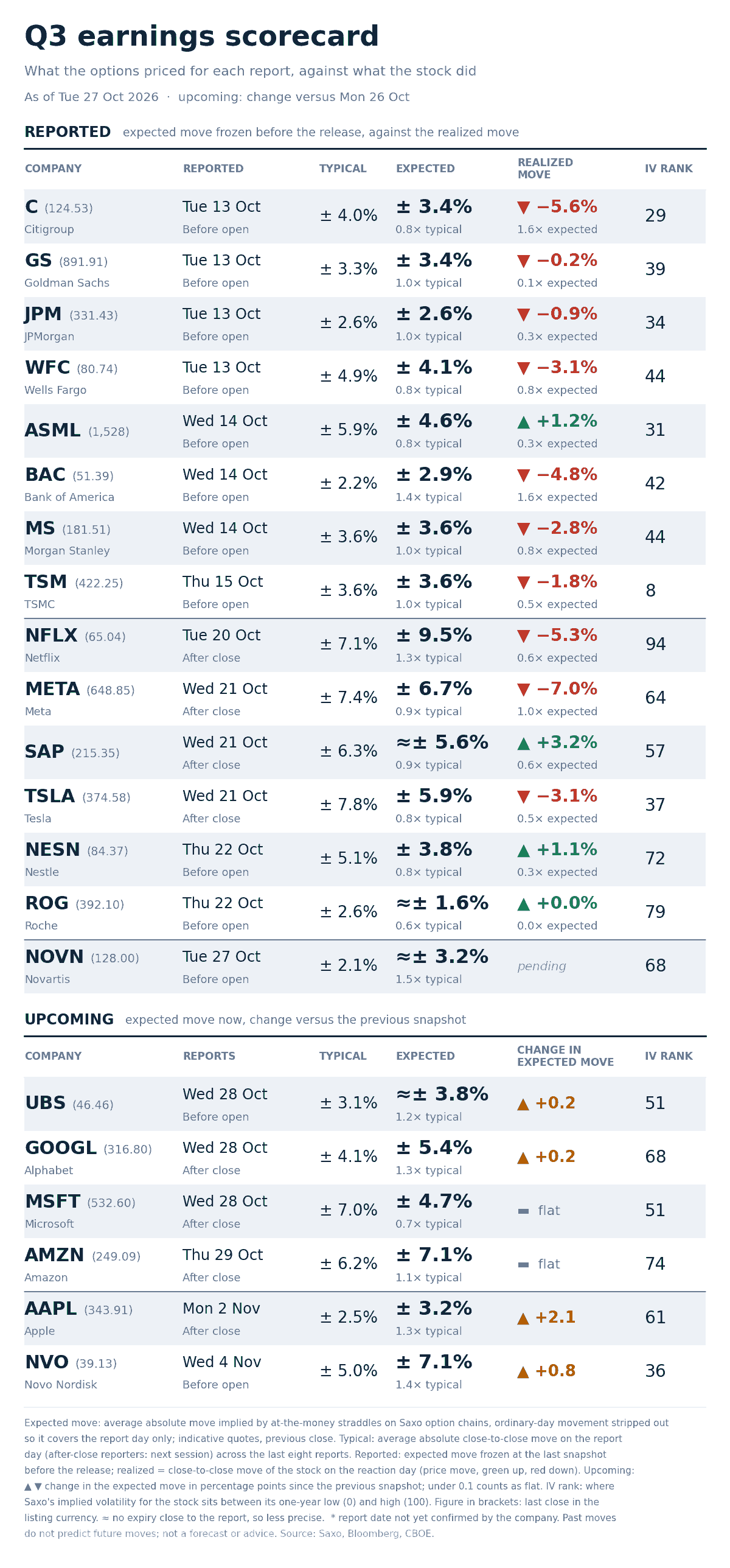
Option-implied expected move for each report day against the stock’s average move after its last eight reports, across the twenty-one names tracked this season. Past performance is not indicative of future results. Source: Saxo, Bloomberg, CBOE.
The spread between what is priced and what each name has done has narrowed to 1.4x at one end and 0.7x at the other. Novo Nordisk is richest, 7.1% priced into 4 November against an eight-report average of 5.0%. Microsoft is cheapest, 4.7% into Wednesday against a 7.0% history, which is the one name of the five reporting this week priced below what it has typically delivered. Alphabet sits at 5.4% against 4.1% and Amazon at 7.1% against 6.2%.
Rank and the event premium answer different questions. Amazon carries the highest rank of the group at 74 and prices 7.1%; Novo Nordisk has the lowest at 36 and the richest event premium, 1.4x its own history. Rank describes where a name’s volatility sits in its year. The event premium describes one afternoon.
Next are UBS, Alphabet and Microsoft on Wednesday, Amazon on Thursday and Apple on Monday 2 November.
Options carry a high risk of rapid loss and are not suitable for every investor. Costs and charges apply and vary by account and venue; check the rates applicable to you.
What the market is pricing
- Session implied range: S&P 500 options price 37.80 points, 0.49%, for today’s expiry, from the at-the-money straddle on the Saxo chain centred on put-call parity. Yesterday’s edition quoted a different contract, so no like-for-like comparison applies.
- Event implied range: the 30 October expiry prices 104.90 points, 1.37%. Read the same way yesterday morning it was 135.65 with five sessions left; four remain, so the clock alone would have left about 121. Roughly 16 points have come out beyond decay, and the contract still holds the Federal Reserve, the European Central Bank, the Bank of Japan and three large results.
- Correlation read: implied correlation fell 7.00% to 13.95, one session after printing the highest reading in our store at 15.00, while dispersion rose 2.95% to 38.02. In our view the market may have stopped paying for the index to move as one block and started paying for the names to separate.
- Tail risk signal: SKEW at 150.97 held above its 145.66 median even as the one-day gauge collapsed. The cost of the far wing may be behaving independently of the cost of the next session.
In our view the question this morning may be whether a week can get cheaper while its calendar stays the same. The premium left the whole contract rather than one day of it, and the correlation and dispersion readings suggest the market may expect Wednesday and Thursday to be paid for name by name. Flow, which bought index protection into the rally, argues the other way. Options carry a high risk of rapid loss and are not suitable for every investor. Costs and charges apply and vary by account and venue; check the rates applicable to you. Past performance is not indicative of future results.
| More from the author |
|---|