
Access both platforms from your single Saxo account.

The defence sell-off: Opportunity or warning sign?

Note: This is marketing material. This article is not investment advice, capital is at risk.
Key takeaways
- The SPADE Defence Index has fallen nearly 13% over the past two months, despite positive industry catalysts, including heightened geopolitical tensions.
- Defence stocks had priced in substantial future spending, but uncertainty around budget increases, higher inflation and yields, and the possibility of the Iran war ending have weighed on valuations.
- Order books are at or near record levels, with backlog and book-to-bill ratios among the key indicators of future revenue across the sector.
- With three of the four defence primes reporting today, all three have beaten earnings expectations and raised their full-year guidance.
Why do these earnings matter?
Defence demand remains strong, but valuations appear to reflect uncertainty over when record backlogs will translate into higher profits. Trump’s proposed annual defence spending of $1.5 trillion, up from $1 trillion, could be weighed down by growing expectations of a Democratic sweep in the upcoming midterm elections. The Financial Times reports that investors are betting that the Trump administration’s proposed $500 billion increase in military spending could be scrapped. Defence indices have also been negatively correlated with prediction-market expectations that Democrats will retake both chambers of Congress.
Trump’s 7 January 2026 Executive Order, “Prioritizing the Warfighter in Defense Contracting”, has added another layer of uncertainty for US defence stocks. The order allows dividends and share buybacks to be restricted where contractors are deemed to be underperforming, which can include insufficient production speed, investment or prioritisation of US government contracts.
With these measures determined at the Secretary’s discretion, higher orders may not necessarily translate directly into shareholder returns if companies are required to reinvest more heavily in production capacity. Aerospace and defence companies with a high proportion of revenue derived from defence and government contracts face greater exposure to political risk. Lockheed Martin, RTX and Northrop Grumman all identify changes in US government defence spending as a major risk in their financial statements.
Despite this, higher defence budgets provide further long-term support, while munitions replenishment remains a key global demand driver.
The question is whether results can show that record order books are turning into profit and cash while Washington’s budget remains unresolved.
Where the sector goes from here
- Higher US defence budgets: The House has backed the proposed 2027 defence spending budget, but final funding still depends on congressional approval. Democratic opposition is focused on the broader scale and funding of the Iran war, the size of the defence increase, and how defence spending is balanced against domestic priorities. Some Republicans have also raised concerns over the deficit.
- Munitions and air defence: Rebuilding depleted munitions stockpiles remains an immediate demand driver across the US, UK and Europe, while governments are also investing to expand production capacity and address manufacturing bottlenecks. Most recently, the EU allocated €168.2 million to projects expected to reduce production lead times by up to 90% from 2027.
- Golden Dome: The layered US missile shield ordered by Trump presents a multi-year opportunity, but the timing of funding remains uncertain.
- Modernisation: Ageing fleets, evolving threats and ongoing nuclear modernisation are driving long-term defence investment, while aircraft backlogs are forcing operators to keep legacy fleets in service for longer. All nine nuclear-armed states continue to modernise their arsenals.
- Drones and autonomy: Drone and counter-drone spending is accelerating, with the Pentagon planning major drone procurement and the US Army recently awarding $4.15 billion in counter-drone contract ceilings. NATO has also identified counter-drone capabilities as a pressing priority.
One theme, three trades
Today’s earnings help answer two key questions: are defence backlogs converting into cash, and is demand continuing to grow?
The results could have implications for individual defence stocks and bonds, as well as ETFs with exposure to the industry.
Individual stocks
| Company | Reporting date | Earnings call | Expected EPS | Reported EPS |
|---|---|---|---|---|
| GE Aerospace | 20 October 2026 | 12:30pm BST | $2.00 | $2.25 |
GE Aerospace raised its 2026 guidance across the board, supported by continued strength in orders, revenue and engine deliveries. Defence & Propulsion Technologies, which accounts for around 25% of total revenue, saw its operating margin decline by around 1% from Q2. Book-to-bill remained around 1.0x in Q3, while the year-to-date ratio moderated from 1.7x to 1.5x. The company also has more than $170 billion in commercial services backlog. | ||||
| RTX | 20 October 2026 | 1:30pm BST | $1.78 | $2.26 |
RTX generates around 52% of its total sales from defence, with Raytheon focused on defence, while Pratt & Whitney and Collins Aerospace serve both commercial and military markets. RTX raised its 2026 outlook for adjusted sales, adjusted EPS and free cash flow, while backlog reached a record $340 billion, an 18% increase from Q2. Operating margin percentages improved from Q2 across Collins Aerospace, Pratt & Whitney and Raytheon, increasing by around 36%, 15% and 16%, respectively, based on the quarterly comparison. Raytheon’s book-to-bill rose to 6.54x from 2.4x in Q2, while its rolling 12-month ratio increased to 2.0x from 1.77x, indicating that new orders continue to outpace sales. | ||||
| Northrop Grumman | 20 October 2026 | 2:30pm BST | $7.18 | $7.89 |
Northrop Grumman raised its 2026 financial guidance for segment operating income and MTM-adjusted EPS. The company is primarily exposed to defence, with the US government accounting for 84% of sales in 2025. The operating margin rate increased 14% from Q2 to Q3. Northrop Grumman’s backlog reached around $110 billion, approximately 5% higher than in the previous quarter. Its book-to-bill ratio was 1.5x, compared with 1.84x in Q2, meaning new orders continued to exceed revenue recognised during the quarter but at a lower rate. | ||||
| Lockheed Martin | 22 October 2026 | 1:30pm BST | $7.49 | – |
| For Lockheed Martin, the focus will be on whether strong demand continues to translate into improved margins. In Q2, the company reported a 3.2x book-to-bill ratio, a $230 billion backlog and an operating margin of 10.8%. | ||||
Individual bonds
If you like these companies but don’t necessarily want to take on equity valuation and share-price risk, Saxo provides access to their corporate bonds. Time horizon and duration are important considerations, as longer-dated bonds are more sensitive to changes in interest rates and therefore tend to experience greater price volatility when yields move.
If you remain positive on the companies’ ability to convert their strong backlogs into cash flow, their bonds offer another way to gain exposure. Buying a bond at the yields shown below can lock in its current yield to maturity if held to maturity, assuming the issuer does not default. These corporate bonds also offer a yield premium over comparable US Treasuries to compensate investors for additional credit and liquidity risk.
| Company | Maturity date | Mid-yield to maturity | Coupon | Credit rating | US Treasury yield |
|---|---|---|---|---|---|
| RTX | 27 February 2053 | 6.25% | 5.375% | BBB | 30-year: 5.428% |
| Northrop Grumman | 15 January 2028 | 4.87% | 3.25% | BBB | 2-year: 4.765% |
| Northrop Grumman | 1 May 2040 | 6.03% | 5.15% | BBB | 20-year: 5.483% |
| Northrop Grumman | 1 May 2050 | 6.26% | 5.25% | BBB | 30-year: 5.428% |
| Lockheed Martin | 15 June 2030 | 5.31% | 1.85% | A | 5-year: 4.92% |
| Lockheed Martin | 15 November 2063 | 6.23% | 5.90% | A | – |
ETFs
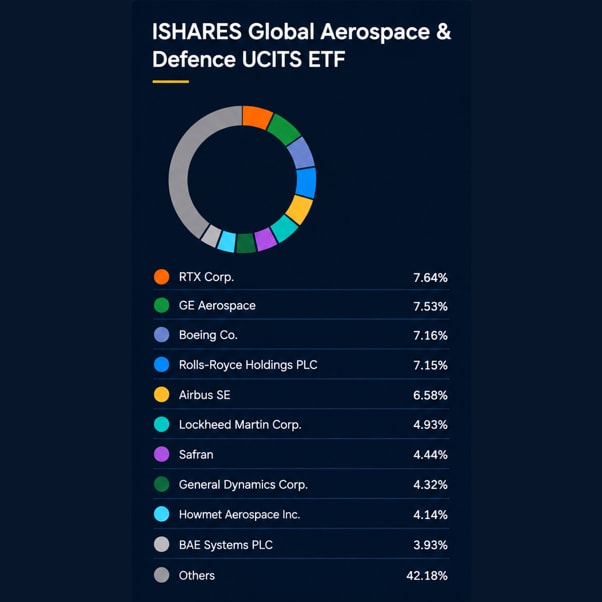
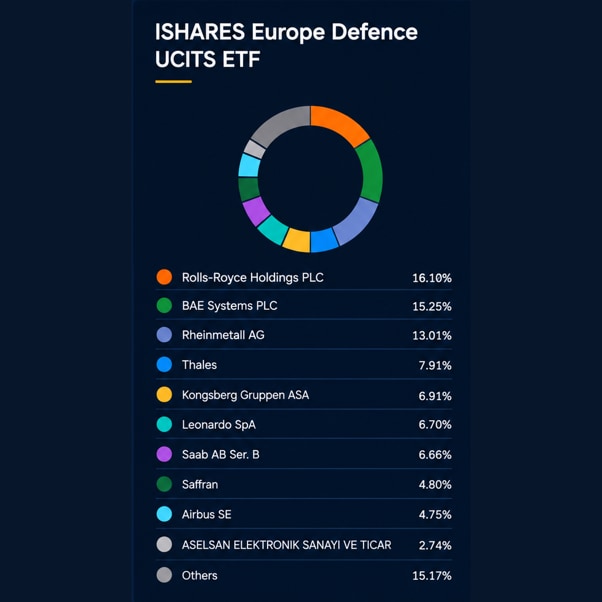
Investors looking for broader defence exposure can consider the ETFs below. One provides global diversification with a large weighting towards US defence companies, while the other provides concentrated exposure to the European defence industry.
| ETF |
|---|
 |
 |
How does the defence business work?
Defence primes sell to governments under multi-year contracts, so revenue can be more predictable than in many other industrial sectors. Four mechanics help drive revenue and profitability:
- Backlog and book-to-bill: Backlog is work the company has already won but has not yet completed. Book-to-bill shows whether new orders are coming in faster than sales are being delivered. A ratio above 1.0x means new orders exceed current sales.
- Contract type: With cost-plus contracts, the customer generally covers additional eligible costs. With fixed-price contracts, the company bears more of the risk if costs are higher than expected, which is where significant programme losses can arise.
- Competitive edge: Once equipment is integrated into a defence platform, replacing the supplier can require costly redesign, integration, testing and certification.
- Service: After equipment is delivered, companies can continue generating revenue from maintenance and upgrades for many years, often at higher margins than those earned from building the original equipment.