
You can access both of our platforms from a single Saxo account.

Protective puts, step by step: insurance for your shares

Summary: A protective put works like insurance for shares an investor owns: a known cost up front, and a loss capped at a chosen level. This step-by-step guide follows one example and shows how it differs from a stop-loss order.
What if you could decide in advance how much a fall in your shares can cost you?
Most people insure their house, and they do it before the fire, not after. A protective put applies the same idea to shares. The investor pays a small, known amount now. In return, the investor gets the right to sell the shares at a fixed price, whatever the market does.
This page follows one example from start to finish. The company is fictitious, and all numbers are made up to show the mechanism.
Important note: The strategies and examples provided in this article are purely for educational purposes. They are intended to assist in shaping your thought process and should not be replicated or implemented without careful consideration. Every investor or trader must conduct their own due diligence and take into account their unique financial situation, risk tolerance, and investment objectives before making any decisions. Remember, investing in the stock market carries risk, and it’s crucial to make informed decisions.
Step 1: The idea
Suppose an investor owns 100 shares of Fictitious Inc., bought at USD 100. The investor wants to keep them, but the next two months look uncertain.
A put option is a contract. The buyer pays a fee, called the premium, and gets the right to sell 100 shares at a set price, the strike, until a set date, the expiry. The buyer can use that right, but does not have to. If the shares do well, the put simply expires and the premium is gone. That is the cost of the insurance.
Step 2: How this differs from a stop-loss order
Many investors already use a stop-loss order. It is a standing instruction to sell if the price falls to a chosen level. The catch is that once the level is hit, the order turns into a market order. It sells at the next available price. If the shares close one evening and open far lower the next morning, the sale can happen well below the level the investor had in mind.
A put works differently. The strike price is a right, not an instruction to sell at whatever price is available. If the strike is USD 90, the investor can sell at USD 90 even if the shares open at USD 70. This guaranteed price is the main thing a put offers that a stop-loss does not.
Step 3: What the investor does
In the example, the investor buys one put contract:
Example structure (illustrative only, not a trade recommendation):
- Own 100 Fictitious Inc. shares at USD 100
- Buy 1 put, strike USD 90, expiry in 60 days, at USD 2.00 per share
- Premium paid: USD 200 (USD 2.00 × 100 shares)
- Maximum risk: USD 1,200, which is the USD 1,000 fall from USD 100 to the USD 90 strike plus the USD 200 premium
- Maximum profit: not capped. The shares can keep rising, but the USD 200 premium is deducted from any gain.
This is a hypothetical example for education only. The cost of the put is always lost if the shares stay above the strike. Protection ends at expiry, and the investor must decide whether to buy it again.
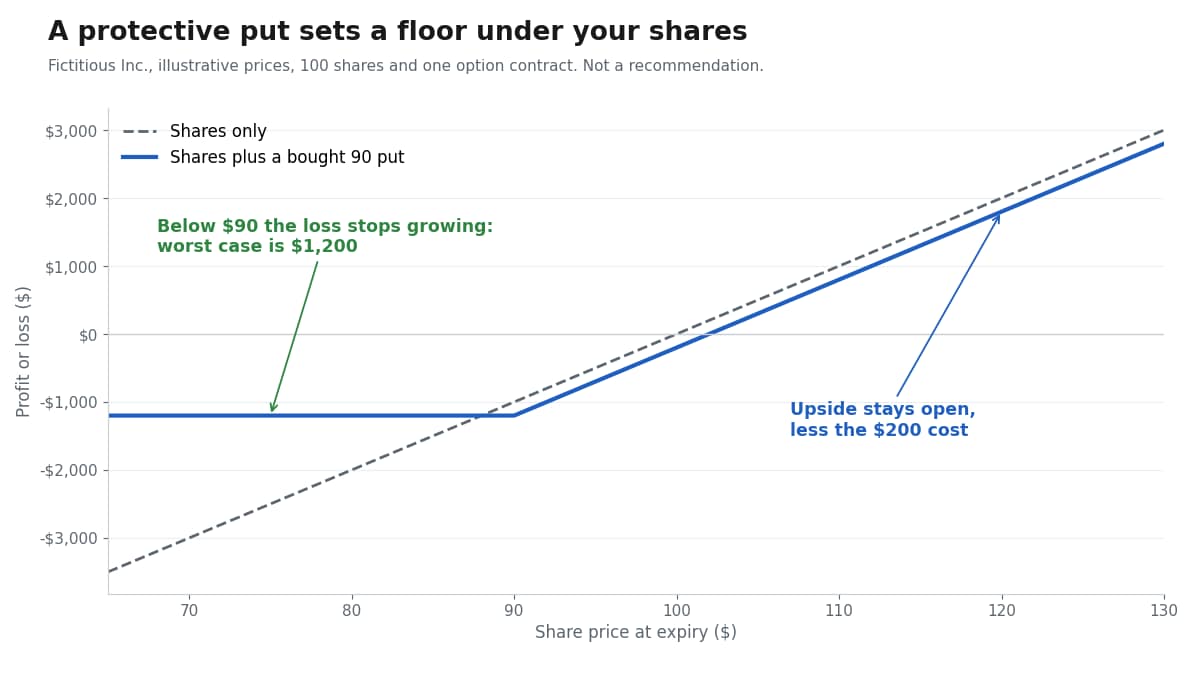 Illustrative example with a fictitious company and made-up prices. Not a recommendation. Past performance is not indicative of future results. The chart is illustrative and not predictive.
Step 4: Three possible outcomes
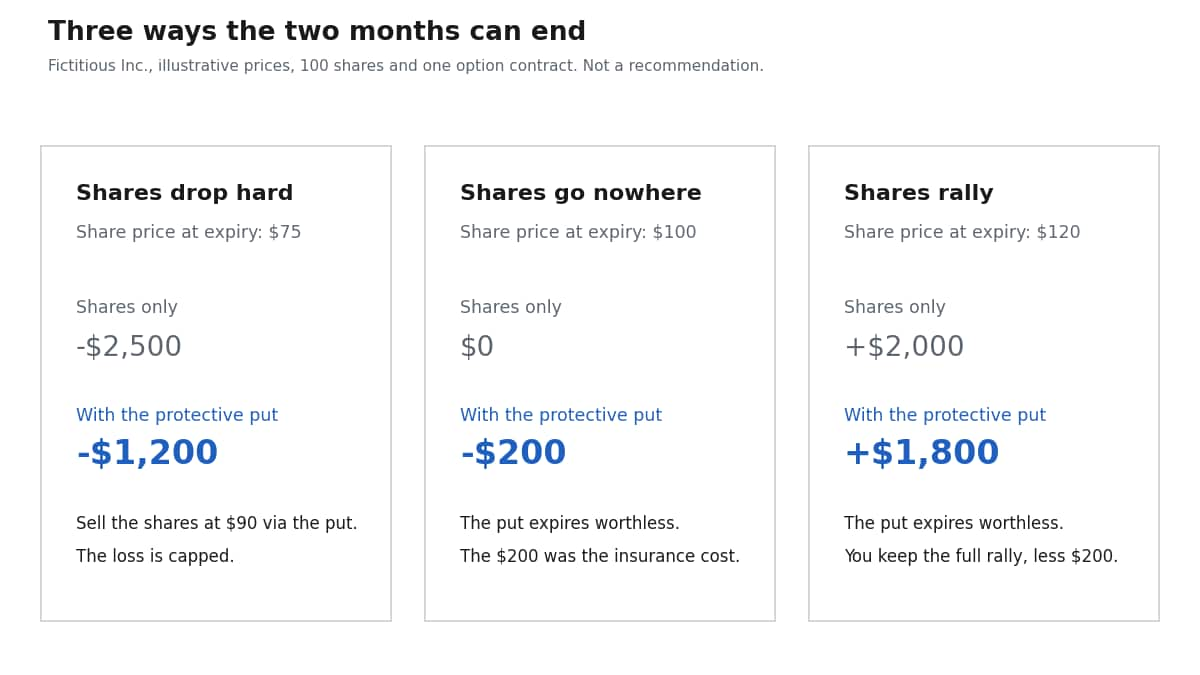
Here is what the position would look like at expiry in three cases, compared with owning the shares alone.
 Illustrative example with a fictitious company and made-up prices. Not a recommendation.
The shares drop to USD 75. Shares alone would lose USD 2,500. With the put, the investor can sell at USD 90 instead. The loss is USD 1,200: USD 1,000 from the fall to the strike, plus the USD 200 premium. The loss is capped.
The shares stay at USD 100. The put expires worthless. The investor has lost the USD 200 premium. This is the cost of the insurance, as with a home policy in a year without a fire.
The shares rise to USD 120. The investor gains USD 1,800. Shares alone would have gained USD 2,000. The USD 200 difference is the premium. The full upside is kept, less the cost of the protection.
These outcomes are hypothetical and for education only. In the second and third cases the premium reduces the result, and in the first the investor still loses money.
Step 5: The prices that matter
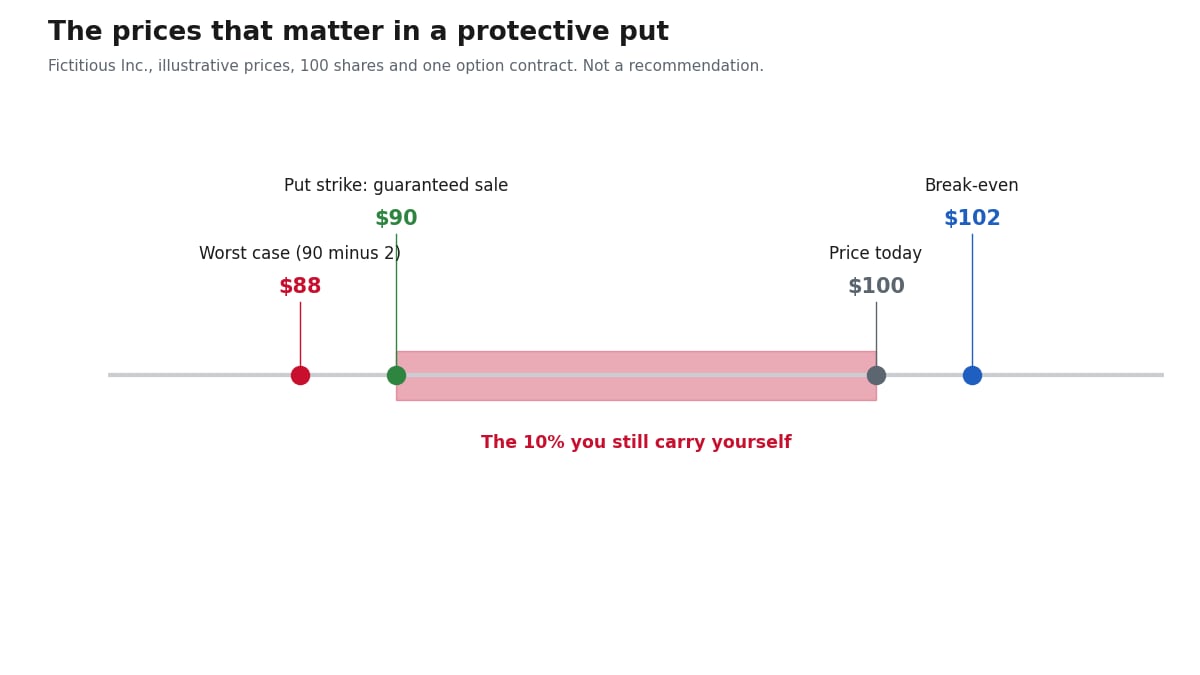
Four prices describe the position.
 Illustrative example with a fictitious company and made-up prices. Not a recommendation.
The worst case is USD 88. This is the strike of USD 90 minus the premium of USD 2. It is the lowest net sale price the investor can get, whatever happens to the shares. The strike is USD 90. Today’s price is USD 100. The break-even is USD 102, which is today’s price plus the premium. Above that level, the position is in profit at expiry.
Note the gap between USD 100 and USD 90. The first 10% of a fall is still carried by the investor. The put only starts to pay off below the strike.
Step 6: Choosing the strike and the expiry
Two choices decide what the insurance costs and what it covers.
A strike closer to today’s price gives more protection, because less of a fall is left to carry. It also costs more. A strike further away is cheaper, but leaves a bigger fall uncovered.
A longer expiry costs more in total, but often less per month of cover. A put also does not have to be held to expiry: if the shares fall or markets get nervous, it may be worth more, and it can be sold to recover part of its cost.
Step 7: When it fits
A protective put may suit an investor who wants to keep a position through an uncertain stretch, such as a company event, or who has a large gain to protect and does not want to sell. It tends to fit less well as a permanent habit, because the premium is paid again each time the cover runs out.
Fees and commissions are charged per contract and weigh more on a small premium, so check the costs in the trading platform first.
Options carry a high risk of rapid loss and are not suitable for every investor.
What to take away
A protective put sets a floor under the shares for a known price. The cost is paid up front and is lost if the shares do not fall. The guaranteed strike is what sets it apart from a stop-loss order.
| Related articles/content |
|---|
| Covered calls step by step getting paid to wait | 26 Nov 2026 What investors misunderstand about covered calls | 10 Jun 2026 Covered call or cash-secured put | 2 Jun 2026 From shareholder to options user | 26 May 2026 |
| More from the author |
|---|