
You can access both of our platforms from a single Saxo account.

Asia Market Quick Take – 30 April, 2026
Asia Market Quick Take – 30 April, 2026
Key points:
- Macro: Fed holds rates; Trump not lifting blockade till nuclear deal secured
- Equities: AMZN, GOOG, MSFT rises after earnings; META sinks on higher capex
- FX: Dollar hits mid‑April high as Fed splits; JPY weakens past 160
- Commodities: Brent +7% to >$119.50, highest since June 2022
- Fixed income: US 10-year Treasury yield rose to 4.43%, highest in over nine months
------------------------------------------------------------------
Disclaimer: Past performance does not indicate future performance.
Macro:
- The Fed left rates unchanged amid growing internal dissent, with four officials opposing the decision. Two-year Treasury yields jumped 11 basis points, the biggest Fed-day move since 2022. Jerome Powell said he will stay on the Board after his chair term ends and remain through the ongoing criminal investigation.
- Trump told Axios he won’t lift the naval blockade of Iranian ports until he secures a nuclear deal with Tehran, extending the standoff disrupting energy flows through the Strait of Hormuz.
- Japan’s retail sales rose 1.7% YoY in March 2026, beating the 0.8% forecast and rebounding from a 0.1% drop, with autos and other goods leading gains. Month-on-month, sales grew 1.3% after falling 2.0% in February.
- The BoC held its policy rate at 2.25% in April 2026, offering no clear guidance amid geopolitical uncertainty. Inflation rose on higher energy prices from Middle East tensions, but broader effects remain limited and expectations anchored. The BoC projects GDP growth of 1.2% in 2026 and 1.7% in 2027.
- US durable goods orders rose 0.8% in March 2026 to $318.9 billion, beating the 0.5% forecast and rebounding from a 1.2% drop. Despite war-related energy and shipping disruptions, orders gained across computers and electronics (3.7%), machinery, primary metals, electrical equipment, and transportation.
- Germany’s CPI rose to 2.9% YoY in April 2026, up from 2.7% and just below the 3% forecast, driven by a 10.1% jump in energy. Core inflation fell to 2.3%, the lowest since June 2021, and the EU-harmonized rate also hit 2.9%, above the ECB’s 2% target.
Equities:
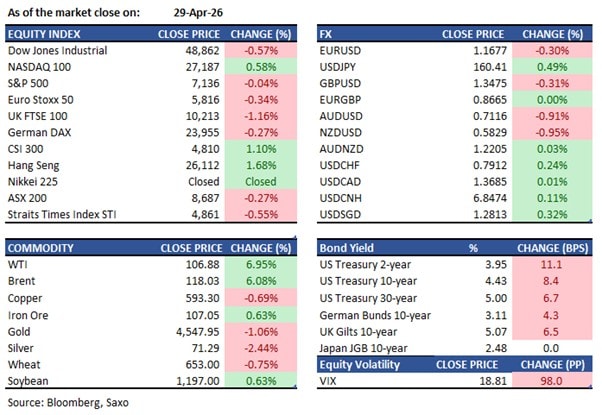
- US: S&P 500 Index ended Wednesday little changed at 7,135.95, as a divided Federal Reserve held rates steady and signaled the war in Iran is clouding the economic outlook. Nasdaq 100 rose 0.6% while the Dow Jones Industrial Average fell 0.6%. In after-hours trading, Alphabet shares rose 7.1% after reporting quarterly revenue and profit that beat projections, fuelled by strong growth in its cloud computing business. Meta shares plunged 7% on rising concerns over AI spending after the company raised its full-year capital expenditures outlook to $125 billion to $145 billion. Qualcomm shares jumped over 12% after the company signalled a bottom in China handset demand and pointed to growing traction with a hyperscaler customer. Amazon gained 2.7% after AWS sales grew 28%, beating the estimated 25% increase driven by strong enterprise spending. KLA Corp shares fell 8% in extended trading after the company reported third-quarter results and provided a fourth-quarter outlook.
- EU: European stocks closed lower, with the Stoxx 600 Index falling 0.6% on Wednesday. The prospect of a prolonged naval blockade of Iranian ports soured risk sentiment amid mixed earnings results. GSK Plc contributed the most to the index decline, decreasing 6.3%, while Konecranes Oyj had the largest drop, falling 13.5%. The FTSE 100 closed down 119.68 points, or 1.2%, at 10,213.11, held back by falls for drugs firms GSK and AstraZeneca. The DAX fell 0.3% to 23,954.56 in Frankfurt, dropping to the lowest closing level since April 13. UBS shares gained after traders helped the Swiss firm beat estimates to keep it on track to lift payouts this year.
Asia: Hong Kong's Hang Seng Index rose 1.7% to close at 26,111.84 on Wednesday, rebounding as policy signals from China's top leadership lifted sentiment alongside improving corporate earnings. Alibaba Group Holding Ltd contributed the most to the index gain, increasing 3.2%, while China Overseas Land & Investment Ltd had the largest increase, rising 8.9%. South Korea's Kospi Index rose 0.8% to 6,690.90 in Seoul. Samsung chip unit posted a 48x profit surge on AI memory demand, beating estimates. Hyperscaler spend boosts HBM outlook. Op income 53.7t won; group net 47.1t won. Taiwan's Taiex Index fell 0.6% to 39,303.50 in Taipei, with Taiwan Semiconductor Manufacturing Co contributing the most to the index decline, decreasing 1.6%. Singapore's Straits Times Index (STI) was not specifically mentioned in recent reports. DBS Q1 profit largely in line: net income +1% to S$2.93b (vs S$2.88b est). Group NII -5% while fee income +16%; wealth management fees +25% to S$907m. Shanghai Sunmi Technology jumped 298% at its Hong Kong trading debut after an initial public offering.
Earnings this week:
- Thursday: Samsung Electronics Merck, ConocoPhillips, Mastercard, Caterpillar, Bristol-Myers Squibb, Apple, Tokyo Electron, DBS Group
- Friday: Chevron, Exxon Mobil, Mitsubishi, Mitsui, Itochu, ANZ, Marubeni
FX:
- The Bloomberg Dollar Spot Index climbed 0.4% to its highest since April 13 after the Federal Reserve kept interest rates unchanged but revealed deepening divisions over the policy outlook.
- JPY extended its slide beyond 160 against USD to its weakest mark this year at 160.47, the weakest since July 2024, fuelling risk that Japanese officials may step into the market to offer support. The yen later pared some losses to 160.27.
- EUR gained an edge over the USD as policymakers at the ECB appeared to have turned more hawkish than their counterparts at the Federal Reserve. Traders now expect the ECB to deliver three-quarter point interest-rate hikes this year.
- The yuan extended losses both onshore and offshoAre, ending Wednesday at the lowest level in more than three weeks. USDCNH rose 0.1% to finish the day at 6.8479, while USDCNY gained less than 0.1% to 6.8430.
- NOK and CAD outperformed peers amid rising oil prices, as the US signalled no letup of the naval blockade in the Strait of Hormuz.
Commodities:
- Brent crude oil rose more than 7% to above $119.50 a barrel on Wednesday, the highest since June 2022, as signs that flows through the Strait of Hormuz could be at a standstill for a prolonged period heightened concerns over a rapidly shrinking global supply cushion. Front-month ICE Brent crude for June delivery gained $6.77 per barrel, or 6.08%, to settle at $118.03.
- Gold held a three-day loss after a divided Federal Reserve kept US interest rates steady and said the war in Iran was clouding the economic outlook. Bullion was near $4,550 an ounce in early trading, having fallen 3.4% over the previous three sessions.
- Copper edged lower as investors weighed the ongoing risks that the Iran war poses to global growth against the outlook for demand in top buyer China. Front-month Comex copper for May delivery lost 3.90 cents per pound, or 0.66%, to $5.8785.
Fixed income:
- Treasuries slumped after the FOMC policy announcement showed some members did not support the inclusion of an easing bias in the statement announcing it was holding rates steady. Two-year yields rose 11 basis points, the biggest jump on a Fed decision day since 2022. The US Treasury 10-year yield rose 8 basis points to 4.43%, the highest in more than nine months.
- Australian bonds slid in early trading, tracking Treasuries after the Federal Reserve kept its policy rate on hold and after oil prices jumped. The yield on Australia's 3-year note jumped 10 basis points to 4.78%, while that on the 10-year bond gained 8 basis points to 5.08%.
- Japan's 10-year yield rose 4 basis points to 2.5%, the highest level since 1997. Futures for the bond fell as much as 43 ticks to 129.27 in morning trading. Japanese government bonds are expected to drop, with investor caution mounting ahead of a two-year sale later Thursday.
For a global look at markets – go to Inspiration.
This content is marketing content and should not be considered investment advice. Trading financial instruments carries risks and historic performance is not a guarantee for future performance. The instrument(s) mentioned in this content may be issued by a partner, from which Saxo receives promotion, payment or retrocessions. While Saxo receives compensation from these partnerships, all content is conducted with the intention of providing clients with valuable options and information.