
You can access both of our platforms from a single Saxo account.

Asia Market Quick Take – 24 April, 2026
Asia Market Quick Take – 24 April, 2026
Key points:
- Macro: US continues to block Iranian ports; Japan inflation rises
- Equities: Intel gains 20% after delivering strong sales forecast
- FX: USDJPY near 160, 4th straight gain; NZDUSD G10 laggard
- Commodities: Gold set for weekly drop; oil up fifth day, WTI near $100
- Fixed income: 5 year breakevens topped 2.7%, widest since 23 Mar
------------------------------------------------------------------
Disclaimer: Past performance does not indicate future performance.
Macro:
- Japan’s annual inflation rose to 1.5% in March 2026 from 1.3% in February, driven by higher transport and household item costs. Food inflation eased to 3.6%, while electricity and gas prices fell further on subsidies. Core inflation picked up to 1.8%, still below the 2% target. Month-on-month, CPI increased 0.4%, the strongest rise since January 2025.
- Trump’s Truth Social posts and decision to maintain a naval blockade of Iranian ports have hindered prospects for renewed talks with Tehran. The US‑Iran ceasefire and the Israel‑Lebanon truce were both extended, but disruptions have sharply reduced Middle East oil and gas shipments, tightening global supply.
- The S&P Global flash US Composite PMI rose to 52 in April 2026 from 50.3 in March, indicating modest growth. Services activity was weak despite a move back into expansion, while manufacturing saw its strongest output gain in four years, partly from stockpiling. Input costs and supply delays hit their worst since mid-2022, triggering the largest jump in selling prices since July 2022, and employment increased only slightly.
- US initial jobless claims rose by 6,000 to 214,000 in the week ending April 18, near expectations. Continuing claims edged up by 12,000 to 1.821 million. Both remain below last year’s averages, consistent with low layoff levels. Federal employee claims fell by 60 to 452.
- The Chicago Fed National Activity Index fell to -0.20 in March 2026 from +0.03 in February, its weakest since November 2025, as production, sales, and consumption/housing turned negative, partly offset by slightly stronger employment indicators.
Equities:
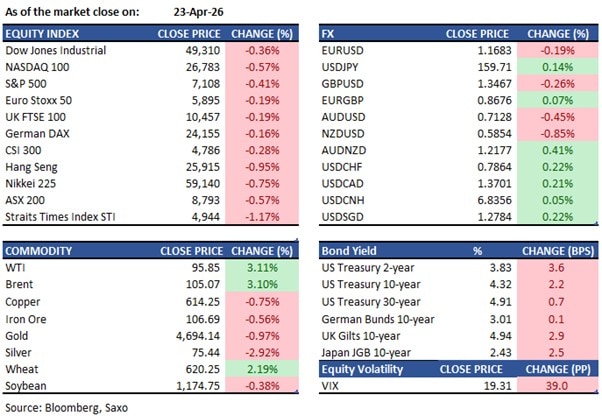
- US: The S&P 500 Index slid 0.4% to 7,108.40 on Thursday, as oil rose on concern about an escalation of the conflict in the Middle East that could prolong the Strait of Hormuz closure. Nasdaq 100 fell 0.6% while the Dow Jones dropped 0.4%. Technology stocks led the decline, with the sector shedding 1.5%, dragged down by ServiceNow which plunged 17.8% after cutting its full-year forecast. Lockheed Martin lost 4.7% after reporting an 11% decline in earnings which was more than expected. In after-hours trading, Intel delivered a blockbuster sales forecast, with revenue guidance of $13.8 billion to $14.8 billion in the June quarter vs estimates of $13b, sending shares +20%. AppFolio shares rose 6.4% after raising its full-year revenue forecast, while Boyd Gaming and other stocks also moved.
- EU: European stocks closed a touch higher on Thursday, with the Stoxx Europe 600 Index advancing slightly to 614.20, having fluctuated as markets digested a flurry of earnings and conflicting messaging around the conflict in the Middle East. Food giant Nestle was the biggest point gainer, increasing 5.9% as demand for coffee and snacks saw sales top expectations, while L'Oreal reported its strongest quarterly sales growth in two years. The FTSE 100 fell for the fourth day, dropping 0.2% to 10,457.01 in London, while the DAX fell 0.2% to 24,155.45 in Frankfurt. The Swiss Market Index broke its three-day losing streak, closing 1.38% higher amid a busy day of corporate financial updates.
- Asia: Asian markets showed mixed performance on Friday. South Korea's Kospi Index opened 0.3% higher at 6,496.10, following a strong Thursday session where it rose 0.9% to 6,475.81, driven by an earnings beat by SK Hynix and a surprisingly strong print for Korea's first-quarter GDP, with Samsung shares setting another record. Nikkei futures were down 0.2% at 59,050 on the SGX as uncertainty over the US-Iran conflict continues, with the dollar at 159.74 yen. The Nikkei 225 touched 60,000 for the first time earlier this week amid huge foreign inflows to Japanese equities. Singapore's Straits Times Index has been volatile, with the benchmark rising 0.3% to 5,021.20 on April 15, though it dipped 0.2% to 4,997.93 on April 17 as investors awaited the extension of the US-Iran war ceasefire. Hong Kong's Hang Seng and other regional markets remained cautious amid Middle East tensions.
Earnings this week:
- Friday - Procter & Gamble
FX:
- The dollar climbed for a third day while all G-10 currencies fell against the greenback Thursday, with the Bloomberg Dollar Spot Index rising 0.1%, climbing more than 0.5% in three days.
- USDJPY gained 0.15% to 159.73 yen, up for four straight sessions, as Japan's Finance Minister Satsuki Katayama warned that officials are in close contact around the clock with their US counterparts as Tokyo remains on high alert over speculative moves keeping the yen weak. One-week implied volatility on USDJPY jumped to 8.5%, the highest since March 31 on an end-of-day basis, with both Fed and Bank of Japan rate decisions coming up next week and uncertainties persisting over US-Iran peace negotiations.
- The euro lost 0.16% to $1.1686, down for three straight sessions and hitting the lowest five pm New York rate since Wednesday, April 8, 2026, with the euro dropping below its 200-day moving average to $1.1671, the lowest since April 13.
- The yuan slipped as the US dollar climbed for a third straight day amid growing uncertainties surrounding US-Iran peace talks, with USDCNH rising less than 0.1% to 6.8350 and the People's Bank of China weakening its daily reference rate for a second day.
- The New Zealand dollar underperformed all other G10 currencies against the US dollar.
Commodities:
- Gold was headed for a weekly decline, snapping four weeks of gains, trading steady below $4,700 an ounce, having given up nearly 3% over the week as the US and Iran intensified a maritime standoff and progress faltered on talks to end the war that's choked energy supplies and heightened inflation risks.
- WTI crude rose at the open in Asia near $97 per barrel, with oil swinging between gains and losses as the US and Iran remained locked in a battle for control of the Strait of Hormuz after plans to meet for a fresh round of peace talks failed, with President Donald Trump ordering the US Navy to shoot any boat laying mines in the waterway.
- Copper fell with most other metals as investors watched for the next major developments from the Middle East after peace talks stalled, with Comex Copper settling 0.73% lower at $6.0755 per pound and LME 3-month copper closing $78 lower at $13,356 a ton.
Fixed income:
- US Treasury yields rose across the curve, with the 10-year yield rising 2.2 basis points to 4.327% and the 30-year yield rising 1.7 basis points to 4.923%, marking the largest one-day yield gain for the 30-year since Thursday, April 16, 2026.
- The US Treasury's 5-year TIPS reopening was awarded at 1.367% versus the when-issued yield of around 1.365%, with the auction stopping around 0.2 basis points above the WI yield, while 5-year breakeven rates topped through 2.7%, the widest since March 23.
- Munis cheapened slightly on the front of the curve, as US Treasuries saw continued losses, with munis weaker on the front end for a few days, leading to a slight inversion of the curve starting around the 2028 maturities.
For a global look at markets – go to Inspiration.
This content is marketing content and should not be considered investment advice. Trading financial instruments carries risks and historic performance is not a guarantee for future performance. The instrument(s) mentioned in this content may be issued by a partner, from which Saxo receives promotion, payment or retrocessions. While Saxo receives compensation from these partnerships, all content is conducted with the intention of providing clients with valuable options and information.