
You can access both of our platforms from a single Saxo account.

Asia Market Quick Take – 20 February, 2026
Asia Market Quick Take – 20 February, 2026
Key points:
- Macro: Japan’s inflation falls to 1.5%, lowest since March 2022
- Equities: Opendoor Technologies rises 13% after strong Q4 performance
- FX: Pound extends losses for four straight sessions
- Commodities: Oil steadied near a six-month high; gold steadied near $5,000
- Fixed income: Long-end Treasuries rebounded on strong 30-year TIPS demand
------------------------------------------------------------------
Disclaimer: Past performance does not indicate future performance.
Macro:
- Japan's annual inflation fell to 1.5% in January 2026, the lowest since March 2022. Food and transport prices slowed, while energy costs remained negative. Core inflation reached the central bank's 2% target. Monthly CPI declined 0.2%.
- Trump stated the US needs to "make a meaningful deal" with Iran, adding that the next 10 days will determine an accord. He noted Iran is a "hot spot" but mentioned "good talks" with officials.
- The Philadelphia Fed Manufacturing Index increased to 16.3 in February 2026, exceeding expectations. Business activity and orders were strong, but shipments slowed. Employment dipped slightly, and the workweek shortened. Prices rose overall, though at a slower pace.
- US pending home sales fell 0.8% in January 2026, after a 7.4% drop in December, missing the expected 1.3% increase. Sales decreased in the Northeast and South but rose in the Midwest and West. Year-over-year, sales were down 0.4%. Economist Lawrence Yun emphasized the need for more housing supply to avert higher prices.
- US initial jobless claims fell 23,000 to 206,000 in mid-February, below the expected 225,000. Continuing claims grew 17,000 to 1,869,000, indicating a stable labor market. Federal employee claims rose by 80 to 695 during the government shutdown.
- The US trade deficit grew to $70.3 billion in December 2025, above the $55.5 billion forecast. Exports fell by 1.7%, and imports rose by 3.6%. The 2025 trade deficit was $901.5 billion, slightly less than 2024, with reduced deficits with the EU and China but expanded with Mexico, Vietnam, and Taiwan.
Equities:
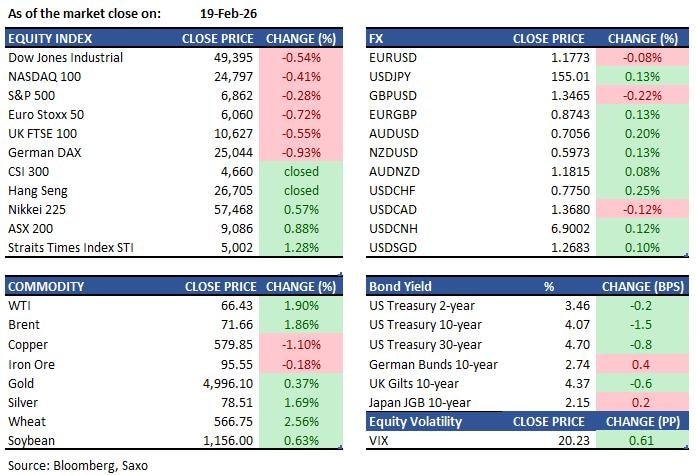
- US - U.S. equities slipped as the S&P 500 fell 0.3%, the Nasdaq 0.4%, and the Dow 0.6%, with investors trimming risk after FOMC minutes suggested slower disinflation and potentially higher rates. Longer yields rose, while crude gained on Iran tensions and Trump’s strike comments, boosting energy but pressuring banks. Blue Owl’s liquidity move hit asset managers, dragging Blackstone and Apollo. Software names weakened on AI concerns. Walmart dipped 1.3% despite strong results while Opendoor Technologies jumped 13% in after hours following their strong Q4 performance.
- EU - The Eurozone’s STOXX 50 slid 0.8% and the STOXX 600 dropped 0.6%. Fed minutes signaled inflation may take longer to ease, and some policymakers even left the door open to further hikes. Banks, strong earlier this month, retreated, with UniCredit, Santander, and BBVA down over 2%. Airbus sank 7% after missing delivery targets, while Enel fell nearly 4% after Italy increased taxes on utilities.
- SG - The Straits Times Index gained 1.3%, rising 62.98 points to 5,001.56, while the iEdge Singapore Next 50 Index added 0.6% to 1,510.73. Yangzijiang Shipbuilding led STI gainers, climbing 4.9% to S$3.64. Mapletree Logistics Trust was the weakest performer, slipping 1.5% to S$1.28. All three local banks advanced: DBS rose 1.3% to S$57.62, OCBC gained 2.3% to S$21.59, and UOB added 0.7% to S$38.66.
Earnings this week:
- Friday: Anglo American PLC
FX:
- A Bloomberg dollar gauge rose for a fourth straight day.
- GBPUSD slipped 0.3% to 1.3452, USDJPY rose 0.2% to 155.07 and is up 1.5% week to date.
- AUDUSD was little changed at 0.7045 as a better-than-expected jobless rate lifted the implied probability of a May RBA hike to 91% from about 80% before the release,
- EURUSD fell 0.2% to 1.1762, and USDCAD edged up 0.1% to 1.3706.
Commodities:
- Oil steadied near a six-month high as President Donald Trump said Iran had at most 15 days to strike a nuclear deal and the US assembled forces in the Middle East, with WTI near $67 after almost 7% gains over the prior two sessions and Brent near $72.
- Gold steadied near $5,000 an ounce after rising more than 2% over the past two sessions as traders weighed escalating Middle East risks, with President Donald Trump allowing only 10 to 15 days for Iran nuclear talks amid the largest US regional deployment since before the 2003 Iraq war.
Fixed income:
- Treasuries were mixed, with front-end yields marginally higher and the long end slightly lower as long-end prices rebounded from an early drop on strong demand for 30-year TIPS, while a flight-to-quality amid Iran-related geopolitical concerns and steady demand for upside option structures added support; Japanese government bonds opened higher after January headline inflation undershot consensus.
For a global look at markets – go to Inspiration.
This content is marketing content and should not be considered investment advice. Trading financial instruments carries risks and historic performance is not a guarantee for future performance. The instrument(s) mentioned in this content may be issued by a partner, from which Saxo receives promotion, payment or retrocessions. While Saxo receives compensation from these partnerships, all content is conducted with the intention of providing clients with valuable options and information.