
You can access all of our platforms from a single Saxo account.

Asia Market Quick Take – 03 September 2026

Asia Market Quick Take – 3 Sep, 2026
Key points:
- Macro: RBNZ hikes to 2.75%. BoC holds at 2.25% but warns of higher inflation
- Equities: US indices rise; Snowflake rises 23% after strong earnings
- FX: Hawkish BOJ comments and intervention speculation drove USDJPY down to 158.71
- Commodities: Oil eases after Trump downplays prolonged conflict
- Fixed income: Japan 10-year yields hit 3% since 1996
------------------------------------------------------------------
Disclaimer: Past performance does not indicate future performance.
Macro:
- US carried out new strikes on Iranian IRGC targets near the Strait of Hormuz, driving a sustained oil rally and reviving inflation fears, though prices later eased after Trump downplayed the risk of a prolonged conflict.
- The latest ADP report showed US private employers added just 38,000 jobs in August, the weakest gain since January and below the 47,000 expected, signaling a cooling labor market. Markets now see a 66% chance of a Fed rate hike in September, up from about 40% a week earlier.
- US factory orders rose 0.9% in July 2026, rebounding from a 0.2% drop in June and beating the 0.6% forecast. Gains were led by a 2.3% jump in transportation equipment, including a 12.7% surge in civilian aircraft. Orders ex-transportation rose 0.6%, and ex-defense increased 1.0%.
- The RBNZ delivered a second straight 25 bp hike to 2.75% but signaled a slower tightening path than markets expected. It now projects the cash rate at 2.81% by December and 3.15% by end-2027, below the roughly 3.5% peak priced in, and said further hikes are likely but timing is uncertain.
- BoC left its policy rate at 2.25% but warned of stronger upside inflation risks from higher energy prices, the Middle East war, and renewed US tariffs, while saying the outlook remains too uncertain to guide future moves.
- Australia Q2 GDP beat estimates, sending the 3-year yield up nearly 10 bps, while earnings beats are outpacing misses for the first time in four years.
Equities:
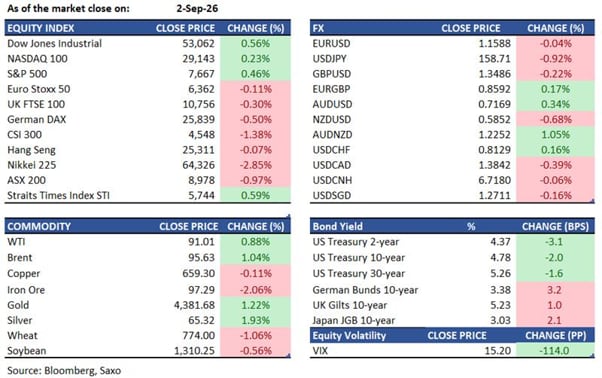
- US — S&P 500 rose 0.5% to 7,666.60 on Wednesday, snapping a three-day losing streak, as oil prices stalled and bargain hunters returned. Nasdaq 100 gained 0.2% and the Dow Jones Industrial Average climbed 0.6%. Ten of eleven S&P 500 sectors closed higher, led by materials and communication services. Dell Technologies surged 15.8% on a solid earnings outlook. Meta Platforms gained 3.1% and Nvidia rose 3.2%, while Palo Alto Networks fell 9.3%. In after-hours trading, Broadcom slid as much as ~3.7% after issuing a Q4 revenue forecast that missed expectations ($34.8b vs $35.03b). Snowflake rose 23% after a strong earnings report and upbeat guidance, with revenue jumping 35% yoy, largely driven by new accounts of its AI coding agent CoCo.
- EU — European equities extended their losing streak on Wednesday. The Stoxx Europe 600 fell 0.2% to 645.91, its lowest close since 29 July, led lower by industrials — Siemens dropped 1.5% and Lottomatica fell 7.6%. The DAX declined 0.5% to 25,839, with Zalando down 4.7%. The FTSE 100 fell 0.3% to 10,756, with LSE Group down 3.0% and Kingfisher falling 3.8%. The SMI bucked the trend, rising 0.2%, led by UBS (+1.1%) and Alcon (+1.8%). Index changes were also announced: Nokia and Engie will join the Euro Stoxx 50 on 21 September, replacing Volkswagen and Dutch utility Stellantis.
- Asia — Asian equities are advancing this morning, tracking Wall Street's recovery, with the MSCI Asia Pacific gauge up ~0.5%. Japan's Nikkei had fallen 2.9% to 64,325 on Wednesday — its lowest in nearly a month — as oil prices and elevated bond yields pressured tech and auto stocks. South Korea's Kospi tumbled ~4% on Wednesday, led by chip stocks Samsung, SK Hynix and SK Square, amid rising oil and rate-hike fears. Australian ASX 200 fell 1% after the stronger-than-expected GDP print reinforced RBA rate-hike expectations. Hong Kong and mainland China markets also declined ~1% or more on Wednesday. The yen's sharp overnight move is also keeping traders alert.
Earnings this week:
- Thursday: Ciena
FX:
- A sharp BOJ‑driven yen rally pushed USDJPY down over 200 pips (160.39–158.22) and it closed at 158.71, amid stop‑run‑like price action and only moderate JPY futures volumes, casting doubt on actual Japanese intervention.
- CAD outperformed on hawkish Bank of Canada rhetoric, with USDCAD falling to ~1.3842 and 2-year yields jumping, while Citi initiated a short USDCAD position targeting 1.35.
- EURUSD slipped to 1.1588, breaking below its 21-day moving average and showing mixed Harami patterns on weekly (bearish) and daily (bullish) charts.
- AUDUSD closed at 0.7169, the weakest G10 performer, as higher oil prices amid rising US–Iran tensions pressured Asia FX.
- SGD's 120-day correlation with the USD has dropped to -0.94, the most inverse link since May 2024 and the most negative in Asia, positioning it as a key beneficiary if the dollar debasement trade accelerates.
- KRW has transformed from Asia's worst-performing currency to its best, driven by AI-related capital inflows from chip firms repatriating overseas earnings.
Commodities:
- WTI crude settled above $90 per barrel on Wednesday after a sharp two-day rally driven by US-Iran hostilities over the Strait of Hormuz. Brent had briefly hit ~$95 before easing as President Trump played down the prospect of a prolonged conflict.
- Gold traded around $4,330–$4,416 per ounce, having fallen nearly 6% over the prior three sessions to a two-week low as surging global bond yields and a stronger dollar weighed on the non-yielding metal. Gold mining stocks, however, had their best August since at least 1994, driven by geopolitical and fiscal uncertainty.
Fixed income:
- After a sharp sell-off that pushed the 10-year yield to its highest since October 2023 (~4.81%) and the 30-year to ~5.27% — levels last seen before Treasury Secretary Bessent expanded the buyback programme — yields edged slightly lower on Wednesday. The 1-year yield fell 2.3bps to 4.16%, the 10-year fell 0.5bps to 4.796%, and the 30-year fell 0.7bps to 5.268% by the close.
- The rout spread across markets, with Japan's 10-year yield touching 3% for the first time since 1996, UK 30-year gilt yields hitting 5.89% — the highest since May 1998 — and German 10-year Bund yields reaching their highest since 2011.
- Overnight swaps were pricing a full 25bp Fed rate hike at the October policy meeting, with nearly 70% odds of a hike as early as 16 September. BOJ board member Hajime Takata also left the door open for an outsized rate increase, pushing Japanese front-end yields higher during the Asian session.
For a global look at markets – go to Inspiration.
This content is marketing content and should not be considered investment advice. Trading financial instruments carries risks and historic performance is not a guarantee for future performance.The instrument(s) mentioned in this content may be issued by a partner, from which Saxo receives promotion, payment or retrocessions. While Saxo receives compensation from these partnerships, all content is conducted with the intention of providing clients with valuable options and information.