0502koreaM

AI selloff widens: Why Asia can diversify the next phase of the AI trade

Charu Chanana 400x400
Charu Chanana

Chief Investment Strategist

Key points

  • The current selloff isn’t “AI is over” — it’s a rotation from AI pioneers priced for perfection toward AI enablers with nearer-term cashflows and pricing power.
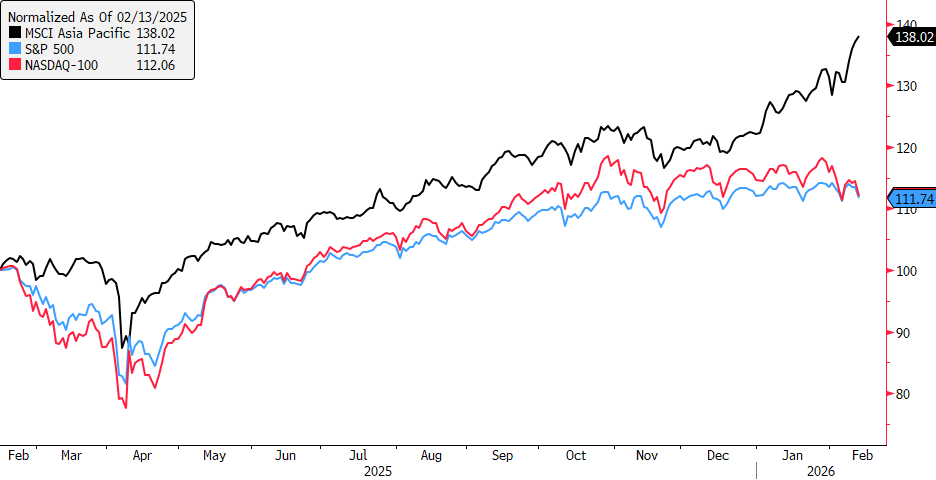
  • Asia’s resilience reflects its heavier exposure to upstream AI infrastructure (memory, foundries, assembly/packaging) versus the US market’s heavier exposure to downstream software and services now being scrutinised for disruption risk.
  • Asia can act as a diversifier when correlations fall — but investors should be alert to concentration risk within Asia indices (a few mega names dominate) and the fact that Asia is not immune if the selloff becomes broad global risk-off.


Where the AI dispersion trade is hitting

The AI selloff is no longer confined to a single corner of tech. The market is increasingly pricing dispersion and separating likely AI beneficiaries from businesses where AI could compress margins or automate away fee pools.

So far, the pressure has been most visible in:

  • Software: renewed scrutiny on pricing power and whether new AI tools commoditise workflows. Read more here.
  • Wealth management / brokers: concerns that AI-driven automation lowers switching costs and compresses advisory and platform fees.
  • Insurance: fear that underwriting, claims and distribution become more automated and competitive.
  • Logistics and transport: questions around how quickly AI and automation reprice efficiency, pricing and labour costs across the value chain.
  • Real estate services / other intermediaries: areas where AI can reduce the need for manual processing, documentation and brokerage-like functions.

That widening “who gets disrupted?” narrative is what’s driving rotation, and it helps explain why parts of Asia are holding up better, given their heavier exposure to upstream AI infrastructure rather than downstream service models.

A profit-capture rotation, not an “anti-AI” move

Markets rarely abandon a transformative theme overnight. What they do abandon is the most crowded expression of that theme when the narrative shifts from excitement to scrutiny.

The latest leg of the AI selloff has broadened beyond a handful of high-flying tech names into pockets of the market that look most exposed to AI-driven business model disruption — particularly software and select service industries.

At the same time, that fear is showing up as a surprising tailwind for parts of Asia.

A cleaner way to frame the current rotation is:

US = downstream AI (apps, software, services)

The US market has the deepest concentration in the downstream layers—where AI’s promise is enormous, but so is the monetisation and disruption debate:

  • Who loses pricing power as AI commoditises workflows?
  • Which fee pools shrink as automation expands?
  • Does AI capex pay back fast enough—and for whom?

In other words, the market is asking whether AI expands the pie or forces the winners to give the pie away to customers.

Asia = upstream AI (compute and components)

Asia’s exposure is more upstream—the infrastructure that has to be built regardless of which applications dominate:

  • Components and advanced manufacturing capacity that sit beneath the AI stack
  • The physical supply chain that enables scaling models in the real world

When the market worries about AI disrupting business models, downstream feels it first. When the focus shifts to what must be built either way, upstream often behaves differently.

Chart 1: Performance divergence: MSCI Asia Pacific Index vs S&P 500 vs Nasdaq 100

13_CHCA_Asia vs Us

Source: Bloomberg

Asia isn’t one trade: Korea/Taiwan vs Japan

This is where the “Asia as diversifier” story becomes investable rather than theoretical.

Korea & Taiwan: the purest “AI infrastructure beta”

Korea and Taiwan are the cleanest expression of upstream AI buildout. They tend to respond to:

  • The pace of global AI hardware demand
  • Supply tightness and pricing power in key components
  • Capex cycles and utilisation rates

These markets can be resilient when infrastructure demand is strong, but they’re also cyclical and can swing when global tech sentiment turns.

Japan: AI spend and adoption, with less immediate disruption risk

Japan adds something different, and arguably more interesting in this phase of the narrative. Japan can capture AI upside through adoption and implementation rather than pure “app-layer disruption”:

  • Industrial AI and automation: productivity upgrades in manufacturing, robotics, sensors, precision machinery, and process optimisation.
  • Enterprise adoption: AI as a tool to offset labour constraints, improve efficiency, and modernise operations—often in areas where change is incremental and execution-driven.
  • More entrenched sector mix: parts of Japan’s equity market are anchored in industries where disruption is slower and where relationships, regulation, and operational complexity create inertia.

That doesn’t mean Japan has no disruption risk. It means the near-term equity story is more often AI as a productivity catalyst than AI as an existential pricing threat.

The Asia opportunity is real — but don’t ignore the caveats

A credible diversification pitch includes the risks.

Risk 1: Concentration inside Asia indices

Asia’s equity indices have become increasingly top-heavy.

  • Taiwan’s benchmark has a large weight in a single foundry leader.
  • Korea’s index is heavily influenced by a small number of memory and hardware champions.

What this means: “Buying Asia” can unintentionally become “buying a handful of chip names.” Diversification improves when the portfolio has multiple drivers, not simply a different postcode.

Risk 2: Asia isn’t immune — it’s just differently exposed

Even if Asia is less exposed to certain AI-disrupted service models, it can still be hit through:

  • global risk-off episodes (funding conditions, USD strength, volatility spikes)
  • synchronised tech drawdowns (when investors cut risk broadly)
  • down-cycles in semiconductors (inventory, pricing, demand shocks)

The excerpt itself notes that some Asia-listed software and IT services names fell alongside US peers during the selloff.

Risk 3: The AI buildout is cyclical too

Upstream beneficiaries can enjoy pricing power — until they don’t. Memory pricing, foundry utilisation and capex cycles can turn quickly.

Bottom line: Asia can diversify the type of AI exposure, not eliminate AI exposure.

Closing: Asia is not a “safe haven” — it’s a different set of drivers

The most useful way to think about Asia in this AI selloff is not as a bet that “Asia wins.”

It’s a recognition that Asia’s role in the AI ecosystem, and the region’s broader equity composition, can provide diversification by driver at a moment when the US market is repricing concentrated leadership.

If the AI trade is moving from hype to selectivity, Asia is one place where selectivity can be expressed — but with eyes open to concentration and cycle risk.


This material is marketing content and should not be regarded as investment advice. Trading financial instruments carries risks and historic performance is not a guarantee of future results.
The instrument(s) referenced in this content may be issued by a partner, from whom Saxo receives promotional fees, payment or retrocessions. While Saxo may receive compensation from these partnerships, all content is created with the aim of providing clients with valuable information and options..

Quarterly Outlook

01 /

  • Q1 Outlook for Traders: Five Big Questions and Three Grey Swans.

    Quarterly Outlook

    Q1 Outlook for Traders: Five Big Questions and Three Grey Swans.

    John J. Hardy

    Global Head of Macro Strategy

    Strap yourself in for key market questions that must be answered in 2026.
  • Q1 Outlook for Investors: “AI” party hangover needs discipline and diversification

    Quarterly Outlook

    Q1 Outlook for Investors: “AI” party hangover needs discipline and diversification

    Charu Chanana

    Chief Investment Strategist

    2026 is a high-valuation, high-dispersion year: the AI story matures, policy becomes less predictabl...
  • Q4 Outlook for Investors: Diversify like it’s 2025 – don’t fall for déjà vu

    Quarterly Outlook

    Q4 Outlook for Investors: Diversify like it’s 2025 – don’t fall for déjà vu

    Jacob Falkencrone

    Global Head of Investment Strategy

  • Q4 Outlook for Traders: The Fed is back in easing mode. Is this time different?

    Quarterly Outlook

    Q4 Outlook for Traders: The Fed is back in easing mode. Is this time different?

    John J. Hardy

    Global Head of Macro Strategy

    The Fed launched a new easing cycle in late Q3. Will this cycle now play out like 2000 or 2007?
  • Q3 Investor Outlook: Beyond American shores – why diversification is your strongest ally

    Quarterly Outlook

    Q3 Investor Outlook: Beyond American shores – why diversification is your strongest ally

    Jacob Falkencrone

    Global Head of Investment Strategy

  • Q3 Macro Outlook: Less chaos, and hopefully a bit more clarity

    Quarterly Outlook

    Q3 Macro Outlook: Less chaos, and hopefully a bit more clarity

    John J. Hardy

    Global Head of Macro Strategy

    After the chaos of Q2, the quarter ahead should get a bit more clarity on how Trump 2.0 is impacting...
  • Equity outlook: The high cost of global fragmentation for US portfolios

    Quarterly Outlook

    Equity outlook: The high cost of global fragmentation for US portfolios

    Charu Chanana

    Chief Investment Strategist

  • Commodity Outlook: Commodities rally despite global uncertainty

    Quarterly Outlook

    Commodity Outlook: Commodities rally despite global uncertainty

    Ole Hansen

    Head of Commodity Strategy

  • Upending the global order at blinding speed

    Quarterly Outlook

    Upending the global order at blinding speed

    John J. Hardy

    Global Head of Macro Strategy

    We are witnessing a once-in-a-lifetime shredding of the global order. As the new order takes shape, ...
  • Asset allocation outlook: From Magnificent 7 to Magnificent 2,645—diversification matters, now more than ever

    Quarterly Outlook

    Asset allocation outlook: From Magnificent 7 to Magnificent 2,645—diversification matters, now more than ever

    Jacob Falkencrone

    Global Head of Investment Strategy

Disclaimer

The Saxo Group entities each provide execution-only service and access to Analysis permitting a person to view and/or use content available on or via the website is not intended to and does not change or expand on this. Such access and use are at all times subject to (i) The Terms of Use; (ii) Full Disclaimer; (iii) The Risk Warning; (iv) the Rules of Engagement and (v) Notices applying to Saxo News & Research and/or its content in addition (where relevant) to the terms governing the use of hyperlinks on the website of a member of the Saxo Group by which access to Saxo News & Research is gained. Such content is therefore provided as no more than information. In particular no advice is intended to be provided or to be relied on as provided nor endorsed by any Saxo Group entity; nor is it to be construed as solicitation or an incentive provided to subscribe for or sell or purchase any financial instrument. All trading or investments you make must be pursuant to your own unprompted and informed self-directed decision. As such no Saxo Group entity will have or be liable for any losses that you may sustain as a result of any investment decision made in reliance on information which is available on Saxo News & Research or as a result of the use of the Saxo News & Research. Orders given and trades effected are deemed intended to be given or effected for the account of the customer with the Saxo Group entity operating in the jurisdiction in which the customer resides and/or with whom the customer opened and maintains his/her trading account. Saxo News & Research does not contain (and should not be construed as containing) financial, investment, tax or trading advice or advice of any sort offered, recommended or endorsed by Saxo Group and should not be construed as a record of our trading prices, or as an offer, incentive or solicitation for the subscription, sale or purchase in any financial instrument. To the extent that any content is construed as investment research, you must note and accept that the content was not intended to and has not been prepared in accordance with legal requirements designed to promote the independence of investment research and as such, would be considered as a marketing communication under relevant laws.

Please read our disclaimers:
- Notification on Non-Independent Investment Research (https://www.home.saxo/legal/niird/notification)
- Full disclaimer (https://www.home.saxo/en-hk/legal/disclaimer/saxo-disclaimer)

None of the information contained here constitutes an offer to purchase or sell a financial instrument, or to make any investments. Saxo does not take into account your personal investment objectives or financial situation and makes no representation and assumes no liability as to the accuracy or completeness of the information nor for any loss arising from any investment made in reliance of this presentation. Any opinions made are subject to change and may be personal to the author. These may not necessarily reflect the opinion of Saxo or its affiliates.


Hong Kong

Contact Saxo

Hong Kong S.A.R
Hong Kong S.A.R

Saxo Capital Markets HK Limited (“Saxo”) is a company authorised and regulated by the Securities and Futures Commission of Hong Kong. Saxo holds a Type 1 Regulated Activity (Dealing in Securities); Type 2 Regulated Activity (Dealing in Futures Contract); Type 3 Regulated Activity (Leveraged Foreign Exchange Trading); Type 4 Regulated Activity (Advising on Securities) and Type 9 Regulated Activity (Asset Management) licenses (CE No. AVD061). Registered address: 19th Floor, Shanghai Commercial Bank Tower, 12 Queen’s Road Central, Hong Kong.

Trading in financial instruments carries various risks, and is not suitable for all investors. Please seek expert advice, and always ensure that you fully understand these risks before trading. Trading in leveraged products may result in your losses exceeding your initial deposits. Saxo does not provide financial advice, any information available on this website is ‘general’ in nature and for informational purposes only. Saxo does not take into account an individual’s needs, objectives or financial situation. Please click here to view the relevant risk disclosure statements.

The Saxo trading platform has received numerous awards and recognition. For details of these awards and information on awards visit www.home.saxo/en-hk/about-us/awards.

The information or the products and services referred to on this site may be accessed worldwide, however is only intended for distribution to and use by recipients located in countries where such use does not constitute a violation of applicable legislation or regulations. Products and services offered on this website are not directed at, or intended for distribution to or use by, any person or entity residing in the United States and Japan. Please click here to view our full disclaimer.

Apple, iPad and iPhone are trademarks of Apple Inc., registered in the US and other countries. AppStore is a service mark of Apple Inc. Android is a trademark of Google Inc.