
Access both platforms from your single Saxo account.

Asia Market Quick Take – 10 June, 2026

Key points:
- Macro: US strikes Iran after US helicopter was downed
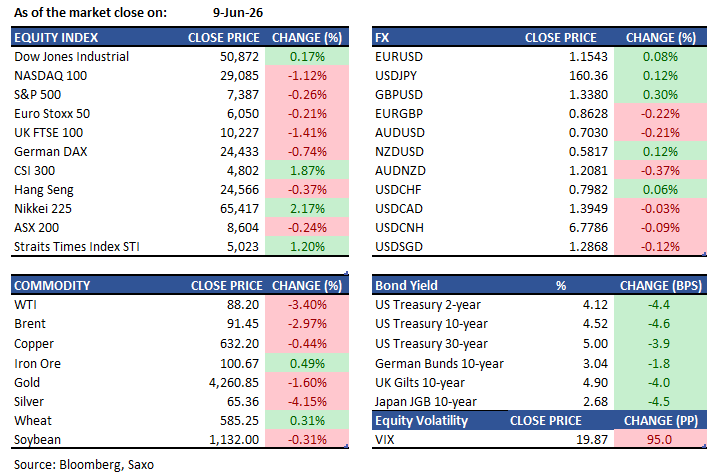
- Equities: Nasdaq 100 recovered, closing lower by 1.1% after falling as much as 4.4%
- FX: Dollar stays firm, with US CPI-driven positioning guiding next move
- Commodities: WTI crude slid as much as 5.9%; gold extended losses, down up to 2.2%
- Fixed income: USTs rallied; the gilt curve bull‑steepened
------------------------------------------------------------------
Disclaimer: Past performance does not indicate future performance.
Macro:
- The US launched new strikes against Iran after an American helicopter was downed, heightening concerns over a fragile ceasefire and longer-term peace prospects. Trump ordered the “self-defense” strikes, while Iran warned it would not leave any attack unanswered.
- US existing home sales rose 3.2% to 4.17 million annualized, beating expectations despite high mortgage rates. Gains were strongest in the Midwest and South, modest in the Northeast, and flat in the West. Inventory rose 3.3% to a 10‑month high, reaching 4.5 months of supply.
- The US trade deficit narrowed to $55.9 billion in April from $56.6 billion, beating expectations. Exports rose 2.6% to a record $327.1 billion, led by capital goods, industrial supplies, and consumer goods, while services slipped. Imports increased 2.0% to $383.0 billion, driven by higher capital goods and service purchases.
- Japan’s producer prices rose 6.3% yoy in May, up from 5.3% and above the 5.5% forecast, the fastest since March 2023 amid higher energy costs. Month-on-month, prices rose 0.9%, down from April’s revised 2.8%.
- US wholesale inventories rose 0.6% m/m in April to $940.3 billion, slightly above forecasts and marking a third straight gain, while the inventory-to-sales ratio held at 1.19.
- US private employers added an average of 29,000 jobs per week in the four weeks to May 23, down from 30,500 and marking a third week of easing growth. Still, ADP’s May report showed a solid 122,000 net job gain, with hiring more broad-based and momentum intact into summer.
Equities:
- US — US equities saw violent intraday swings on Tuesday. The S&P 500 slipped 0.3%, recovering from a 2.3% intraday low, while the Nasdaq 100 closed down 1.1% after briefly falling over 4%. Chipmakers led the selloff — the Philadelphia Semiconductor Index dropped sharply — with Apple -3.7%, Tesla -4.2%, Nvidia -3.4%, and Microsoft -2.4% among the notable decliners. Financials outperformed, with the KBW Bank Index hitting a record high. After hours, Cracker Barrel surged 12% on a raised revenue outlook, while Casey's General Stores rose 2.3% on a revenue beat.
- EU — European equities reversed early gains to close lower on Tuesday. The Stoxx 600 fell 0.5%, the DAX dropped 0.7% to 24,433, and the FTSE 100 declined 1.4% to 10,227, its biggest single-day drop since 15 May. HSBC fell 4.4% and Standard Chartered dropped 6.3%, weighing heavily on the FTSE. Ericsson and Nokia tumbled 6.3% and 7.0% respectively on reports of potential competition from Nvidia in telecom chips. The CAC 40 was broadly flat (+0.05%) and the SMI edged up 0.3%, with Givaudan surging 7.5% after upgrades from Deutsche Bank and JPMorgan.
- Asia — Asian markets are trading lower this morning (Wednesday) as tech selling resumed and US retaliatory strikes on Iran escalated geopolitical risk. The MSCI Asia Pacific Index is down 0.5%, the Kospi has fallen 1.7%, and the Nikkei is also declining. This follows a strong Tuesday session: the Kospi surged 8.2% to 8,096.93 — its fifth-largest single-day gain on record — as SK Hynix (+15.9%) and Samsung Electronics rebounded sharply from Monday's 8.3% rout. The Nikkei rose 2.2% on Tuesday. The STI gained 1.2% to 5,023.25 on Tuesday, buoyed by hopes of a US-Iran deal. Hang Seng edged lower on Tuesday even as broader Asia recovered. South Korea's central bank and financial regulator have launched joint inspections of major FX banks today, the first such action in 14 years, to detect destabilising trading activity.
Earnings this week:
- Wednesday: Oracle, Core & Main, Chewy, Navan, Pennon Group
- Thursday: Chow Tai Fook, Adobe, Halma, Lennar, LPP, Do & Co
FX:
- USD is firm but not broadly surging, with markets positioning around the upcoming US CPI, which is the main driver for the next USD move.
- USDJPY trading near 160.39 in Asia, just below Tuesday’s 160.45 high and close to its weakest yen levels since April, keeping intervention risks in view. Strong May PPI and today’s 30-year JGB auction may pressure the BOJ to hint at faster hikes.
- EURUSD closed at 1.1543, slightly higher but still well below its 52-week high and down month-to-date.
- AUDUSD is near a six-week low, with the Aussie under pressure as a risk proxy after US strikes on Iran hurt sentiment at the Asia open.
- USDCAD slipped to 1.3949 as the dollar fell 0.05% and broke a four-day winning streak.
- USDCNH and USDCNY both edged lower as the PBOC set a stronger yuan fixing and USDCNH volatility ticked up.
Commodities:
- WTI crude fell as much as 5.9%, closing down 3.4% to below $90/bbl, as Israel and Iran agreed to halt strikes and Trump signalled progress on peace talks. However, oil edged higher in early Asian trading Wednesday after US retaliatory strikes on Iran threatened to derail negotiations. US Energy Secretary Chris Wright noted that a return to normal Strait of Hormuz traffic will take many months.
- Gold extended declines, falling as much as 2.2%, as the uptick in Middle East tensions refocused attention on prolonged energy-market tightness and higher-for-longer interest rates. Gold has now broken below its short- and long-term moving averages, including the key 200-day moving average, opening the door for further technical losses.
- LME 3-month copper closed lower at $13,615/ton on Tuesday, with nickel also declining to $18,064/ton. Speculative net-long copper positions fell to a three-week low in the week ending 5 June, reflecting reduced bullish conviction amid geopolitical uncertainty.
Fixed income:
- Treasuries rallied, with yields falling 3–4bps across the curve, largely tracking the decline in oil prices. The 10-year yield closed around 4.53% and the 30-year at 5.01%. The move came despite a soft $58 billion 3-year note auction, which stopped 0.3bps above the when-issued yield at 4.192% — the highest auction result since February 2025.
- The 2-year Treasury yield remains elevated at approximately 4.15%, well above the Fed's current policy band of 3.50%–3.75%, signalling that the market is pricing in at least one rate hike. Bond options markets show traders increasingly positioning for multiple Fed hikes, with some targeting a move as early as September. JPMorgan has raised its 10-year yield year-end forecast to 4.70%.
- In Europe, gilts bull-steepened and bunds twist-steepened as energy prices fell on optimism around a potential US-Iran deal. Swaps now imply 45bps of BOE hikes this year, down from 51bps previously, while ECB hike expectations were pared modestly beyond June, with markets pricing approximately 67bps of tightening by year-end.
For a global look at markets – go to Inspiration.
This content is marketing content and should not be considered investment advice. Trading financial instruments carries risks and historic performance is not a guarantee for future performance.
The instrument(s) mentioned in this content may be issued by a partner, from which Saxo receives promotion, payment or retrocessions. While Saxo receives compensation from these partnerships, all content is conducted with the intention of providing clients with valuable options and information.