
You can access both of our platforms from a single Saxo account.

Asia Market Quick Take – 18 September, 2026
Asia Market Quick Take – 18 September 2026
Key points:
- Macro: BoE holds rates at 3.75%; warns of hikes if inflation rises
- Equities: Chips lead equities with SMH up 3.1%
- FX: AUDUSD firms to 0.7120 on hawkish RBA expectations
- Commodities: Oil drops further as Saudi restores pipeline
- Fixed income: US yields break 8-day rise, down 9bps
------------------------------------------------------------------
Disclaimer: Past performance does not indicate future performance.
Macro:
- The BoE kept rates at 3.75% in a 6–3 vote but warned they could rise if Middle East tensions stoke inflation. Governor Bailey said the energy shock’s impact is so far limited but prolonged volatility could increase inflation risks.
- Eurozone inflation rose to 3.2% in August 2026, near a 2½-year high and above the ECB’s 2% target, driven by a 14.3% jump in energy. Core inflation edged down to 2.4% and services inflation to 3.0%. Inflation picked up in Germany, France, Spain, and Italy, but eased slightly in the Netherlands.
- Canada’s producer prices rose 1.3% m/m in August 2026, up from 0.3% in July and versus expectations for no change. Energy and petroleum prices gained 4%, led by refined products, while PPI excluding energy rose 0.8%. Non‑ferrous metals (+4.4%) and chemicals (+2.8%) also rebounded, boosted by unwrought precious metals and plastic resins.
- Saudi Arabia is rerouting crude via ship-to-ship transfers near Oman’s Sohar to offset a key pipeline shutdown, cutting tankers’ exposure to Iranian attacks. It expects to restore about half of the East-West pipeline’s capacity within days and full flows in six weeks. Ship-to-ship transfers in the Gulf of Oman have risen to 2.7 million bpd from 1.5 million bpd in August.
- US jobless claims fell by 10,000 to 196,000 in mid‑September, near July’s 60‑year low and below the 208,000 forecast. Continuing claims dropped to 1.73 million, the lowest since January 2024, highlighting labor market resilience. Federal employee claims edged up to 398 but remain historically low.
- The US House passed a bipartisan bill imposing economic sanctions on Russia via tariffs in a 262-159 vote. The bill is expected to be signed by President Trump.
Equities:
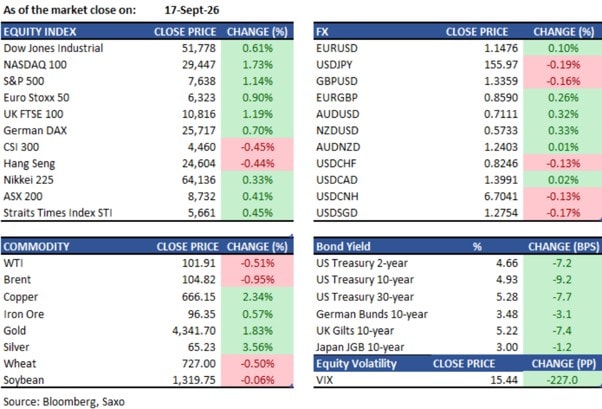
- US (Thursday close): US equities posted their best session in six weeks on Thursday, with the S&P 500 rising 1.1% to 7,637.76, the Nasdaq 100 climbing 1.7% to 29,447, and the Dow Jones gaining 0.6% to 51,778. The Philadelphia Semiconductor Index surged 3.1%, led by Nvidia (+~2.5%) after CEO Jensen Huang said the company expects to sell twice as many chips next year. Berkshire Hathaway was a notable laggard, weighing on financials. In after-hours trading, Steel Dynamics fell 3.4% and Nucor dropped 3.7% after both steel producers issued Q3 EPS guidance below consensus estimates. Intuit reported in-line Q1 revenue guidance of $4.29–4.31bn.
- EU (Thursday close): European equities advanced for a second consecutive session, buoyed by the Fed's inflation-fighting commitment and a pullback in oil. The Stoxx 600 rose 0.9% to 642.60, the DAX gained 0.7% to 25,717, the CAC 40 added 0.6% to 8,187, and the FTSE 100 climbed 1.2% to 10,816 after the BoE held rates. ASML led the Stoxx 600 higher, while Allegro.eu surged 9.5% to a 52-week high. Man Group rose as much as 6% after a UBS upgrade. Raiffeisen Bank was among the notable decliners. The OMX Stockholm 30 rose 1.3%, led by Swedbank (+2.6%) and Boliden (+3.3%).
- Asia (Friday open): Asian equities are tracking Wall Street's rally, supported by lower oil prices and cooling Treasury yields. The Kospi opened sharply higher, rising 2.5% to 6,886 at the open, driven by Korean memory chipmakers on the back of Nvidia's bullish chip demand outlook. The Nikkei 225 is trading around 64,136, with attention focused on the BOJ rate decision due later today — a 25bp hike to 1.25% is fully priced in, though markets are watching Governor Ueda's press conference for forward guidance. The Hang Seng closed Thursday at 24,604 (-0.4%), weighed by Tencent (-1.7%) and Laopu Gold (-3.0%), though mainland investors bought a net HK$3.36bn via Stock Connect for a ninth consecutive session. Huawei announced over 10 new AI chipsets at its annual summit in Shanghai, accelerating the launch of its Ascend 960DT chip to Q1 2027.
Earnings this week:
FX:
- The dollar stayed firm post‑Fed, keeping USDJPY elevated around 156.2 (with Citi eyeing upside toward 159 if the BOJ disappoints), weighing on EURUSD near 1.148 amid weaker French OATs and political risk, and pushing GBPUSD down to 1.336 after leading G10 losses despite some short covering post‑BoE; in contrast, AUDUSD firmed to about 0.712 on hawkish RBA expectations, while USDCNH held steady around 6.70, supported by the PBOC fix and continued northbound Stock Connect inflows.
Commodities:
- Oil fell for a third day, with Brent near $104.8/bbl and WTI around $101.2, as Saudi plans to restore about half of its East-West pipeline capacity and easing Middle East risks unwind the recent price premium. Gold jumped to about $4,346/oz after spiking to $4,380, helped by lower Treasury yields and a softer dollar post-Fed. Copper remains volatile as traders await a US decision on refined copper tariffs, keeping pressure on names like Freeport-McMoRan and Southern Copper after LME prices previously hit a record $14,617/ton on tariff bets.
Fixed income:
- US Treasury yields snapped an eight-day rise Thursday, with the 10-year down about 9 bps to 4.93%, the 30-year at 5.29% and the 1-year at 4.38%, helped by weaker oil and the BoE’s hold boosting gilts and Treasuries. A $19bn 10-year TIPS auction tailed at 2.653%, the highest since 2008 and ~2 bps above WI, with softer indirect demand. A Bloomberg survey shows over 60% of respondents expect the 10-year above 5% by end-2026 (median 5.1%); KKR lifted its year-end target to 5.1%, and Jeffrey Gundlach warned a future US recession could spark a fiscal-driven surge in long yields.
For a global look at markets – go to Inspiration.
This content is marketing content and should not be considered investment advice. Trading financial instruments carries risks and historic performance is not a guarantee for future performance.
The instrument(s) mentioned in this content may be issued by a partner, from which Saxo receives promotion, payment or retrocessions. While Saxo receives compensation from these partnerships, all content is conducted with the intention of providing clients with valuable options and information.