
You can access both of our platforms from a single Saxo account.

Asia Market Quick Take – 03 July, 2026

Asia Market Quick Take – 3 July, 2026
Key points:
- Macro: NFP slows sharply at 57k vs forecasts of 110k.
- Equities: Tesla falls 7.5% despite strong deliveries
- FX: USD mixed; USDJPY 161.43, GBP outperforms as EURGBP breaks 0.86
- Commodities: Gold above $4,100 after NFP
- Fixed income: Front end treasuries rally after NFP
------------------------------------------------------------------
Disclaimer: Past performance does not indicate future performance.
Macro:
- The US added 57K jobs in June 2026, a four‑month low and below May’s revised 129K and the 113K forecast, but near the 12‑month average. Gains in professional and business services, social assistance, and health care were offset by a 61K drop in leisure and hospitality, while other sectors were flat. April–May payrolls were revised down by 74K.
- Unemployment rate fell to 4.2% in June 2026 from 4.3%, largely because the labor force shrank. Unemployment dropped by 213,000, but employment fell by 507,000 and the labor force by 720,000, pulling participation down to 61.5% and the employment rate to 59.0%.
- US jobless claims dipped by 1,000 in the last full week of June to below the 220,000 forecast, a five‑week low, while continuing claims rose by 2,000 to 1,814,000, a three‑month high but still low by historical standards. Federal employee claims inched up to 44.
- US factory orders fell 1.3% in May 2026 after a 5.3% April surge, less than the expected 1.8% drop. A 4.5% decline in durable goods, driven by a 14% fall in transportation equipment and a 51.8% plunge in nondefense aircraft orders, led the decrease. Ex‑transportation, orders rose 1.9%, with gains in fabricated metals, machinery, and computers/electronics, while nondurable goods orders rose 2.2%.
- Australia’s services PMI was revised up to 50.5 in June 2026 from 49.9 and 48.7 in May, signaling marginal expansion. Employment rose modestly, but new orders and export demand fell again. Fuel-driven input costs increased, though both input and output price inflation eased, and sentiment slid to its lowest since November 2023.
Equities:
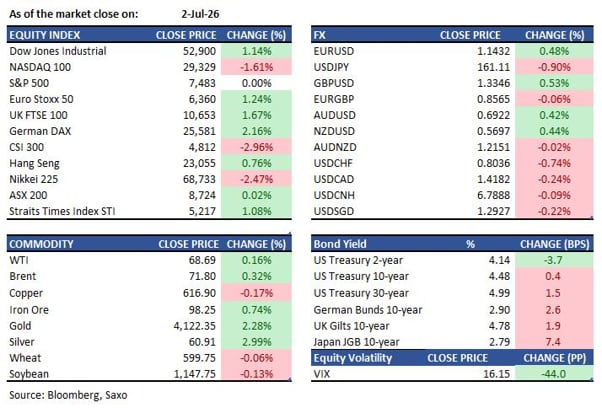
- US — On Thursday, the Dow Jones Industrial Average climbed 1.1% to a record high of 52,900, while S&P 500 closed virtually flat at 7,483 as a semiconductor rout offset broad market gains. Nasdaq 100 fell 1.6%, dragged by the Philadelphia Semiconductor Index, which shed 5.4%. Tesla was the standout decliner, closing down 7.5% in its worst session in nearly a year. Apple surged 4.8%, while Meta fell 4.5% and Nvidia slipped 2.3%. Genuine Parts rose 12.9%, the largest single-stock gain in the S&P 500. US markets are closed Friday for the Independence Day holiday.
- EU — European equities rallied strongly on Thursday, with the Stoxx Europe 600 rising 1.4% to a fresh record at 648.35, led by healthcare and financials as investors rotated out of technology. The DAX surged 2.2% to 25,580, the FTSE 100 gained 1.7% to 10,652, and the CAC 40 rose 1.65% to 8,474. Bayer was the standout mover, jumping 8.9% after an upgrade and further steps to cap litigation risk. AstraZeneca added 4.9%. Technology was the only sector to decline, tracking weakness in US and Korean chip names. Saab rose 8.6% on the Stockholm exchange.
- Asia — Asian markets were sharply mixed on Thursday, dominated by a brutal chip-driven selloff in South Korea. The Kospi plunged 7.9% to 7,648, its second consecutive large decline, with SK Hynix losing 14.6% and Samsung Electronics falling 9.1% — the two stocks combined shedding approximately $290 billion in market value. Korea Exchange temporarily suspended program selling. The Nikkei also fell as the tech rout spread regionally, with TSMC and Kioxia among the decliners. The Straits Times Index bucked the trend, rising 1.1% to 5,217 on optimism around US-Iran peace talks, with ST Engineering the top gainer at +2.7%. On Friday morning, the Kospi is attempting to stabilise, trading up approximately 1.5% to 7,763 in early trade, with South Korea also reportedly considering using semiconductor tax revenues to fund a sovereign AI model.
Earnings this week:
- Friday – US market closed
FX:
- The USD traded mixed-to-stronger overnight, with USDJPY leading moves as it climbed 0.24% to 161.43, bringing the pair closer to the intervention-sensitive 162–163 area that has markets on edge ahead of the US Independence Day holiday. USD against other majors, gains were subdued: AUDUSD slipped to 0.6910 (‑0.10%), EURUSD to 1.1420 (‑0.09%), GBPUSD to 1.3340 (‑0.07%).
- GBP strengthened against both the USD and the EUR, extending its winning streak versus EUR to a fourth consecutive session. EURGBP broke below the key 0.86 support level, triggering unwinds of previously bullish euro–pound options positions. GBPUSD traded near 1.3340.
- The yuan was broadly stable overnight, with USDCNH inching just 0.01% higher. The PBOC maintained a steady daily fixing, while Fed Chair Warsh’s remarks that inflation risks have “receded in recent weeks” helped limit further dollar upside.
Commodities:
- Gold held two days of gains, trading around $4,130/oz after surging 2.3% on Thursday — its largest single-day move in three weeks — as the weak payrolls data reduced the probability of near-term Fed rate hikes. UBS cut its year-end gold forecast by $600 to $5,000/oz, citing higher rates and a stronger dollar as headwinds, while maintaining a $4,000–$5,000/oz trading range view.
- Oil prices continued to slide as Saudi Arabia's crude exports recovered to approximately 90% of pre-war levels, with six supertankers transiting the Strait of Hormuz. Citi reiterated a recommendation to sell summer rallies and forecast Brent falling to $60–$65/bbl by year-end, contingent on the US-Iran MoU holding.
- Iron ore futures briefly topped $100/ton in Singapore overnight, rising as much as 3.8% to $101.20/ton, after China's state-backed buyer CMRG signalled it may restrict some Fortescue inventory held at mainland ports, before paring gains through the Thursday session.
Fixed income:
- Treasuries twist-steepened on Thursday following the payrolls miss, with the front-end rallying sharply — the 2-year yield fell approximately 6 basis points to 4.11% and the 1-year yield fell ~4 basis points to 3.94% — while the long end cheapened slightly, with the 30-year yield rising ~1.4 basis points to 4.99%. The 10-year yield ended little changed at around 4.49%.
- The curve steepened materially, with the 5s30s spread widening approximately 2 basis points on the day to 75.5 basis points, as rate-hike premium faded at the front end while long-end inflation concerns persisted. US 10-year real yields fell 1.3 basis points to 2.24%, though they remain 31 basis points higher year-to-date.
- Treasury bill auctions of $85 billion in 4-week and $85 billion in 8-week bills were supported by the soft jobs data, with record money-market fund assets of $7.95 trillion providing a potential demand cushion. Barclays estimates the Treasury may need to fund an additional $30–$35 billion in tariff refunds in July, though this is not expected to alter its forecast for $250 billion in net bill issuance to private investors this month.
For a global look at markets – go to Inspiration.
This content is marketing content and should not be considered investment advice. Trading financial instruments carries risks and historic performance is not a guarantee for future performance. The instrument(s) mentioned in this content may be issued by a partner, from which Saxo receives promotion, payment or retrocessions. While Saxo receives compensation from these partnerships, all content is conducted with the intention of providing clients with valuable options and information.