
You can access both of our platforms from a single Saxo account.

Stop-loss orders: insurance with a gap in the cover

Summary: A stop-loss feels like insurance for your shares. It mostly is, with one gap in the cover: it guarantees that you sell, not the price you sell at. How stops work, the gap, and two refinements.
A stop-loss promises you will get out. It does not promise the price.
A stop-loss feels like insurance. You set it once, and you can stop worrying about a falling share price. In most markets it does that job well. It also has one gap in the cover, and it is better to know about it before you need it.
What a stop order does
You choose a trigger price below today’s price. If the share trades down to that price, your stop becomes a market order to sell. A market order sells at the next available price, whatever that turns out to be.
Read that last part twice. The stop price is the trigger. It is not the price you are promised.
Why stops are useful
Stops give you discipline. You decide in advance how much of a fall you will accept, so you do not have to decide while the price is dropping and emotions run high. You do not need to watch the screen all day. In a normal, liquid market, prices move in small steps, so the sale happens close to your trigger. That limits the loss to roughly what you planned.
The gap
Now take Fictitious Inc. You own 100 shares and you have a stop at 88. The company announces bad news after the market has closed. The next morning the share opens at 78.
The price never traded at 88. It jumped straight past it. Your stop triggers at the open and becomes a market order, so it is filled near 78, not at 88. That is about 10 per share, or roughly 1,000 on 100 shares, worse than the loss you planned for.
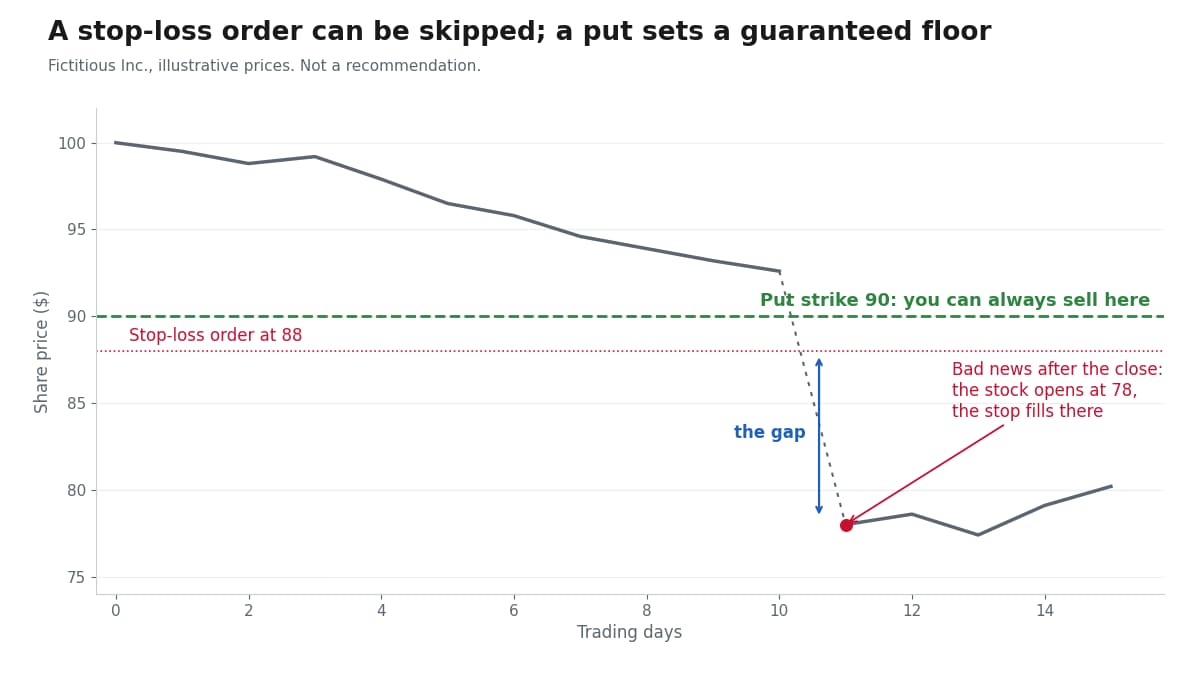 Illustrative example with a fictitious company and made-up prices. Not a recommendation.
The stop guaranteed a sale. It did not guarantee a price. The same thing can happen in a fast market during the day, when prices move quicker than orders can be filled.
A stop-loss does not protect you against a gap. The sale price can be well below your stop price, and the loss can be larger than you intended.
Two refinements
A stop-limit order adds a price floor to the sale. You set a trigger and also a lowest price you accept. This protects you from a bad fill, but it creates a new problem. If the share gaps below your limit, the order may not be filled at all. You are then still holding a share that keeps falling.
A trailing stop follows the price up but never down. Say you set it 10% below the highest price reached. As the share rises, the stop rises with it. If the share falls, the stop stays where it is. When the price drops 10% from its peak, the stop triggers. This helps you lock in gains without resetting the order by hand.
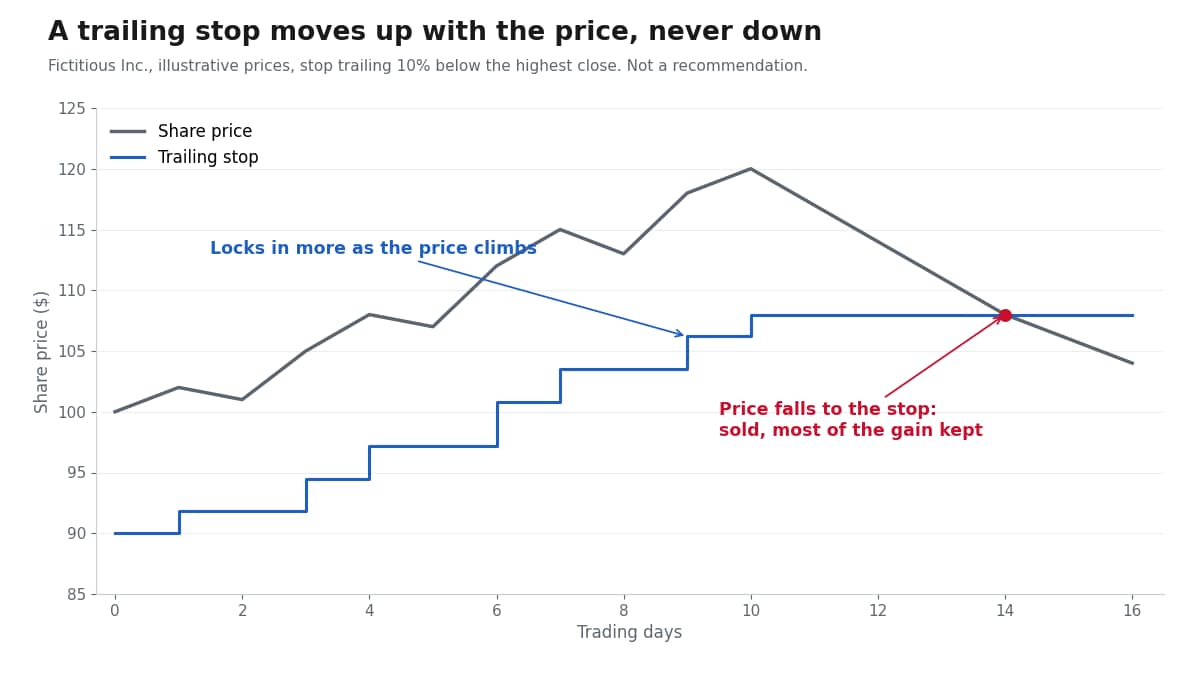 Illustrative example with a fictitious company and made-up prices. Not a recommendation.
A trailing stop has the same weakness as any stop. If the price gaps below it, the sale happens at the next available price.
Stop-limit and trailing orders reduce some risks, but neither removes gap risk. A stop-limit order may not execute at all.
Where stops fit
Stops work best on liquid shares in normal markets, as a tool for discipline. They are less reliable around events that can move a price overnight, such as earnings reports and surprise news. They are also less reliable in thinly traded shares, where there may be few buyers at any given price.
Think of a stop as a rule you set for yourself, not as a guarantee.
If you need the price to hold
Some investors want a price that holds even through a gap. For that, the tool is a protective put. It gives you the right to sell at a fixed price whatever happens, for a known cost. In the chart above, the put floor sits at 90, so the gap down to 78 would not change the price you can sell at. Our step-by-step guide to protective puts shows how it works.
Options carry a high risk of rapid loss and are not suitable for every investor.
Important note: The strategies and examples provided in this article are purely for educational purposes. They are intended to assist in shaping your thought process and should not be replicated or implemented without careful consideration. Every investor or trader must conduct their own due diligence and take into account their unique financial situation, risk tolerance, and investment objectives before making any decisions. Remember, investing in the stock market carries risk, and it’s crucial to make informed decisions.
Fictitious Inc. is a hypothetical company, and all prices are illustrative.
| Related articles/content |
|---|
| Protective puts step by step insurance for your shares | 26 Nov 2026 |
| More from the author |
|---|