
Un seul compte Saxo suffit pour accéder à nos plateformes.

Shell into second-quarter earnings: two ways to use options for income
Options

Résumé: Shell has rallied back to the top of its range just as second-quarter results land on 30 July. The options market is pricing a real move, so can a holder be paid to wait for it?
You hold Shell for the exposure and the dividend. Can the options market pay you something extra while you wait for the second-quarter results?
Shell (SHELL:xams, the Amsterdam listing) has rallied back toward the top of its range, trading around EUR 39.10 into its second-quarter report (Source: Saxo and Bloomberg, 23 July 2026). The stock fell to roughly EUR 34 in late June, then recovered through July to sit above both its 50-day and 200-day moving averages, close to the EUR 40 to 41 area that capped it earlier in the year. Shell is scheduled to report second-quarter 2026 results, and to declare its second-quarter interim dividend, on 30 July 2026 (Source: Shell advance notice).
Past performance is not indicative of future results.
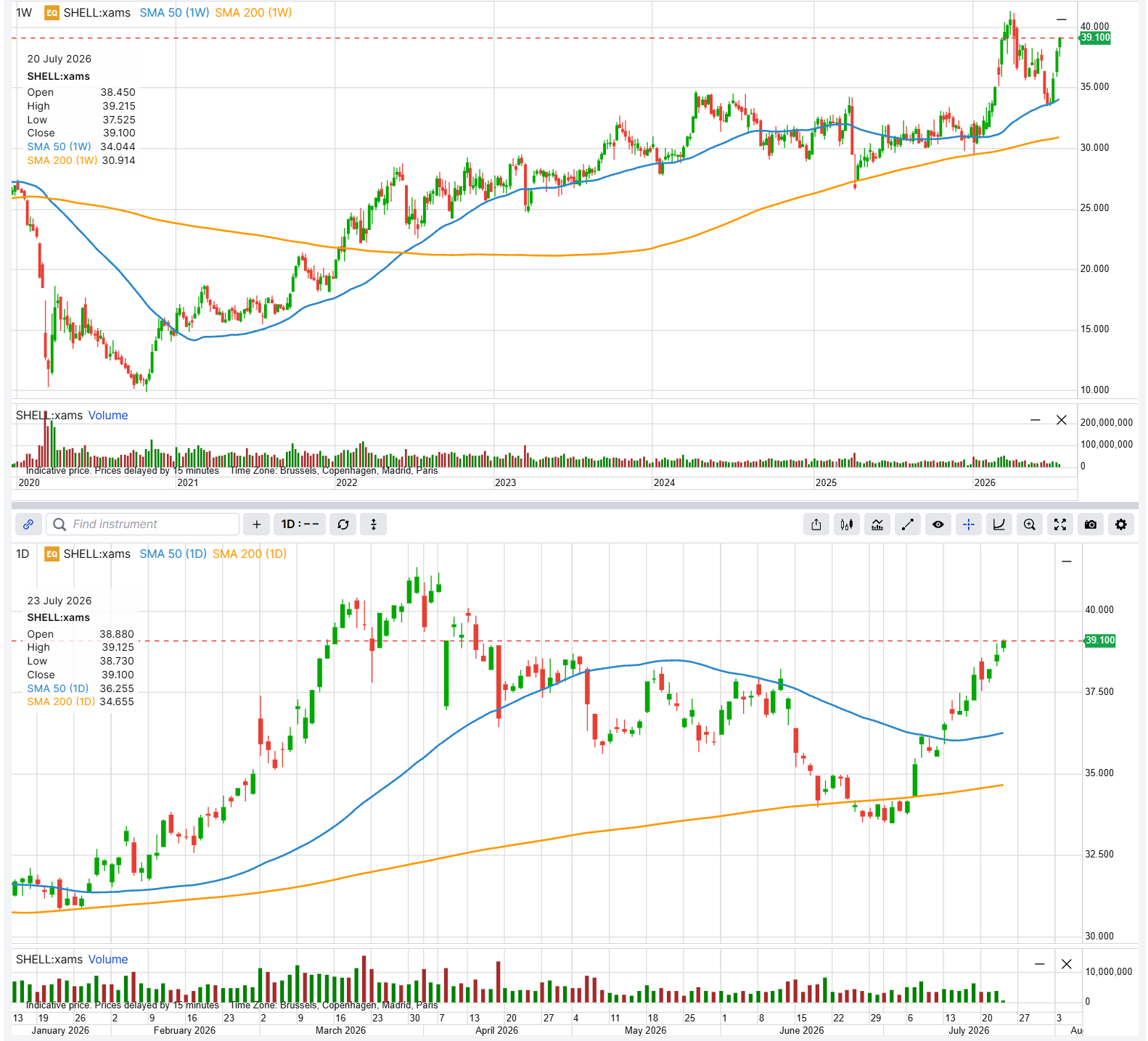
Shell (SHELL:xams) weekly since 2020 and daily year-to-date, trading around EUR 39.10 on 23 July 2026. The shares sit above both the 50-day and 200-day moving averages, near the EUR 40 to 41 area that has capped them this year. Source: Saxo, 23 July 2026. Illustrative and educational only, not predictive. Past performance is not indicative of future results.
For a long-term holder, results season is a familiar mix of opportunity and nerves. Investors may want to keep the shares and the dividend, while the report remains a known event that can move the price sharply in either direction. Options give an investor a way to act on a view they already hold, whether that view is a willingness to sell a little higher or to buy a little lower.
What the options market is pricing
The examples below use the standard monthly expiry of 21 August 2026, the third Friday of the month, which falls after the 30 July results. The reporting date and the expiry date are different, and a position held over 21 August spans the announcement and the weeks after it.
A common way to estimate the market-implied move is to add the at-the-money call premium and the at-the-money put premium for the expiry that captures the event. For 21 August, the EUR 39 call trades around EUR 1.21 and the EUR 39 put around EUR 1.25, a combined EUR 2.46 (Source: SaxoTraderPRO option chain, 23 July 2026). That points to a move of roughly 6% of the share price in either direction between now and expiry. Future outcomes are uncertain and may result in losses.
Implied volatility helps put that in context. Shell's 30-day implied volatility sits near 24.75%, with an implied volatility rank of about 53 over the past year (Source: Bloomberg, 23 July 2026). In our view that reads as a moderate rather than extreme level: above the one-year average near 22%, though well below the March peak above 32%. Option premiums appear a little richer than usual because the results fall inside the window, without pricing a crisis.
Important note: The strategies and examples provided in this article are purely for educational purposes. They are intended to assist in shaping your thought process and should not be replicated or implemented without careful consideration. Every investor or trader must conduct their own due diligence and take into account their unique financial situation, risk tolerance, and investment objectives before making any decisions. Remember, investing in the stock market carries risk, and it’s crucial to make informed decisions.
The following examples are hypothetical and for educational use only; they are not advice or trade recommendations.
Income while you hold: the covered call
Consider an investor who owns 100 Shell shares, is comfortable holding through the report, and would be content to sell around EUR 41, a level the stock has struggled to clear this year. A covered call collects a premium today in exchange for agreeing to sell at that price if the shares finish above it. The EUR 41 strike sits near the upper edge of the range the chain is pricing.
Example structure (illustrative only – not a trade recommendation)
- Hold 100 shares of Shell at EUR 39.10, a position value of EUR 3,910
- Sell 1 Shell call, 21 August 2026 expiry, EUR 41 strike, at a mid price of about EUR 0.505 per share (bid 0.49, ask 0.52; implied volatility about 28%, delta about 0.28; open interest 506 contracts)
- Premium received: approximately EUR 50 (EUR 0.505 multiplied by 100 shares)
- Maximum gain if the shares are called away: approximately EUR 240, combining the premium and about EUR 190 of share appreciation to the strike
- Maximum loss: approximately EUR 3,860, the full position value less the premium, if the shares fell to zero
- Break-even on the share position: approximately EUR 38.59
- Risk: below the break-even the investor keeps the full downside of the shares, offset only by the premium, while the upside above EUR 41 is capped, and the short call carries early-assignment risk
- All figures are hypothetical and for education only. Past performance is not indicative of future results; figures are illustrative and not predictive.
- Costs and charges apply to each leg; see Saxo pricing for full details.
The premium of about EUR 0.505 per share is roughly 1.3% of the current share price, collected for a holding period of about four weeks, and it lands on top of the dividend the shares already pay. That is the appeal of using calls to enhance the yield on a holding: the income may arrive whether or not the stock rises. The trade-off matters as well. Selling the call caps upside above EUR 41, so a strong post-results rally would be left on the table.
The investor retains the full downside risk of holding the shares; the premium received provides a partial offset, but it does not protect against a significant decline in the stock price. Theta, or time decay, works in the seller's favour here: the option loses a small amount of value each day, which benefits the seller.
Strategy insight – selling into strength. Placing the strike near a level the stock has repeatedly failed to clear means agreeing to sell where sellers have shown up before, which can make the capped upside easier to accept. The risk is the mirror image: if the results are strong enough to break that ceiling decisively, the shares are called away and the extension above EUR 41 is missed. Illustrative only, not a trade recommendation.
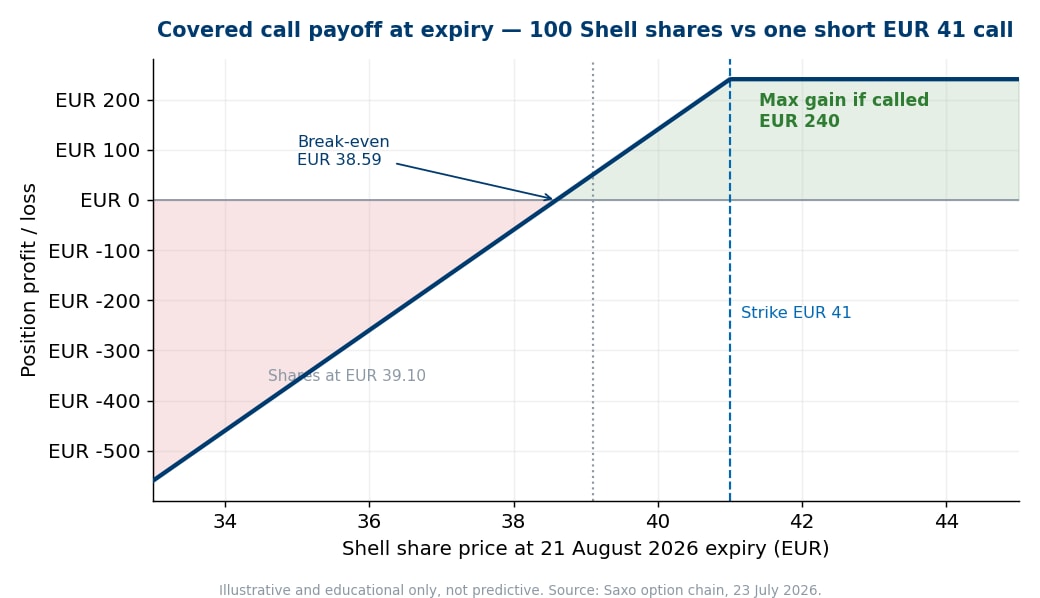 Covered call payoff at expiry, 100 Shell shares against one short EUR 41 call, 21 August 2026. Source: Saxo option chain, 23 July 2026. Illustrative and educational only, not predictive. Past performance is not indicative of future results; figures are illustrative and not predictive.
Getting paid to buy: the cash-secured put
Consider instead an investor who does not own Shell yet but would like to, and who thinks the results could offer a better entry. A cash-secured put pays a premium today in exchange for agreeing to buy the shares at a lower price if they fall there by expiry. The EUR 37 strike sits near the lower edge of the range the chain is pricing.
Example structure (illustrative only – not a trade recommendation)
- Sell 1 Shell put, 21 August 2026 expiry, EUR 37 strike, at a mid price of about EUR 0.46 per share (bid 0.44, ask 0.48; implied volatility about 28%, delta about -0.25; open interest 3,255 contracts)
- Premium received: approximately EUR 46 (EUR 0.46 multiplied by 100 shares)
- Cash set aside: EUR 3,700
- Maximum profit: approximately EUR 46, if the put expires worthless
- Maximum loss: approximately EUR 3,654 if the shares fell to zero
- Effective purchase price if assigned: approximately EUR 36.54, around 6.5% below the current price
- Risk: if Shell falls below EUR 37 the seller is obliged to buy at an effective EUR 36.54 and can lose further if the stock keeps dropping, and the contract is American-style so assignment may occur before expiry
- All figures are hypothetical and for education only. Past performance is not indicative of future results; figures are illustrative and not predictive.
- Costs and charges apply to each leg; see Saxo pricing for full details.
Selling a cash-secured put means agreeing to buy 100 shares at EUR 37 if the stock falls there by expiry. In exchange, the seller collects the premium today, again roughly 1.2% of the cash committed for about four weeks. If Shell holds above EUR 37, the put expires worthless and the premium is kept as income. If it falls below EUR 37, the shares are bought at an effective EUR 36.54 once the premium is counted, and the dividend starts to accrue to the new owner.
The risk is real: owning the stock at that price if it keeps falling, so this suits an investor who genuinely wants the shares, not one reaching for premium alone. As with the call, time decay works in the seller's favour.
Strategy insight – choosing an entry. The EUR 37 strike sits just below the July breakout and near where the 50-day average and the recent base meet, a level where buyers have recently stepped in. The seller is paid to set a limit order they were willing to place anyway. The catch is that a large, results-driven drop could take the stock well below EUR 37, leaving the investor holding shares already showing a loss. Illustrative only, not a trade recommendation.
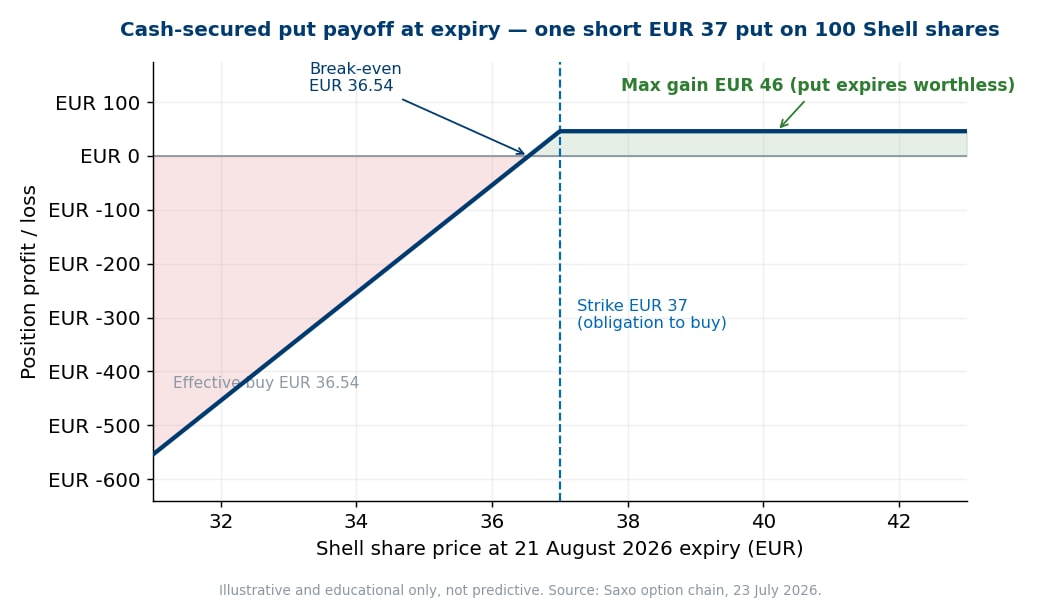 Cash-secured put payoff at expiry, one short EUR 37 put on 100 Shell shares, 21 August 2026. Source: Saxo option chain, 23 July 2026. Illustrative and educational only, not predictive. Past performance is not indicative of future results; figures are illustrative and not predictive.
Before you trade
Both strikes sit on the more liquid standard monthly series, with open interest of 506 contracts on the EUR 41 call and 3,255 on the EUR 37 put (Source: SaxoTraderPRO option chain, 23 July 2026). Even so, the entry price can matter as much as the strategy choice. Options carry a high risk of rapid loss and are not suitable for every investor.
Before placing the trade, check
- Bid and ask spreads, since wide spreads can erode the premium at entry
- Volume and open interest at the specific strike and expiry chosen
- That the 21 August 2026 expiry is a standard monthly, which it is, rather than a weekly
- Whether the 30 July results are released before or after the market opens
- Implied volatility relative to how much Shell typically moves
- An exit plan, defined before entering the position
See Saxo pricing for costs and applicable charges: pricing overview.
Assignment risk note: Because Shell options are American-style, a short call or put can be assigned before expiry if it moves in the money, particularly close to expiration or around ex-dividend dates. Since Shell declares its interim dividend with these results, an investor holding a short call should monitor it carefully and understand the platform's assignment process. The seller of the option carries the assignment obligation; the buyer of a put or call does not.
Final thoughts
Neither of these strategies is a shortcut to quick profit. They are ways to act on a view an investor already holds about a stock they already follow: a willingness to sell a little higher, or to buy a little lower. The premium is a modest, illustrative supplement to the returns a Shell holding may already provide, not a guaranteed yield, and each strategy carries a clear obligation in exchange. Options carry a high risk of rapid loss and are not suitable for every investor.
Both positions can often be managed before expiry if the picture changes. A covered call can be bought back to keep the upside, and a cash-secured put can be closed if the view on the entry shifts. The point of options here is not to predict the 30 July results, but to decide in advance what an investor would happily do at a higher or lower price, and to be paid a little for the patience. Past performance is not indicative of future results.
This content is marketing material and should not be regarded as investment advice. Trading financial instruments carries risks and historic performance is not a guarantee of future results.
The author does not hold positions in any of the instruments mentioned in this article.
The Author is permitted to wait at least 24 hours from the time of the publication before they trade the instruments themselves.
The instrument(s) referenced in this content may be issued by a partner, from whom Saxo receives promotional fees, payment or retrocessions. While Saxo may receive compensation from these partnerships, all content is created with the aim of providing clients with valuable information and options.
This content will not be changed or subject to review after publication.
| Related articles/content |
|---|
| LVMH through results season what mini options change for a smaller portfolio | 22 Jul 2026 Options on leveraged ETFs how investors actually use them | 7 Jul 2026 Adding options to your portfolio what actually changes | 26 Jun 2026 Protecting your gains without selling how to hedge a tech portfolio with options | 19 Jun 2026 What investors misunderstand about covered calls | 10 Jun 2026 Covered call or cash-secured put | 2 Jun 2026 From shareholder to options user | 26 May 2026 |
| More from the author |
|---|