
Un seul compte Saxo suffit pour accéder à nos plateformes.

PayPal earnings: trading the expected move with options
Options 10 minutes to read

PayPal earnings: trading the expected move with options
PayPal reports first-quarter earnings on 5 May 2026, before the US market opens. For options traders, the setup is useful because the stock is near USD 50, the chart is trying to stabilise after a long decline, and the options market is pricing in a meaningful move.
This article is not a prediction and not a recommendation. It is an educational case study using option prices observed on 29 April 2026, when PYPL traded around USD 50. Prices, implied volatility, bid-ask spreads and risk/reward figures will likely differ by the time this article is read, especially if it is published on 4 May, the day before earnings.
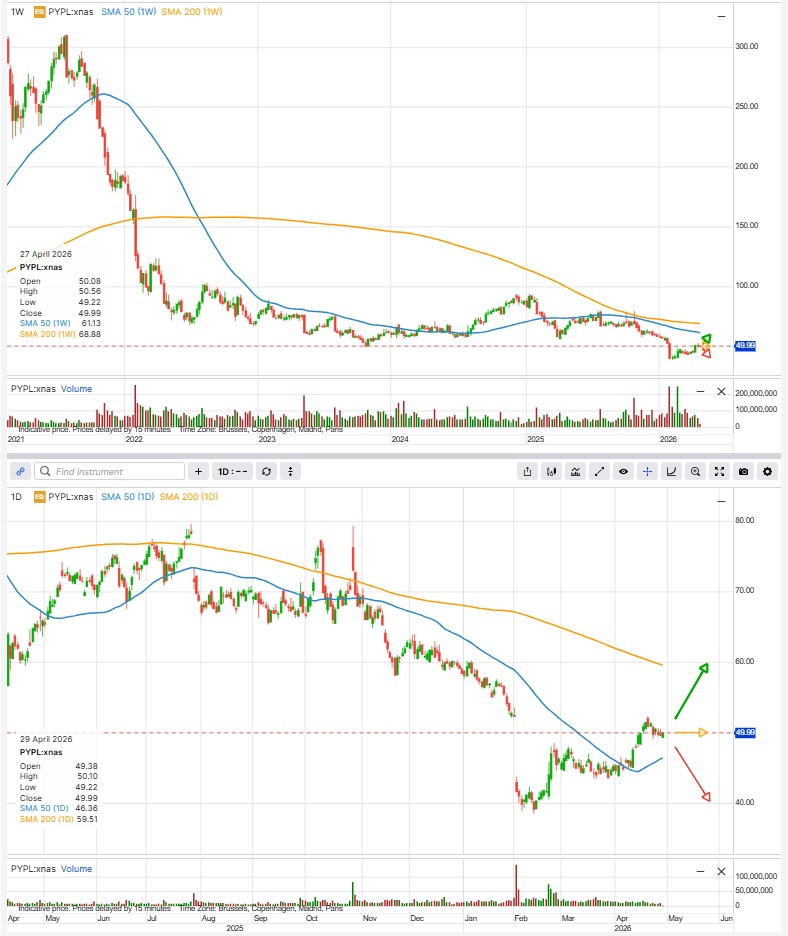
PayPal remains below its longer-term moving averages, while the daily chart shows a short-term recovery attempt near USD 50 ahead of earnings. Source: SaxoTrader
Why the 15 May expiry?
The first weekly expiry after earnings, 8 May, gives the cleanest read on the market’s expected earnings move. The examples below use the 15 May 2026 expiry instead.
That choice is deliberate. The 15 May expiry gives the trades more time, wider strike flexibility and more usable option premiums. The trade-off is that the implied move for 15 May reflects the earnings event plus several post-earnings trading days. It should not be described as a pure one-day earnings move.
For the article examples, the important strikes are USD 40, USD 45, USD 50, USD 55 and USD 60.
A simple way to estimate the options market’s expected move is to add the price of the at-the-money call and the at-the-money put for the chosen expiry. This is not a forecast and it is not a guarantee; it is a market-implied estimate based on what traders are currently willing to pay for upside and downside exposure. With PYPL trading near USD 50, the 15 May USD 50 call and USD 50 put together give a rough indication of the move the options market is pricing through that expiry. That expected range helps explain the strike selection in the examples below: the USD 45 and USD 55 strikes sit around the central range, while the USD 40 and USD 60 strikes define the wider risk boundaries for the spreads.
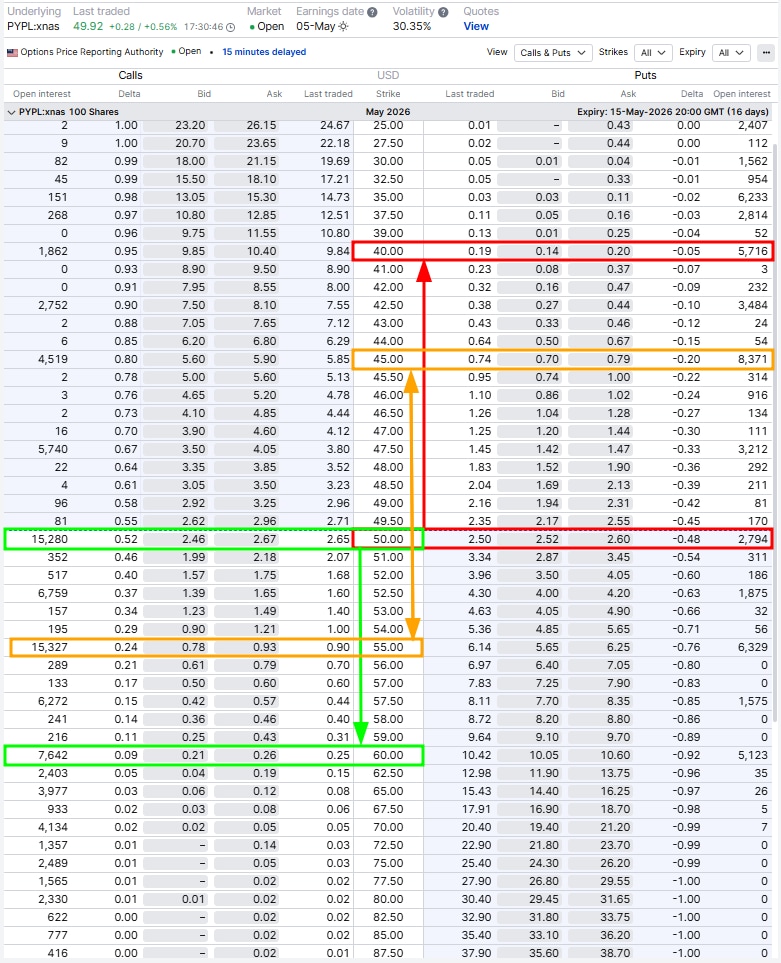
The 15 May option chain highlights the strikes used in the examples: USD 40, USD 45, USD 50, USD 55 and USD 60. Prices were observed on 29 April 2026 and are not live quotes. Source:SaxoTrader
The options question
Around earnings, the key question is not only direction. It is whether the realised move will be larger, smaller or more directional than the options market already prices in.
Long option strategies need a large enough move to overcome the post-earnings drop in implied volatility, often called IV crush. Short-premium strategies benefit from that volatility decline, but can suffer if the stock gaps through the expected range. Defined-risk spreads help make that trade-off more transparent.
Important note: The strategies and examples provided in this article are purely for educational purposes. They are intended to assist in shaping your thought process and should not be replicated or implemented without careful consideration. Every investor or trader must conduct their own due diligence and take into account their unique financial situation, risk tolerance, and investment objectives before making any decisions. Remember, investing in the stock market carries risk, and it’s crucial to make informed decisions.
Below are three ways to frame the same event.
Bullish view: bull call spread
A bull call spread may fit a trader who expects a positive earnings reaction but wants defined risk and a lower cost than buying a call outright.
Example using the 15 May 2026 expiry:
- Buy the USD 50 call
- Sell the USD 60 call
- Net debit: about USD 2.40 per share, or USD 240 per standard contract
- Maximum risk: about USD 240
- Maximum profit: about USD 760
- Breakeven at expiry: about USD 52.40
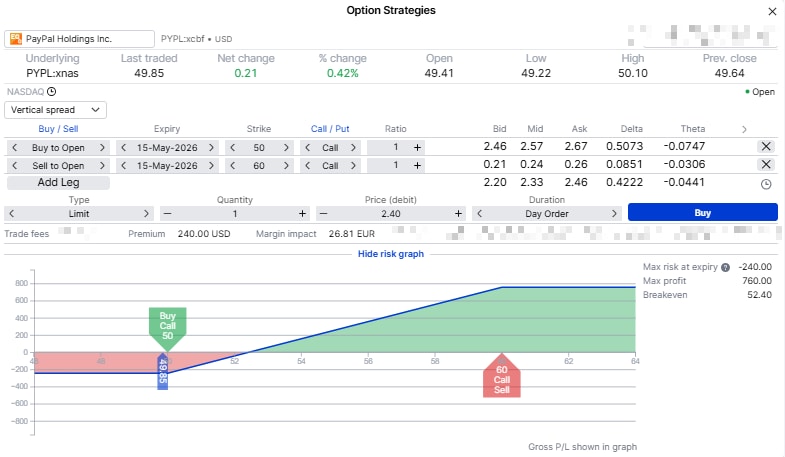
Example bull call spread: long the USD 50 call and short the USD 60 call, using the 15 May 2026 expiry, for an indicative debit of about USD 2.40 per share. Source: SaxoTrader
The long call gives upside exposure. The short call reduces the cost but caps the profit above USD 60. This structure is useful when the trader expects upside, but not unlimited upside.
The risk is simple: if PayPal stays below the breakeven level, the spread loses money. If the stock is below USD 50 at expiry, the spread can expire worthless.
Bearish view: bear put spread
A bear put spread may fit a trader who expects disappointment, weaker guidance or a renewed downside move after earnings.
Example using the 15 May 2026 expiry:
- Buy the USD 50 put
- Sell the USD 40 put
- Net debit: about USD 2.35 per share, or USD 235 per standard contract
- Maximum risk: about USD 235
- Maximum profit: about USD 765
- Breakeven at expiry: about USD 47.65
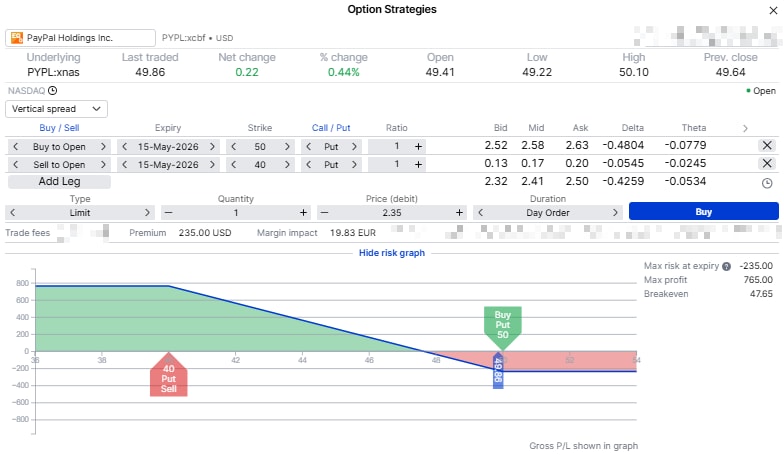
Example bear put spread: long the USD 50 put and short the USD 40 put, using the 15 May 2026 expiry, for an indicative debit of about USD 2.35 per share. Source: SaxoTrader
The long put benefits if the stock falls. The short put reduces the cost, but caps the profit below USD 40. That can be sensible around earnings because long options are expensive before the event and lose implied volatility value afterwards.
The risk is a flat or positive reaction. If PayPal rallies, or simply does not fall enough, the spread can lose most or all of the debit paid.
Neutral view: iron condor
An iron condor may fit a trader who believes the market is pricing too much movement and that PayPal will remain inside a defined range after earnings.
Example using the 15 May 2026 expiry:
- Sell the USD 45 put
- Buy the USD 40 put
- Sell the USD 55 call
- Buy the USD 60 call
- Net credit: about USD 1.22 per share, or USD 122 per standard contract
- Maximum profit: about USD 122
- Maximum risk: about USD 378
- Lower breakeven at expiry: about USD 43.78
- Upper breakeven at expiry: about USD 56.22
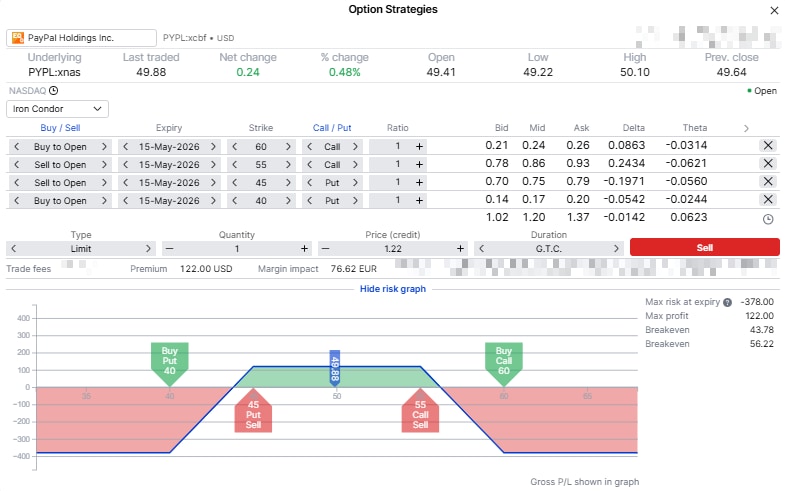
Example iron condor: short the USD 45 put and USD 55 call, protected by the USD 40 put and USD 60 call, using the 15 May 2026 expiry, for an indicative credit of about USD 1.22 per share. Source: SaxoTrader
The trade benefits if the stock stays between the short strikes and implied volatility falls after earnings. It is not a “safe” trade. It is a defined-risk range trade.
The main risk is a larger-than-expected move. If PayPal gaps below USD 45 or above USD 55, one side of the structure can come under pressure quickly. The maximum loss is capped, but it is larger than the maximum profit.
Comparing the structures
| Strategy | Market view | Main benefit | Main risk |
|---|---|---|---|
| Bull call spread | Moderately bullish | Defined-risk upside exposure | Stock does not rise enough |
| Bear put spread | Moderately bearish | Defined-risk downside exposure | Stock does not fall enough |
| Iron condor | Range-bound | Benefits from time decay and IV crush | Large move breaches one side |
The point is not to find the perfect strategy. The point is to match the structure to the thesis.
A trader who expects a directional move should usually avoid selling a narrow range. A trader who believes the implied move is too high should understand that one earnings gap can overwhelm a short-premium trade. A trader buying options must remember that being right on direction may still not be enough if the move is too small.
Bottom line
PayPal’s 5 May earnings report is a useful options case study because the stock is near USD 50 and the 15 May option chain offers clean strikes for defined-risk examples.
The bull call spread expresses a positive view. The bear put spread expresses a negative view. The iron condor expresses the view that the market is pricing too much movement.
Start with the thesis, then choose the structure. Around earnings, doing it the other way around is usually where the expensive lessons begin.
This content is marketing material and should not be regarded as investment advice. Trading financial instruments carries risks and historic performance is not a guarantee of future results.
The Author is permitted to wait at least 24 hours from the time of the publication before they trade the instruments themselves.
The instrument(s) referenced in this content may be issued by a partner, from whom Saxo receives promotional fees, payment or retrocessions. While Saxo may receive compensation from these partnerships, all content is created with the aim of providing clients with valuable information and options.
This content will not be changed or subject to review after publication.
The Author is permitted to wait at least 24 hours from the time of the publication before they trade the instruments themselves.
The instrument(s) referenced in this content may be issued by a partner, from whom Saxo receives promotional fees, payment or retrocessions. While Saxo may receive compensation from these partnerships, all content is created with the aim of providing clients with valuable information and options.
This content will not be changed or subject to review after publication.
| Related articles/content |
|---|
| What IV crush really means in practice reviewed version | 9 April 2026 Trading earnings with defined | 31 Mar 2026 ArcelorMittal earnings what a 10 options move can teach traders | 28 April 2026 ASML earnings is the 8 move already priced in | 10 April 2026 ASML earnings - how to think about the setup before the numbers | 10 April 2026 Options Brief - Mag 7 earnings night Fed holds - 29 April 2026 Options Brief - Mag 7 earnings on deck - 28 April 2026 Options Brief - Oil jolt - US records - 23 April 2026 |
| More from the author |
|---|