
You can access both of our platforms from a single Saxo account.

Nvidia slips as one-day volatility cools - Options Brief - 19 November 2026

Summary: Options let go of the premium they carried into Nvidia’s results, more than the clock alone would explain. Yet implied correlation climbed close to its 60-session high. What is the market still paying for?
The one-day volatility gauge fell back below the VIX once Nvidia’s results were out, while implied correlation climbed close to its 60-session high.
MARKET REGIME: NEUTRAL / CHOP | VIX 24.56 | TERM STRUCTURE: FLAT (CASH) | SKEW: ELEVATED (142.84) | FRONT-MONTH VIX FUTURES: 21.95
Today in brief
The premium that options carried into Nvidia’s results came out on Wednesday, and more of it than the clock alone would remove. The one-day volatility gauge, which measures what options charge for protection over the next session, fell 13.38% to 23.25, back below the VIX at 24.56. Today’s S&P 500 expiry prices about 1.12% and Friday’s about 1.55%. Time alone would have taken yesterday’s 2.04% for Friday down to about 1.67%, so in our view traders may have taken premium out of the week rather than added it.
Nvidia was the clearest case. Its options had priced a report-day move of about 7.7%, and the shares fell 2.89% to 150.96 on the first session after a beat, about 0.4 times the price. Its volatility rank, a measure of where its implied volatility sits against its own year, dropped to 59.4 from 100.0. With Nvidia, all twenty-two names on the earnings scorecard have now reported, and 18 of them moved less than their options priced.
One reading cuts the other way. Implied correlation, a gauge of how closely stocks are expected to move together, rose 8.59% to 20.35, just under its 60-session high of 20.93, while SKEW, a gauge of what crash protection on the index costs, eased to 142.84. In our view that may suggest traders still pay for moves in which stocks travel together, though not for a crash. The Fed minutes added to the backdrop, with Governor Waller raising a half-point rise in December.
Backdrop: the S&P 500 fell 0.23% to 7,323.63, a fifth straight loss, and sits further below the range priced for the week, using 177% of it. The typical single name’s volatility rank eased to 37.4 from 40.0, and yesterday’s options flow showed no readable direction in single names and no demand for protection.
That is the whole brief in one read. The sections below hold the detail behind each paragraph, with the charts, the full set of readings and the sources, for when you want to go deeper on one part.
Headline driver
Minutes of the Federal Reserve’s October meeting showed nearly all officials agreed further rate increases would likely be needed, and Governor Waller said a half-point rise should be considered in December, according to the Saxo Market Quick Take. Markets now price three more increases by June 2027, taking the policy rate to 4.50% to 4.75%.
Nvidia fell 2.89% to 150.96 despite strong results and guidance, as investors questioned its leadership transition. UnitedHealth sank 10.2% after proposed tighter Medicare Advantage audits, while TJX gained 8.1% and Palo Alto Networks almost 10%. Copper slumped about 5% to a seven-month low and gold touched a 15-month low near USD 3,694 in Asia this morning.
Market snapshot
- US (Wednesday 18 November close): S&P 500 7,323.63, down 0.23%, a fifth straight decline. Nasdaq 100 27,116.26, up 0.42%. The Dow fell 1.11% to 50,203.03 and the equal-weighted S&P 500 0.12%. Amazon rose 3.82% and the consumer discretionary fund 1.79%, while the health care fund fell 2.20%.
- Europe (Wednesday close): the Stoxx 600 fell 1.03% to 644.06, the Euro Stoxx 50 0.93% to 6,154.40 and the DAX 1.19% to 25,736.24. Miners lost 4.7%, SAP 3.8%, while ASML gained 1.9%.
- Asia (Thursday, 05:00 CET): the Hang Seng was down 1.89% and the Hang Seng Tech index 2.00%, with China’s CSI 300 down 0.49% and the Kospi flat at 0.06%.
- Commodities and rates: Brent traded around USD 92 and gold near its 15-month low, according to the Quick Take. The gold fund fell 3.20% and the gold miners fund 5.97%. The ten-year Treasury yield stood at 5.05% against 5.08% a session earlier, and the two-year at 4.79%.
- Market regime: neutral, with the VIX at 24.56 and the S&P 500 4.25% below its 50-day average.
Index levels and volatility readings from the watchlist export taken at 05:00 CET on 19 November 2026, which carries Wednesday’s US and European closes and early Asian trading; the Fed minutes, single-name moves, European sectors, copper, Brent and gold from the same-morning Saxo Market Quick Take. Past performance is not indicative of future results. Source: Saxo, Bloomberg, CBOE.
Volatility surface
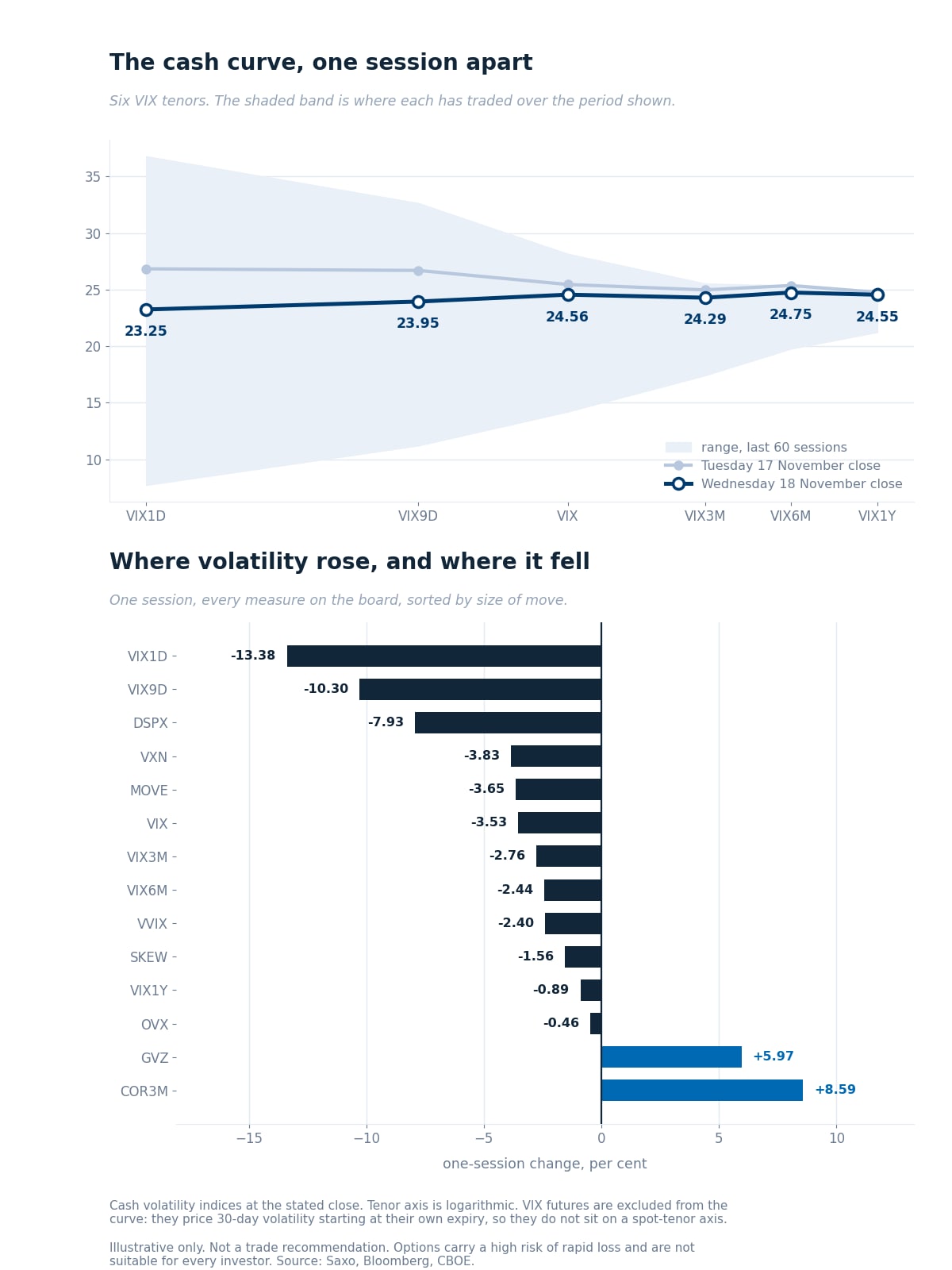
The cash curve at Wednesday’s close against Tuesday’s, over each tenor’s 60-session range, with the one-session change across every measure. Illustrative only. Past performance is not indicative of future results. Source: Saxo, Bloomberg, CBOE.
The front of the curve came back down. The one-day gauge fell 13.38% to 23.25 and the nine-day 10.30% to 23.95, both now below the VIX at 24.56, while the year-ahead gauge slipped only 0.89% to 24.55. The curve is close to flat from one month out. VVIX, the volatility of the VIX, eased 2.40% to 118.37, and MOVE, the Treasury volatility gauge, fell 3.65% to 98.16. Gold volatility went the other way, up 5.97% to 28.04, near its 60-session high. VIX futures stay off the chart, since each prices a month from its own expiry.
Ratios. VIX3M/VIX rose to 0.99 from 0.98. VXN/VIX held at 1.35.
VIX futures. A parity check on the December options puts that contract at about 21.95, down from 22.42 on the same check a session earlier, and January at about 22.03, both roughly 2.5 points below spot.
Tails and correlation. SKEW eased 1.56% to 142.84, below its 60-session median of 149.22 and near the bottom of that range. Implied correlation rose 8.59% to 20.35, against a median of 11.75 and just under its 60-session high of 20.93, while the dispersion index fell 7.93% to 37.97.
Single-name volatility
Single-name volatility eased after two sessions of gains. On a common set of 520 underlyings, each ranked by where its implied volatility sits against its own year, the median rank fell to 37.4 from 40.0, with 358 names down and 158 up, and the count at a rank of 80 or more fell to 36 from 44. The US median eased to 50.0 from 54.5 and the euro-zone median to 30.0 from 31.5.
Reporting did most of the work. Nvidia’s rank fell to 59.4 from 100.0, Target’s to 24.6 from 79.9 and Lowe’s to 61.4 from 83.8 once their results were out. The index funds eased with them: the Nasdaq 100 fund to 82.1 from 93.9, the S&P 500 fund to 59.2 from 64.8 and the semiconductor fund to 77.4 from 90.8.
A few names moved the other way. UnitedHealth’s rank rose to 61.1 from 40.1 and the gold fund’s to 31.6 from 26.1. Walmart, which reports today, eased to 86.0 from 94.0.
Implied-volatility rank from the Saxo screener, read at about 03:00 CET on 19 November 2026, carrying Wednesday’s close, against the reading carrying Tuesday’s close. Source: Saxo.
Options flow sentiment
Based on end-of-day Wednesday 18 November, yesterday’s positioning, not today’s price action.
- Single-name flow had no readable direction, with the largest positions structural and crossed at mid-market.
- Sector and ETF flow was neutral to slightly premium-selling, with no visible demand for near-term or tail protection.
Where the week's range sits
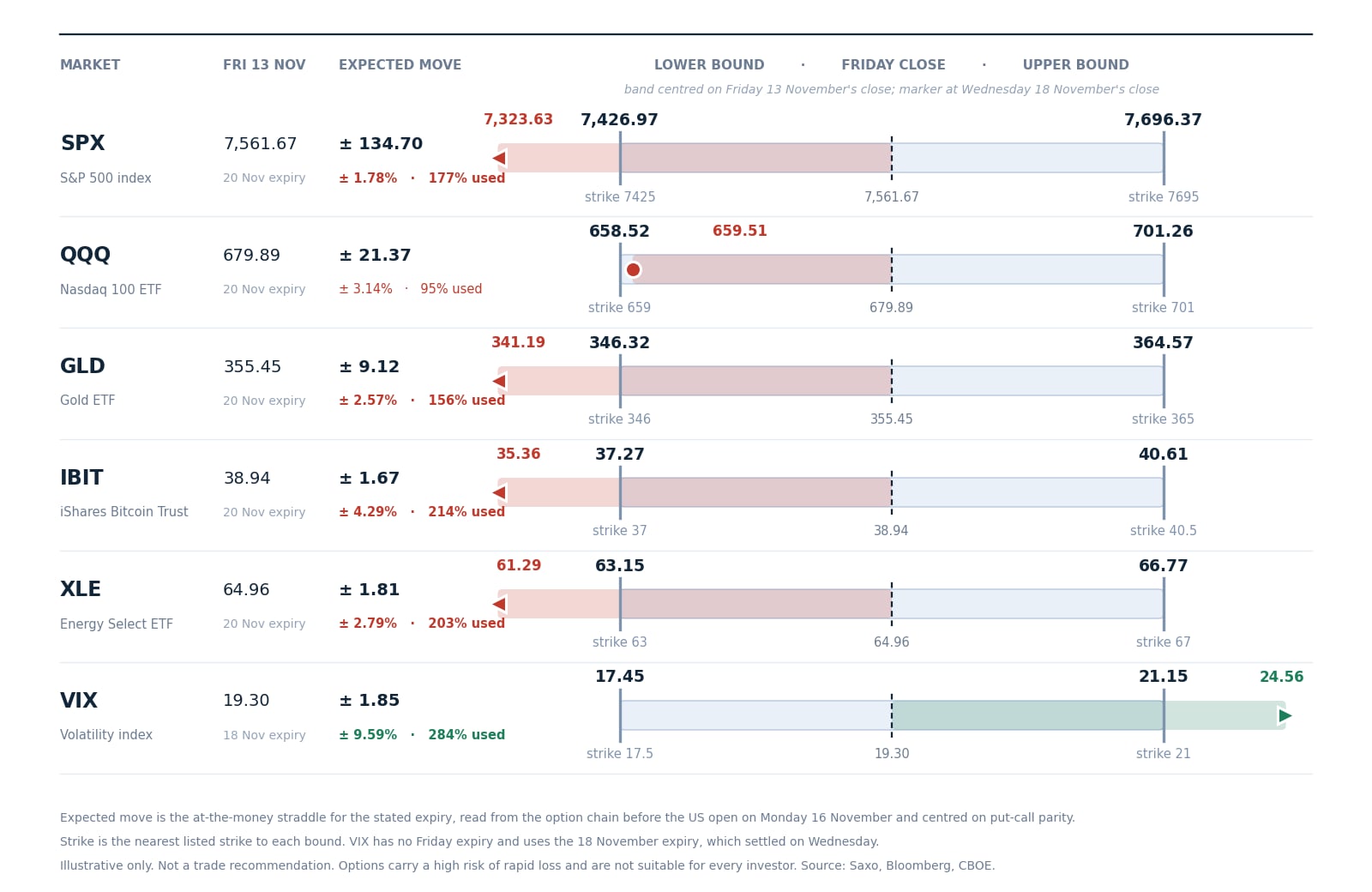
The range the option market priced for this week around Friday 13 November’s close, with each marker at Wednesday 18 November’s close. Illustrative only, not a trade recommendation. Past performance is not indicative of future results. Source: Saxo, Bloomberg, CBOE.
The S&P 500 slipped further below the week’s range. The option market priced 134.70 points around Friday’s 7,561.67 close, 1.78%, from 7,426.97 to 7,696.37, and Wednesday’s close at 7,323.63 uses 177% of the range. The Nasdaq 100 fund moved back inside its band, at 95%.
The gold fund dropped below its band at 156%, after using only 33% a session earlier, and the bitcoin fund and the energy fund sit at 214% and 203%. The VIX row uses the 18 November expiry, which settled on Wednesday, so its band no longer looks forward. The Friday-close reading was missing, so the bands come from Monday’s pre-open chain.
Options carry a high risk of rapid loss and are not suitable for every investor. Costs and charges apply and vary by account and venue; check the rates applicable to you.
Today's catalysts
- Today: 14:30 CET US jobless claims and the Philadelphia Fed survey; Fed speakers Hammack at 14:50 CET, Jefferson at 15:25 CET, Goolsbee at 18:30 CET and Barr at 20:15 CET; 17:00 CET the Kansas City Fed survey. Presidents Trump, Xi and Putin meet in Shenzhen. Walmart, Intuit and Alibaba report, and Japan’s inflation data follow at 00:30 CET.
- This week: Friday’s monthly options expiry, then the Fed meeting on 9 December.
Earnings scorecard
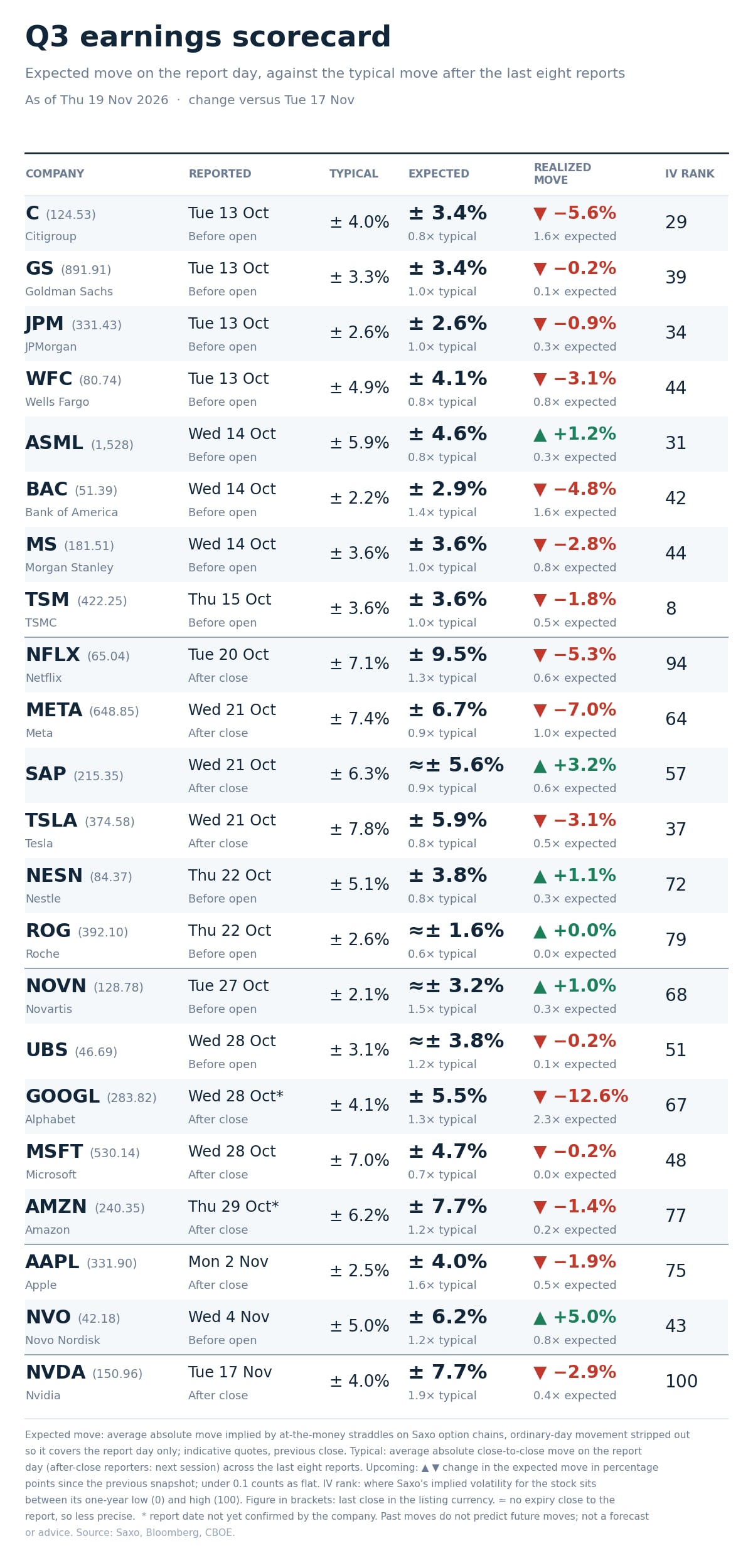
Option-implied expected move for each report day against the stock’s average move after its last eight reports, with the realised move, across the twenty-two names tracked this season. Past performance is not indicative of future results. Source: Saxo, Bloomberg, CBOE.
The board is complete. Nvidia’s options priced a report-day move of about 7.7%, 1.9 times its 4.0% eight-report average. The shares rose 4.8% after hours on the beat, according to the Quick Take, then closed 2.89% lower, about 0.4 times the priced move.
Across all twenty-two names, 18 moved less than priced and 4 moved more, with a median realised move of about 0.5 times the expected move. Alphabet’s fall of 12.6% against 5.5% priced stays the largest miss.
In our view the season may show that report-day prices were mostly generous, with a few large exceptions carrying the risk, and Nvidia’s reversal after hours is a reminder that the sign of a move can change before the cash session settles it.
Options carry a high risk of rapid loss and are not suitable for every investor. Costs and charges apply and vary by account and venue; check the rates applicable to you. Past performance is not indicative of future results.
What the market is pricing
- Session implied range: S&P 500 options price about 1.12%, roughly 82 points, for today’s expiry, from indicative quotes read before the US open. The one-day gauge at 23.25 implies about 1.46%, a one-standard-deviation figure, a different measure from the expected move.
- Clock against price: yesterday’s edition quoted 149.75 points, 2.04%, for the 20 November expiry with three sessions left. Time alone would have left about 122 points, roughly 1.67%, and it now prices 113.40 points, 1.55%, so in our view the market may have taken premium out beyond the clock.
- Week ahead: netting out today leaves about 1.07% for Friday alone.
- Correlation read: implied correlation rose to 20.35 while the dispersion index fell 7.93% and SKEW eased. In our view that may suggest the market is paying for moves in which stocks travel together, rather than for single-name divergence or a crash.
In our view the front of the curve may have released the event premium it carried into Nvidia, while the rise in correlation suggests the broader market is not yet treated as calm. Friday’s expiry and a Fed that keeps a December rise open are what the remaining premium covers. Options carry a high risk of rapid loss and are not suitable for every investor. Costs and charges apply and vary by account and venue; check the rates applicable to you. Past performance is not indicative of future results.
| More from the author |
|---|