
You can access both of our platforms from a single Saxo account.

Asia Market Quick Take – 22 April, 2026
Asia Market Quick Take –22 April, 2026
Key points:
- Macro: US-Iran talks stall; US retail sales rise 1.7% vs 1.4% expected
- Equities: Apple falls 2.5%, dragging the SP500
- FX: Dollar climbs on stalled US‑Iran talks, strong US data; euro, sterling lag
- Commodities: WTI near $90 after 10% two-day surge while silver fell
- Fixed income: Treasury yields up across the curve; 10Y +4 bps to 4.29%
------------------------------------------------------------------
Disclaimer: Past performance does not indicate future performance.
Macro:
- US‑Iran peace talks are stalled and the Strait of Hormuz remains mostly closed after Iran refused talks and vowed not to reopen the route while US naval interceptions continue. Trump extended the ceasefire pending a unified Iranian proposal. The conflict is curbing supply, with demand destruction near 4 million barrels per day and possibly rising to 5 million (about 5% of global supply), mainly impacting Asia.
- US retail sales rose 1.7% in March 2026, beating the 1.4% forecast and marking the fastest growth since March 2025, led by a 15.5% jump in gasoline station receipts amid higher fuel prices. Most major categories posted gains, and core retail sales climbed 0.7%, above the 0.2% forecast.
- Japan’s trade surplus widened to JPY 667.0 billion in March 2026 from JPY 529.8 billion a year earlier, but missed the JPY 1,106 billion forecast. Exports rose 11.7% to a record JPY 11,003.3 billion, outpacing imports, which grew 10.9% to JPY 10,336.3 billion amid strong domestic demand after late-2025 stimulus.
- Fed Chair nominee Warsh said there is a short window to bring inflation down, the Fed’s balance sheet should be smaller and avoid long-term Treasuries, and his disagreements with Powell are purely policy-related. He denied reports Trump pushed him to cut rates, saying he never sought such commitments. Warsh added that inflation is improving but more work is needed and argued the Fed lacks legal authority to issue a digital currency and should not pursue one.
- US private employers added an average of 54,750 jobs per week in the four weeks to April 4, 2026, up from a revised 40,250 and marking a fifth straight week of improving hiring and the highest pace since ADP’s weekly tracking began in September 2025.
Equities:
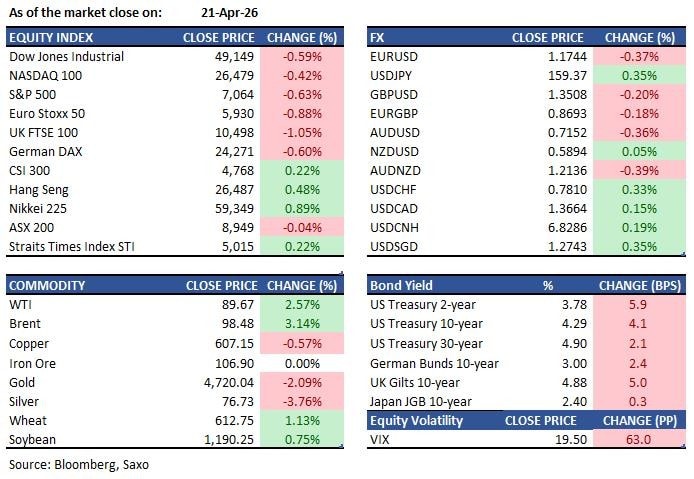
- US - S&P 500 fell 0.6% to 7,064.01, while the Nasdaq 100 declined 0.4%. The Dow Jones Industrial Average dropped 0.6%. Markets initially rose but reversed course after Vice President Vance called off his Pakistan trip, though futures recovered in after-hours trading following Trump's ceasefire extension announcement. Apple contributed the most to the S&P 500 decline, falling 2.5%, while Tractor Supply had the largest drop, plunging 11.7%. United Health Group +7% as it beat Q1 expectations and offered strong 2026 guidance as it authorizes $2b buyback in Q2.In after-hours trading, Capital One, Interactive Brokers, and Intuitive Surgical posted gains.
- EU - European stocks declined on Tuesday as investors weighed earnings and tracked Middle East developments ahead of Wednesday's ceasefire deadline. The Stoxx Europe 600 Index fell 0.9% to 616.03, its largest decline since April 7. Healthcare led declines, down 2%, while food, beverage, tobacco, and industrials also underperformed. Energy rose 0.4%, tracking Brent crude's jump to about $98 per barrel. The DAX fell 0.6% to 24,270.87 in Frankfurt, with MTU Aero Engines dropping 5.8%. Royal Unibrew had the largest drop in the Stoxx 600, falling 24.8%. Rolls-Royce Holdings contributed the most to the index decline, decreasing 6.5%.
- Asia - Asian markets showed mixed performance on Tuesday, with South Korea's Kospi surging to a record high while other markets posted modest gains. The Kospi climbed 2.7% to 6,388.47, powered by chipmakers as the artificial intelligence trade regained momentum amid optimism over potential US-Iran peace talks. SK IE Technology jumped 10%, while technology megacaps including TSMC and SK Hynix led regional gains. Japan's Nikkei 225 rose 0.9%, adding 524.28 points, as bank and tech issues advanced on earnings results. Hong Kong markets finished in the green, with Nvidia supplier Victory Giant surging 50% on its trading debut following the city's biggest IPO this year. The MSCI Asia Pacific Index rose as much as 0.9% to its highest in seven weeks. However, Wednesday's opening showed caution, with the Kospi opening flat at 6,387.57 and Sapporo Holdings falling 4.9% after announcing plans to close its US plant.
Earnings this week:
- Wednesday - AT&T, Boeing, China Mobile, IBM, Tesla, Lam Research, Vertiv, GE Vernova, Boeing, Texas Instruments
- Thursday - Lockheed Martin, American Express, Intel
- Friday - Procter & Gamble
- Sunday - Verizon
FX:
- USD climbed, with the Bloomberg Dollar Spot Index up 0.4% to its highest since April 10, as US–Iran peace talks stalled after Vice President JD Vance’s trip to Pakistan was cancelled, even though President Trump extended the ceasefire.
- USDJPY gained to 159.35 as the BOJ is expected to keep rates on hold next week amid Iran-related risks, though it remains inclined to tighten over time.
- NZDUSD inched higher to 0.5897 after inflation in New Zealand stayed above the RBNZ’s 1–3% target, boosting odds of a July hike.
- EUR underperformed, with EURUSD down 0.4% to 1.1747 as German investor sentiment fell to a three-year low, while GBPUSD slipped 0.2% to 1.3508 amid fresh political pressure on Prime Minister Keir Starmer following testimony about alleged interference in Peter Mandelson’s US ambassadorship vetting.
Commodities:
- Oil held a two-day gain after President Trump extended the ceasefire with Iran. West Texas Intermediate traded near $90 per barrel, after adding almost 10% in the prior two sessions, while Brent closed below $99.
- Gold edged higher in early trade after President Trump said the US will extend its cease-fire with Iran. Front-month Comex gold futures had fallen earlier in the session.
- Silver fell 4.43% to $76.411, marking the largest one-day dollar and percentage decline since March 26, 2026.
Fixed income:
- Treasury yields rose across the curve, with the 10-year yield rising 3.2 basis points to 4.286% and the 30-year yield rising 1.2 basis points to 4.893%. Treasuries extended losses after reports that Vice President Vance's trip to Pakistan was called off, with yields cheaper by up to 7 basis points across 2-year yields.
- Vanguard is boosting its holdings of Treasuries, taking advantage of higher yields following the Middle East conflict to lock in rates and hedge against risks of a potential growth slowdown.
For a global look at markets – go to Inspiration.
This content is marketing content and should not be considered investment advice. Trading financial instruments carries risks and historic performance is not a guarantee for future performance. The instrument(s) mentioned in this content may be issued by a partner, from which Saxo receives promotion, payment or retrocessions. While Saxo receives compensation from these partnerships, all content is conducted with the intention of providing clients with valuable options and information.