


Full report
The future of digital wealth: Why rising expectations, legacy technology and AI are reshaping the next generation of digital wealth models
Digital wealth is moving to a hybrid future
Banks and brokers are trying to launch faster, update ageing technology and meet higher client expectations, without giving up control of the client relationship. The result is a clear move towards hybrid operating models.
Our research highlights a delivery gap. While 75% believe banks and brokers are well equipped to offer strong digital wealth and brokerage propositions, 79% say propositions are being launched before all the capabilities behind them are ready. Nearly three quarters say client expectations are moving faster than institutions’ ability to build the necessary technology internally.
This report looks at what sits behind that gap: where technology and processes slow delivery, what banks and brokers want to keep in-house, and how AI and new competitors are raising the bar.
“There’s no need for us to try and build something which is probably 70% as good as [a specialist’s] core proposition… we focus on the front end and our customer relationship.” - Bank/Broker, APAC
About the research
Savanta surveyed 332 decision-makers at commercial and investment banks, private banks, brokers, fintechs and challenger banks across Europe, MENA and APAC. Those surveyed were directly involved in decisions about how their organisation delivers digital wealth and/or brokerage capabilities. The study was carried out through the summer in 2026 and was supplemented by 18 in-depth interviews with banks, brokers and fintechs.
Commercial banks made up the largest part of the survey sample (42%), followed by investment (26%) and private banks (17%). The market is already using a mix of delivery models: 65% currently combine internal and external capabilities, while smaller groups are fully in-house (19%) or fully outsourced (16%).
Most organisations are still building their digital capability
Only 28% of organisations describe their digital wealth or brokerage capabilities as advanced, with a fully digital value chain. The largest group (43%) say they are fairly advanced: they offer some tailored client experiences, but their digital value chain is only partly in place. A further 24% are still developing their approach.
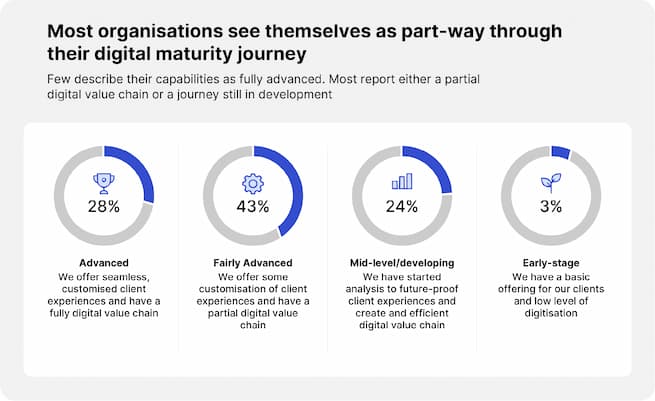
Maturity differs by region and model. Fully in-house organisations are more likely to see themselves as advanced. MENA has more organisations describing themselves as fairly advanced, while APAC has more that say they are still developing.
“We have performance problems on the app. It’s very slow and complicated, we need to fix it urgently.” – Bank/Broker, APAC
Hybrid operating models are becoming the long-term norm
The long-term direction is not full outsourcing. Banks and brokers want a clearer split between the parts they own and the areas where they use specialist providers. Half expect their long-term model to combine in-house capability with one outsourced provider; another 31% expect to use several specialist providers. Only 12% expect to remain mostly in-house.
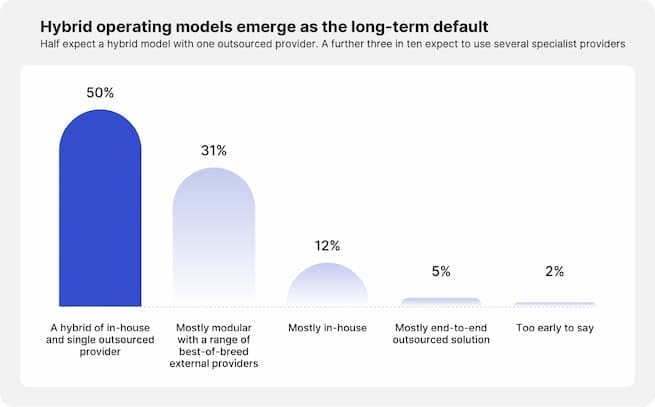
Even among organisations that currently manage everything in-house, 39% expect to move to a hybrid model. Europe is more likely to lean towards modular or mostly in-house models, while MENA and APAC are more likely to expect a hybrid model with one provider.
“I don’t think it is realistic that a wealth management firm can specialise in all things that their clients require.” - Bank/Broker, MENA
Legacy technology makes delivery harder
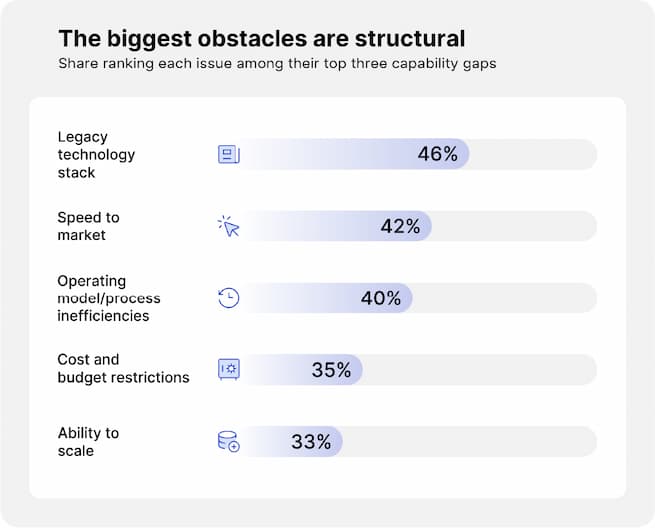
Legacy technology is the biggest gap organisations face when delivering a strong digital wealth or brokerage proposition. It is followed closely by speed to market and operating model or process inefficiencies. These issues are not separate: older technology makes it harder to integrate new tools, adapt products and improve day-to-day journeys.
The gaps vary by maturity. Legacy technology is more likely to be the main issue for fairly advanced and developing organisations, while more advanced organisations are likely to put speed to market first. MENA region stands out for the combined challenge of legacy technology and speed; in APAC, legacy, cost, and operating inefficiency are all reported at similar levels.
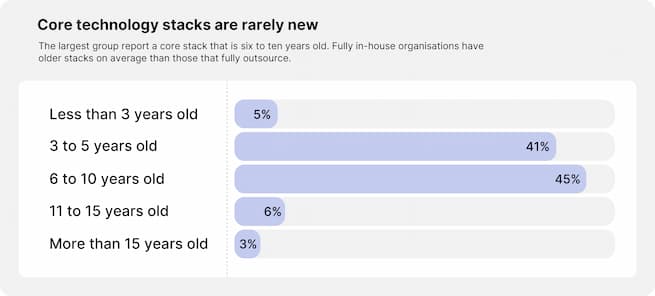
The average core technology stack is 6.7 years old. More than half of organisations are working with a stack that is at least six years old, including 45% with a stack aged six to ten years. Fully in-house organisations report older stacks on average than those that fully outsource (7.5 years versus 6.2 years).
In the qualitative interviews, legacy is described through the practical problems it creates. New solutions can require data mapping, customisation and upgrades to other systems. This adds work for internal teams, slows changes and can leave onboarding, cash movement or servicing feeling fragmented.
“While we’re building the integration into the new system, we have to upgrade the existing system… that adds more tech and resources requirement into implementing the platform.” - Bank/Broker, APAC
Speed matters, but readiness still matters too
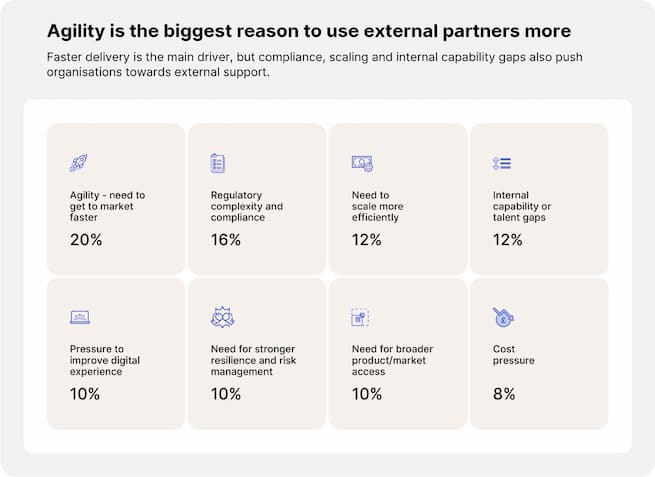
Agility, the need to get to market faster, is the biggest factor likely to push organisations towards greater use of external partners (20%). It is especially important for fairly advanced organisations and in MENA, where 31% name it as the main trigger. Regulatory complexity, scaling needs and internal capability gaps are also part of the picture.
Current delivery times are often close to the point organisations see as acceptable. Digital client onboarding takes longer than organisations would like; 7.1 months on average, compared with an acceptable 6.8 months. AI-enabled investment or trading journeys take 9.3 months, against 8.9 months considered acceptable. The gap is not large, but it shows how little room organisations feel they have when market expectations move quickly.
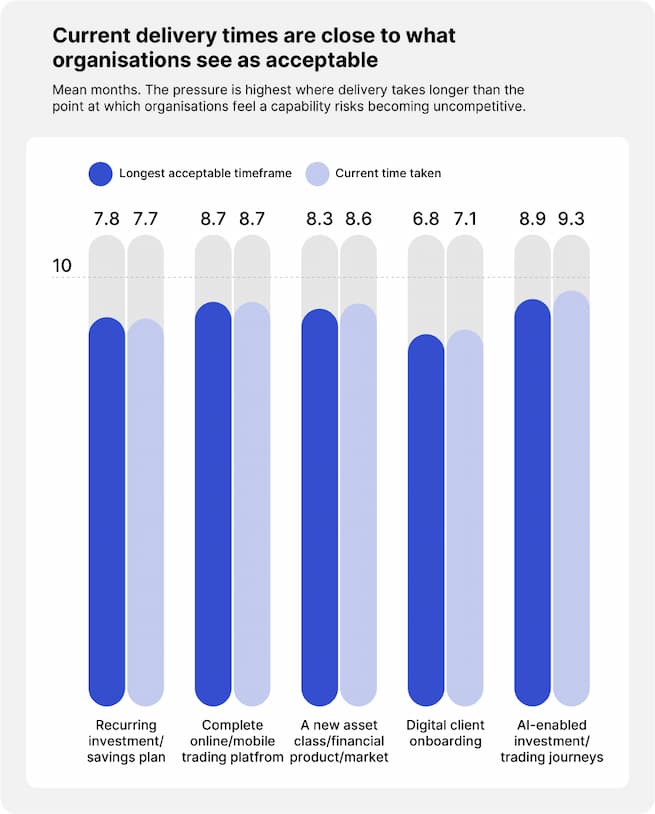
Developing organisations take longer to deliver a complete online or mobile trading platform than advanced organisations. The qualitative interviews indicate that this is not just about the technology provider; internal IT readiness, governance, approvals and integration work can all slow delivery.
“It’s about finding the right partner that is truly able to deliver what we want, in the right time, at the right cost and of the right quality.” - Bank/Broker, APAC
Value is about more than just price
Building and updating wealth technology in-house is seen as expensive, especially when ongoing investment is needed. At the same time, low-cost neo-brokers are changing expectations around price, mobile experience and onboarding.
But interviewees did not describe value as a simple price comparison. Security, trust, resilience, regulatory standing, product breadth, user experience, technology capability, service and ease of integration all play a role in evaluating value. Implementation, custody and ongoing operational costs are also seen as part of the overall cost of a model.
“Pricing will come secondary. We won’t give up quality, asset safety, asset return, and all that, for pricing.” - Bank/Broker, APAC
AI is raising the bar on pace and experience
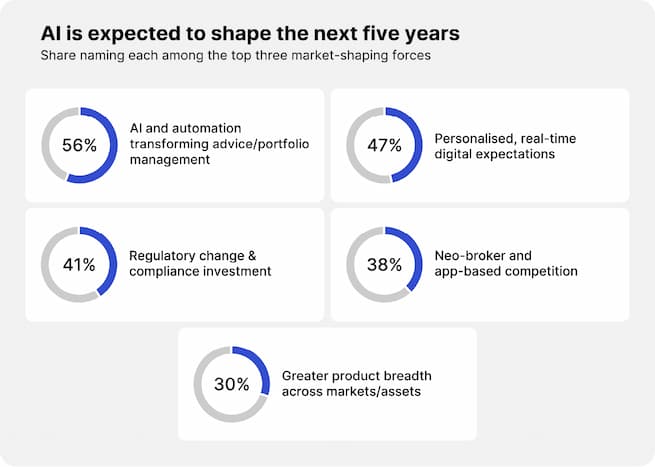
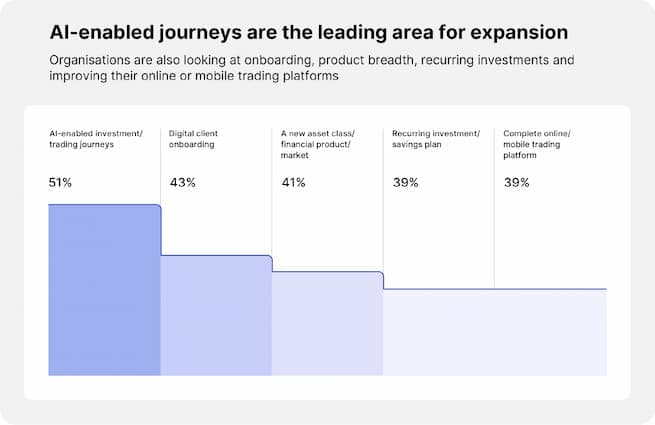
AI and automation is expected to have the biggest impact on digital wealth and brokerage over the next five years (56%). It is also the most common area organisations are considering expanding into (51%), ahead of digital onboarding, new products and online/mobile trading platforms.
Interviewees see AI as providing a way to support teams and clients: improving productivity, personalisation, onboarding, monitoring and development cycles. However, they have been more cautious about AI taking the lead in advice, portfolio construction or trading decisions, where trust, accountability and regulation remain important.
“The way we consume information on investing is going to change… where you get more insightful, tailored nudges.” - Fintech, MENA
Competitive threats are coming from several directions
AI-led robo-advice and automated investment services are seen as the biggest competitive threat over the next three years (48%). Big technology and platform companies are close behind (43%), followed by neo-brokers and app-based investment platforms offering low-cost trading (36%).
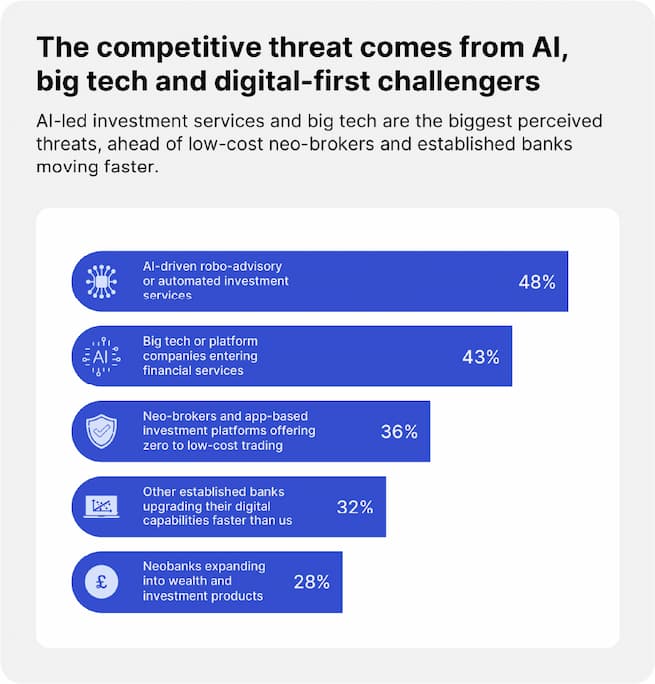
The type of threat varies by market and maturity. Advanced organisations are more likely to identify big tech as a risk. Neo-brokers and app-based platforms are more prominent among fairly advanced organisations, and specifically in the MENA region. In APAC, competition from neo-brokers and app-based investment platforms is a particularly strong future focus.
Institutions want to own the client relationship
Banks and brokers are not looking to hand over every part of the value chain. The functions they most want to own or control in-house are the front end (46%), data and client reporting (45%), regulatory/risk/compliance infrastructure (42%), and brand and client communications (40%).
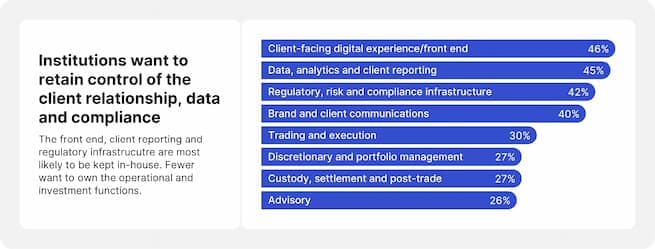
This reflects the parts of the proposition that are closest to the client relationship, brand and regulatory responsibilities. Trading and execution, custody and post-trade, portfolio management and advisory are less likely to be seen as functions that must sit in-house.
The reasons vary. Organisations want to keep control of the client relationship and brand experience, protect their market position, meet regulatory obligations and retain control of client data. The front end is especially important in the MENA region, while regulatory and compliance obligations are more prominent reasons for keeping capabilities in-house in Europe and APAC.
“Whatever the customer interaction the front-end part is, we want to own it. We want to build our engagement layer.” - Bank/Broker, MENA
Banks want more than a technology vendor
There is strong agreement that, in the future, banks will need strategic partners, not just technology vendors (88%). A similar proportion (85%) agree that banks should focus on owning the client experience while partnering for the infrastructure behind it. Stability currently matters more than innovation, and 73% recognise the risk of relying too heavily on in-house builds.
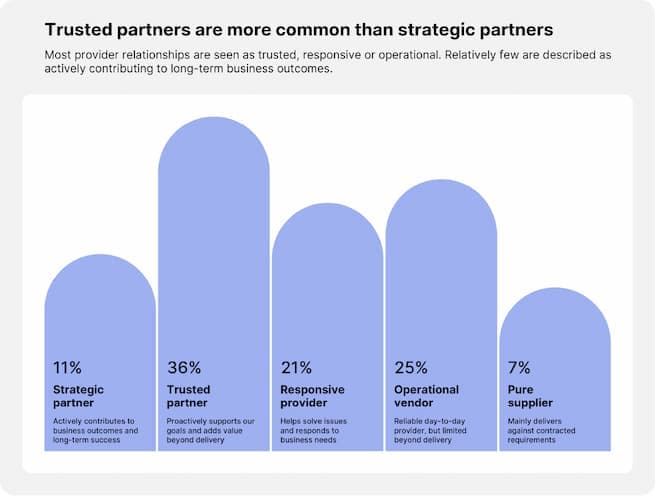
However, a strategic relationship is not the standard experience. Among respondents with a platform provider, 36% call it a trusted partner that adds value beyond delivery, while only 11% describe it as a strategic partner that actively contributes to long-term business outcomes.
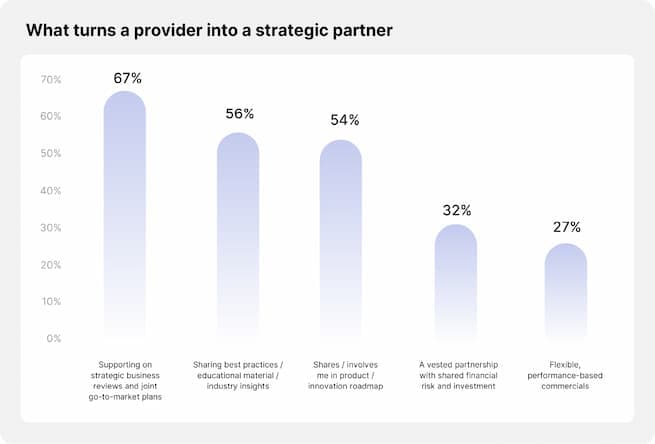
When organisations do see a provider as strategic or trusted, they point to support with strategic business reviews and joint go-to-market planning, sharing best practice and industry insight, and involvement in product and innovation roadmaps. The interviews add the importance of responsiveness, flexibility, integration and commercial alignment.
The selection process itself is often cross-functional. Interviewees described business strategy, IT, risk, legal and senior leadership all being involved. More advanced and fully in-house organisations are more likely to use a formal RFP process, while fairly advanced and developing organisations are more likely to use a business-led route. Regardless of the route, the interviews describe structured due diligence, clear evaluation criteria and senior approval as common parts of the process.
Security and stability remain the basics
Security and asset protection, stability and long-term reliability, and quality of service after implementation are the leading priorities today. Around two thirds see each as a priority, and they remain the leading priorities for the next three to five years.
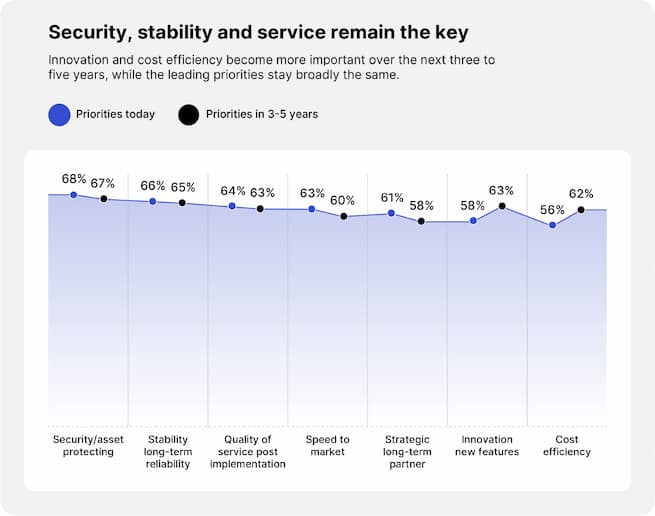
The future shift is towards innovation and cost efficiency: innovation rises from 58% today to 63% in three to five years, while cost efficiency rises from 56% to 62%. Speed to market and the need for a strategic long-term partner remain important but ease slightly.
One market, different regional pressures
The broad direction is shared, but the immediate pressure differs across regions. Europe is more focused on regulatory change and cost efficiency: 45% expect regulation to shape the market, while 70% prioritise cost efficiency over the next three to five years. It also has a higher share of organisations using fully outsourced or white-label solutions (20%), and respondents are more likely to describe their provider as responsive rather than strategic or trusted.
In MENA, personalised real-time experiences, speed and agility are more prominent: 61% cite rising demand for personalised, real-time experiences and 85% say institutions are falling behind. Organisations are more likely to see their provider as trusted, to want to retain the front end and to prioritise a strategic long-term partner. Qualitative interviews highlighted that product breadth and access through a single integration are also key needs.
In APAC, there is a greater sense that capability is still developing and that digital-first competitors are moving quickly. Nearly a third describe their organisation as mid-level or developing, while 45% point to neo-brokers and app-based investment platforms as a key future focus. Recurring investment and savings plans are a more common expansion area in this region, while interviewees also point to the need for AI-enabled innovation and price flexibility as competition increases.
“If we’re not part of it, we will not be around for the future.” - Bank/Broker, MENA