


Executive summary
The future of digital wealth: Why rising expectations, legacy technology and AI are reshaping the next generation of digital wealth models
Digital wealth is moving to a hybrid future
Banks and brokers are under pressure to launch faster, modernise ageing technology and meet rising expectations, without surrendering control of the customer relationship. The result is a market moving decisively towards hybrid operating models.
79% say propositions are launched without all the capabilities needed to deliver them well. 50% expect a hybrid model with one outsourced provider to be their long-term model. 56% expect AI and automation to be among the forces that shape the market over the next five years.
The central tension: ambition is outpacing delivery
The sector is confident in its ability to create compelling digital wealth and brokerage propositions: 75% believe banks are well equipped to do so. Yet 79% also agree that propositions are being launched before the required capabilities are fully in place. 73% say client expectations are outpacing institutions’ ability to build the necessary technology internally.
This is more than an execution issue. It reflects the difficulty of evolving customer-facing services at the pace set by digital-first competitors, while working within established technology, governance and regulatory environments.
Hybrid is becoming the operating model of choice
Half of decision-makers expect their long-term model to combine in-house capability with a single outsourced provider. A further 31% expect a modular model using several specialist providers. Only 12% expect to remain mostly in-house.
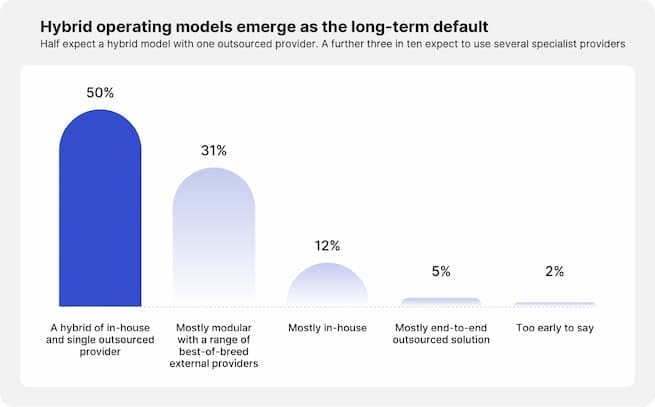
The pattern points to a deliberate division of labour. Institutions continue to value ownership of their client relationship and experience, while recognising that it is increasingly difficult to be a specialist in every part of the digital wealth value chain.
“There’s no need for us to try and build something which is probably 70% as good as [a specialist’s] core proposition… we focus on the front end and our customer relationship.” - Bank/Broker, APAC
“I don’t think it is realistic that a wealth management firm can specialise in all things that their clients require.” - Bank/Broker, MENA
Legacy technology is becoming a competitive constraint
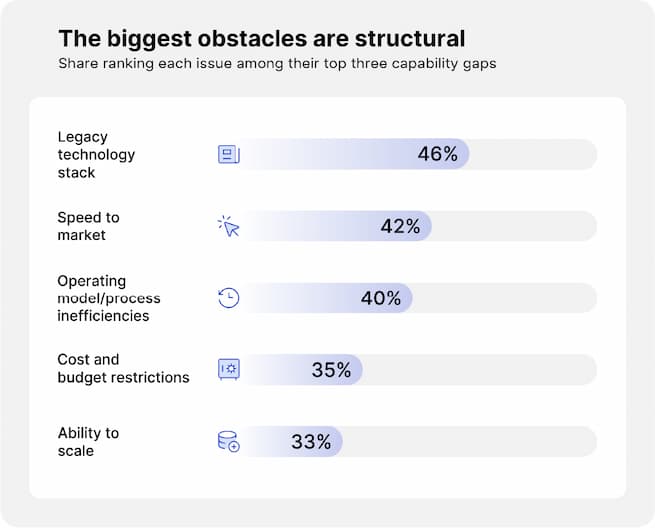
The most frequently cited gaps in delivering a strong digital proposition are legacy technology (46%), speed to market (42%) and operating-model or process inefficiencies (40%). The issue is not technology in isolation: older environments create friction across integration, product change and day-to-day servicing.
“A lot of banks are on very old legacy infrastructure… we are not as nimble as startups… So yes, of course, tech is always a challenge.” - Bank/Broker, APAC
AI is raising the bar, without removing the need for trust
AI and automation is the market force most often expected to shape digital wealth and brokerage over the next five years (56%). It is also the leading area for expansion, with 51% considering AI-enabled investment or trading journeys. Personalised, real-time digital expectations are close behind, cited by 47%.
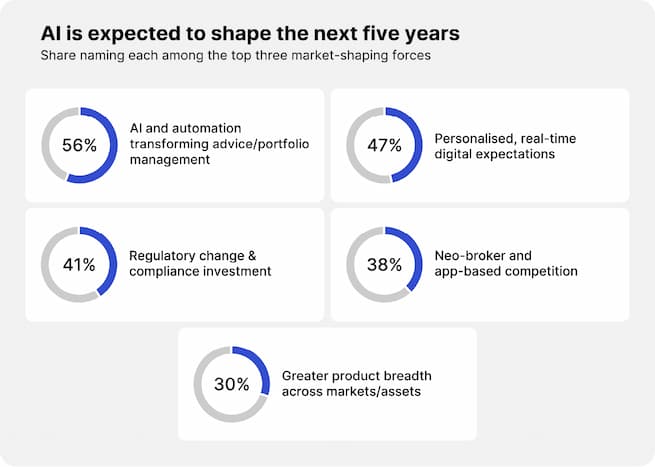
For now, the strongest role for AI is as an enabler: improving productivity, personalisation, onboarding and monitoring, while helping teams develop and iterate more quickly. But there remains caution about fully automating investment judgement, where trust, accountability and regulation are paramount.
“The way we consume information on investing is going to change… where you get more insightful, tailored nudges.” - Fintech, MENA
“Even the best AIs in the world today still can hallucinate and give answers that are not in line with the prompts.” - Bank/Broker, APAC
One market but different regional pressures
The broad direction is shared, but the immediate pressure varies by region. In Europe, regulatory change and cost efficiency are more prominent: 45% expect regulatory change to shape the market, while 70% prioritise cost efficiency over the next three to five years. In MENA, the focus is speed and experience: 61% identify rising demand for personalised, real-time digital experiences, while 85% say institutions are falling behind. In APAC, digital-first competition is especially salient, with 45% citing neo-brokers and app-based investment platforms as a key future focus.
The bottom line
Digital wealth is increasingly a race to combine customer control with specialist capability. Institutions want to retain the relationship, brand and engagement layer, while accessing the technology, operational resilience and product breadth required by a faster-moving market. The long-term model is therefore unlikely to be a choice between building and partnering. It is a question of how effectively the two are brought together.