
Un seul compte Saxo suffit pour accéder à nos plateformes.

Twenty-one names where option premium stood out in early November
Options

Résumé: Lowe’s, Deere and the Health Care Select Sector SPDR sat near the top of their own one-year option range at the 6 November close, while IMCD and Flow Traders sat near the floor. Twenty-one readings, and what a volatility number still cannot tell you.
A high IV rank describes the price of optionality, not the direction of the underlying.
A collector I built on the Saxo API records implied volatility, IV rank and IV percentile every night for the S&P 100 constituents plus 50 liquid ETFs in the US, and every euro-denominated stock option root in Saxo’s catalogue. It records where premium sat; it is not a signal service. This edition covers the close of Friday 6 November 2026 (Source: Saxo platform, recorded 7 November 2026). Past performance is not indicative of future results.
Nothing here is a view on direction or a trade recommendation. Options carry a high risk of rapid loss and are not suitable for every investor.
Important note: The strategies and examples provided in this article are purely for educational purposes. They are intended to assist in shaping your thought process and should not be replicated or implemented without careful consideration. Every investor or trader must conduct their own due diligence and take into account their unique financial situation, risk tolerance, and investment objectives before making any decisions. Remember, investing in the stock market carries risk, and it’s crucial to make informed decisions.
Reading the numbers together
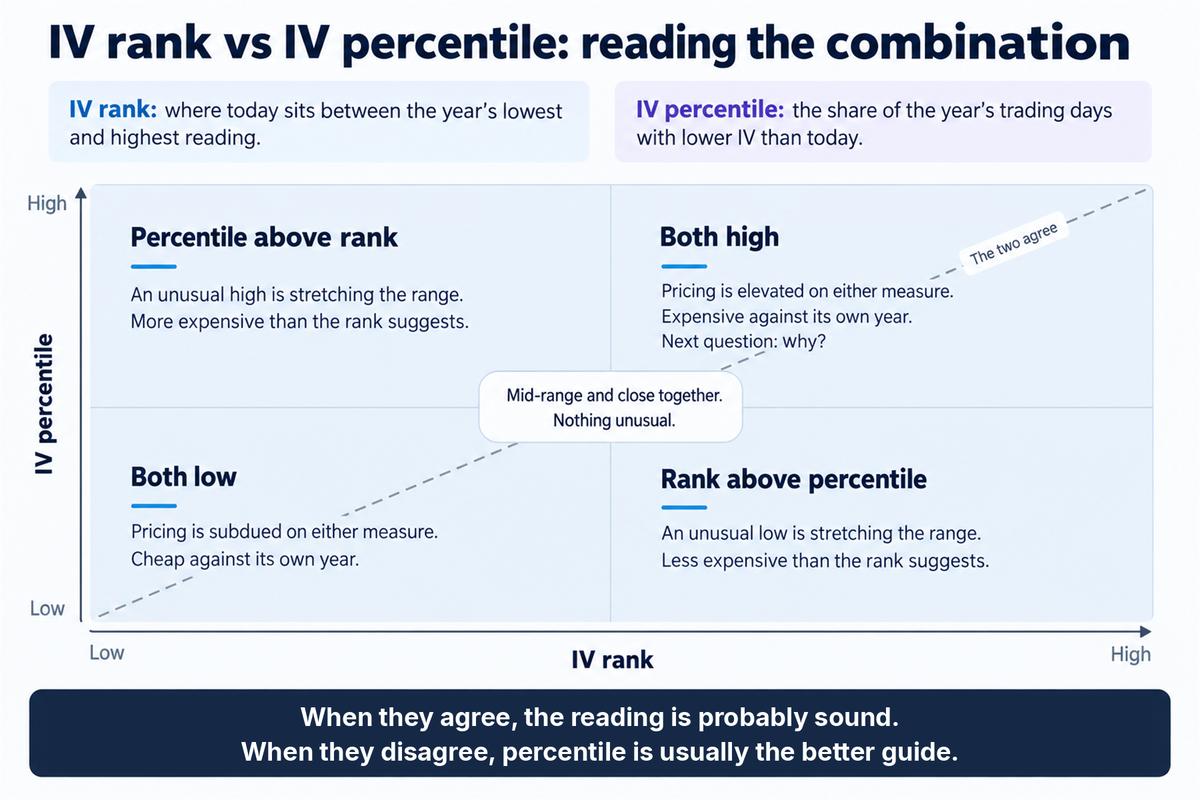
IV rank places today’s implied volatility between the lowest and highest reading of the past year. IV percentile counts the share of days that closed below today’s level. Rank far above percentile suggests one spike set the top of the range; rank far below suggests an old extreme stretched it. With 25 recorded sessions we can now add D5, the five-session change in rank, in rank points. None of these says anything about direction.
All figures below: Source: Saxo platform, 6 November 2026 close. Past performance is not indicative of future results.
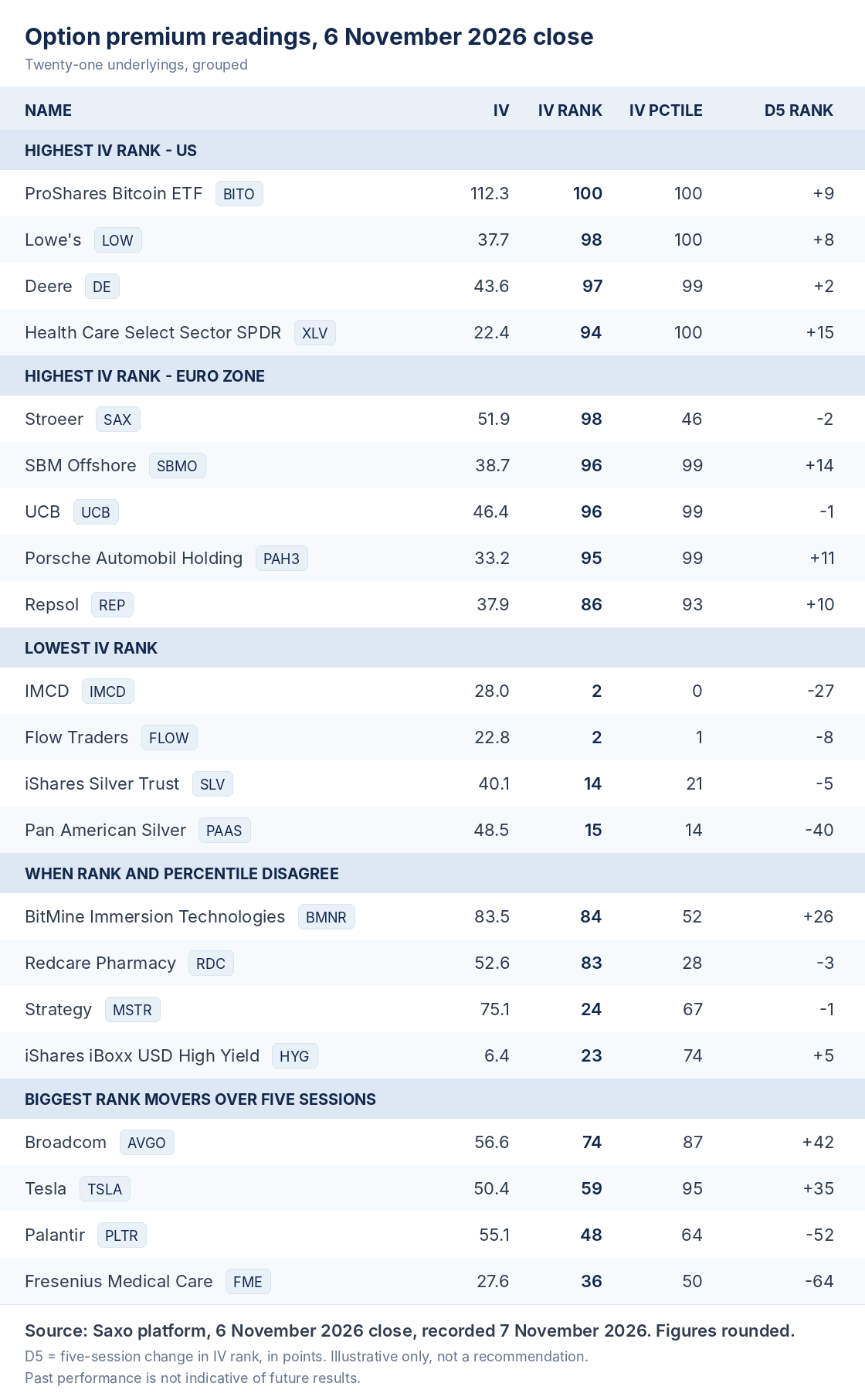 Implied volatility, IV rank, IV percentile and five-session rank change for twenty-one underlyings, 6 November 2026 close. Source: Saxo platform
This table is illustrative and for educational purposes only; it is not predictive and not a trade recommendation. Past performance is not indicative of future results.
Where implied volatility sat highest - US
Illustrative only, not trade recommendations. Options carry a high risk of rapid loss.
- ProShares Bitcoin ETF (BITO) - IV 112.3, rank 100, percentile 100. Rank rose about 52 points in one session, which may point to a fresh spike. Costs and charges apply; see Saxo pricing for full details.
- Lowe’s (LOW) - IV 37.7, rank 98, percentile 100. Rank is up about 45 points over 20 sessions, which appears to reflect premium that has been building.
- Deere (DE) - IV 43.6, rank 97, percentile 99. Near-identical measures suggest the high is not one day’s doing.
- Health Care Select Sector SPDR (XLV) - IV 22.4, rank 94, percentile 100. Low in absolute terms, yet near the top of its range. Costs and charges apply; see Saxo pricing for full details.
Where implied volatility sat highest - euro zone
Filtered to names with at least seven listed expiries and a rank of at least 70 two sessions earlier.
Illustrative only, not trade recommendations. Options carry a high risk of rapid loss.
- Stroeer (SAX) - IV 51.9, rank 98, percentile 46. The widest rank-percentile gap in this group.
- SBM Offshore (SBMO) - IV 38.7, rank 96, percentile 99. Rank was already 86 two sessions earlier.
- UCB (UCB) - IV 46.4, rank 96, percentile 99. Rank was 88 two sessions earlier.
- Porsche Automobil Holding (PAH3) - IV 33.2, rank 95, percentile 99. Rank was 70 two sessions earlier, so the rise is recent and it only just passes the filter.
- Repsol (REP) - IV 37.9, rank 86, percentile 93. Ten listed expiries.
Where implied volatility sat lowest
A low reading is not an invitation to buy options.
Illustrative only, not trade recommendations. Options carry a high risk of rapid loss.
- IMCD (IMCD) - IV 28.0, rank 2, percentile 0. A high absolute level, yet the floor of its own range: rank is relative to each name’s history.
- Flow Traders (FLOW) - IV 22.8, rank 2, percentile 1. Also at the floor of its range.
- iShares Silver Trust (SLV) - IV 40.1, rank 14, percentile 21. High in absolute terms, bottom fifth of its range. Costs and charges apply; see Saxo pricing for full details.
- Pan American Silver (PAAS) - IV 48.5, rank 15, percentile 14. D5 of -40 suggests premium drained out over the week.
When rank and percentile disagree
Illustrative only, not trade recommendations. Options carry a high risk of rapid loss.
- BitMine Immersion Technologies (BMNR) - IV 83.5, rank 84, percentile 52. Near the top of its range yet only slightly above its median day, which may indicate a recent high.
- Redcare Pharmacy (RDC) - IV 52.6, rank 83, percentile 28. A gap of about 55 points suggests an earlier spike still sets the range top.
- Strategy (MSTR) - IV 75.1, rank 24, percentile 67. The mirror image: an older extreme stretched the range, yet the reading sat above about two days in three.
- iShares iBoxx USD High Yield Corporate Bond ETF (HYG) - IV 6.4, rank 23, percentile 74. A modest rank, but implied volatility above roughly three days in four. Costs and charges apply; see Saxo pricing for full details.
Biggest rank movers over five sessions
Illustrative only, not trade recommendations. Options carry a high risk of rapid loss.
- Broadcom (AVGO) - IV 56.6, rank 74, percentile 87, D5 +42. Its front expiry sat two days out against six for most US names, so it is not fully like for like.
- Tesla (TSLA) - IV 50.4, rank 59, percentile 95, D5 +35. Percentile sat high while rank stayed mid-table, which appears to reflect an already stretched range.
- Palantir (PLTR) - IV 55.1, rank 48, percentile 64, D5 -52. The largest US fall: premium drained out over the week.
- Fresenius Medical Care (FME) - IV 27.6, rank 36, percentile 50, D5 -64. The euro-zone mirror.
What this screen does not tell you
It says nothing about direction. A high rank is consistent with a large move up, down, or simply an uncertain one. We have not matched these readings to company events, so none is described as event-driven.
It is a short record: 25 sessions allow five-session change, not longer trends.
It does not measure liquidity. Bid-offer width, open interest and listed expiries decide whether anything here is tradeable. ADP, Webuild, D’Ieteren and BFF Bank had high ranks but only six listed expiries, so they were left out.
It is not always like for like. The front expiry ranged from two to thirteen days, and Sanofi and Thyssenkrupp appeared only as adjusted December contracts, so they were excluded rather than compared.
Final thoughts
A screen like this does not find trades. It separates how much a market is moving from how much movement is already in the price. Expensive optionality can become more expensive, so a high rank is not a sell signal, and cheap premium can stay cheap for months. In our view its use is as a filter for which names deserve a closer look at the chain itself.
Options carry a high risk of rapid loss and are not suitable for every investor. Future outcomes are uncertain and may result in losses. See Saxo pricing for costs and applicable charges: https://www.home.saxo/rates-and-conditions/pricing-overview
The author does not hold positions in any of the instruments mentioned in this article. The Author is permitted to wait at least 24 hours from the time of the publication before they trade the instruments themselves.
| Related articles/content |
|---|
| Is it the company or its sector Option premium moved in packs last week | 2 Nov 2026 Twenty-one options markets where premium stood out on 23 October | 26 Oct 2026 Twenty-one names where option premium stood out after the October expiry | 19 Oct 2026 Finding unusually expensive or cheap options in the Saxo screener | 18 Sep 2026 Implied volatility rank what it measures and what it misses | 11 Sep 2026 What IV crush really means in practice reviewed version | 9 Apr 2026 Trading earnings with defined | 31 Mar 2026 |
| More from the author |
|---|