
You can access all of our platforms from a single Saxo account.

Asia Market Quick Take – 13 March, 2026
Asia Market Quick Take – 13 March, 2026
Key points:
- Macro: Iran pledges to keep Straits of Hormuz closed and threatens escalations
- Equities: Adobe falls 18% after CEO of 18 years steps down
- FX: EURUSD down to 1.1515, third straight drop on broad USD strength
- Commodities: Oil extends gains after highest close since Aug 2022 amid extreme volatility
- Fixed income: Treasuries bear‑flattened sharply, with 19bp of easing priced by December
------------------------------------------------------------------
Disclaimer: Past performance does not indicate future performance.
Macro:
- Iran's Supreme Leader Mojtaba Khamenei pledged to keep the Strait of Hormuz closed and threatened further conflict escalation. President Trump prioritized stopping Iran's nuclear ambitions over oil costs. The blockade halted 20% of global oil trade, forcing GCC production cuts. The IEA labeled the disruption historic, prompting a 400 million barrel release from reserves.
- The US trade deficit reduced to $54.5 billion in January 2026, from December's $72.9 billion, outpacing the forecast of $66.6 billion. Exports increased 5.5% to $302.1 billion, driven by gold, metals, and computers, while pharmaceuticals fell. Imports decreased 0.7% to $356.6 billion, with drops in pharmaceuticals and vehicles, but rose for computers and telecom equipment.
- US housing starts rose 7.2% to 1.487 million, exceeding forecasts and marking three months of growth. Multi-family starts surged 29.1%, while single-family starts fell 2.8%. Construction increased in the South and Northeast, but declined in the West and Midwest.
- Canada's trade deficit increased to C$3.6 billion in January 2026 from C$1.3 billion in December. Exports fell 4.7%, driven by drops in vehicles and aircraft, partially offset by higher energy exports. Imports declined 1.1%, mainly due to decreases in vehicles and electronics. The US surplus narrowed to C$5.4 billion, and the deficit with other countries expanded to C$9.0 billion.
- US initial jobless claims decreased by 1,000 to 213,000 in early March, below expectations. Continuing claims fell by 21,000 to 1,850,000, indicating a stable labor market. Federal employee claims rose by 88 to 617, amid government shutdown concerns.
Equities:
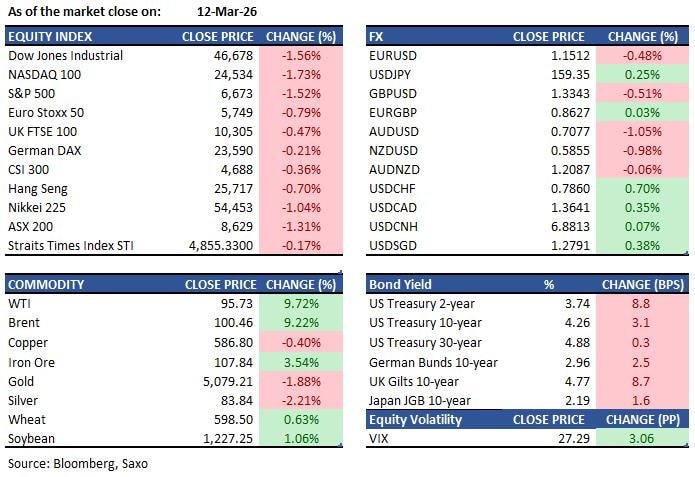
- US - US stocks fell sharply Thursday, with the S&P 500 and Dow down 1.5% and the Nasdaq off 1.7%, as escalating conflict in the Persian Gulf pushed crude toward $100 a barrel. Investors weighed rising energy costs and the absence of a path to resolving the war after new Iranian supreme leader Mojtaba Khamenei insisted the Strait of Hormuz remain closed. Brent crude topped $100 despite a record 400‑million‑barrel emergency release by the IEA. Financials lagged, with Morgan Stanley sliding 4.1%. In after hours, Adobe fell 8% after its CEO Shantanu steps down after 18 years at the firm despite reporting earnings that topped estimates.
- EU - TheEurozone’s STOXX 50 dropped 0.9% and the STOXX 600 slipped 0.7%. Tensions spiked after new Iranian supreme leader Mojtaba Khamenei vowed to keep the Strait of Hormuz closed, raising the risk of prolonged energy supply disruptions. Bond yields jumped on expectations of further ECB tightening, pressuring banks: UniCredit and BNP Paribas fell nearly 4%, while Deutsche Bank slid 5.3% after disclosing$30 billion in private‑credit exposure. Safran and Airbus lost over 2%.HK - Hang Seng fell 0.7% to 25,717 on Thursday, marking a second day of losses as U.S. equity futures tumbled and Iran escalated attacks on regional oil and transport hubs, warning that crude could reach $200 a barrel. Hong Kong authorities launched a major insider‑trading probe into two brokerages and a hedge fund, arresting eight people in their biggest industry crackdown in years. All sectors declined, with property and financials weakest. Cathay Pacific slid 1.6% on plans to raise fuel surcharges, while Swire Properties fell 1.2% after its CFO resigned. Other notable losers included Knowledge Atlas,NongfuSpring, and Henderson Land.
Earnings this week:
- Friday: VEON, Century Casinos, Acurx Pharmaceuticals
FX:
- The dollar is poised for its strongest close in nearly two months as oil surges on fears the Strait of Hormuz will stay shut and the Middle East war drags on.
- USDJPY rose 0.3% to a session high of 159.43, taking the yen beyond 159 as options markets and strategists see a high threshold for Japanese intervention.
- EURUSD fell 0.5% to 1.1515 for a third straight decline, while GBPUSD dropped 0.5% to 1.3344. US Trade Representative Jamieson Greer said his office will launch a Section 301 probe into more than a dozen economies, including China and the EU, over alleged excess manufacturing capacity. Goldman Sachs pushed its call for the next BOE rate cut to July from April, citing the energy shock linked to the Iran war.
- USDCAD rose 0.2% to 1.3626; AUDUSD fell 1% to 0.7081, holding overnight losses near 0.7078 after a 1.1% New York drop; NZDUSD slid 1% to 0.5855. The offshore yuan weakened for the first time in five days and the onshore yuan fell for a third time this week as the dollar advanced.
Commodities:
- Oil extended gains from its highest close since August 2022 after one of the most volatile weeks in years, as investors braced for further upheaval with Iran vowing to keep the Strait of Hormuz effectively shut; WTI traded near $97 after a roughly 10% surge on Thursday, while Brent settled above $100. In his first public comments since succeeding his father, Iran’s new supreme leader, Mojtaba Khamenei, said the Islamic Republic would seek to ensure the vital waterway for crude and natural gas remains closed.
- Gold steadied near $5,090 an ounce after a two-day drop of over 2% as traders weighed a firmer US dollar and surging oil almost two weeks into the Middle East war, with defiant remarks from US President Donald Trump and Iran’s new supreme leader, Mojtaba Khamenei, on day 13 amid a Strait of Hormuz blockade that has triggered the oil market’s biggest disruption on record.
Fixed income:
- US Treasuries saw a sharp bear‑flattening as surging oil prompted traders to unwind front‑end Fed rate‑cut premia, while solid demand at the $22bn 30‑year auction and flattener flows tightened the curve and capped long yields, with a hawkish shift in Fed expectations pushing rates volatility to its highest since August and Fed‑dated OIS now pricing just 19bp of easing by December—about 75% odds of a single 25bp cut.
For a global look at markets – go to Inspiration.
This content is marketing content and should not be considered investment advice. Trading financial instruments carries risks and historic performance is not a guarantee for future performance. The instrument(s) mentioned in this content may be issued by a partner, from which Saxo receives promotion, payment or retrocessions. While Saxo receives compensation from these partnerships, all content is conducted with the intention of providing clients with valuable options and information.