
You can access all of our platforms from a single Saxo account.

Market selloff: Buying opportunity or more pain ahead?
Equities

Key points:
- A market rebound does not require the problems to be solved. Stocks can bottom before earnings, regulatory or economic uncertainty clears. But investors must distinguish between companies facing temporary valuation pressure and those facing lasting damage to profits.
- The next leg lower may come from earnings or leverage, not just sentiment. Nvidia's SEC investigation, AI spending risks and potential credit stress could turn a valuation correction into something more serious.
- The biggest opportunity may be beyond the stocks that fell the most. Equal-weight equities, quality dividend stocks, cash-generative technology and selected international markets offer ways to diversify beyond AI infrastructure.
- Don't make one all-or-nothing market bet. A resilient portfolio should participate if markets recover, withstand further losses if they don't, and retain some flexibility to buy when opportunities improve.
After the selloff, what comes next?
Last week's market rout was more than a routine pullback. The S&P 500 and Dow entered correction territory, while the Nasdaq erased its gains for the year. The selling spread into Asia, Europe and commodities, raising questions about whether investors were witnessing a temporary reset in valuations or something more serious.
Artificial intelligence has been at the centre of the turmoil. Nvidia's leadership and regulatory uncertainty, questions over AI infrastructure spending, and Anthropic's IPO failing to restore market confidence have exposed vulnerabilities in what had been one of the market's strongest investment themes.
Higher interest rates, growing concerns over US growth and crowded investor positioning have added to the pressure.
There are reasons to expect further volatility. But there are also reasons why markets could recover before the uncertainties disappear.
The most useful question for investors is not simply whether the market has bottomed. It is: What do you think happens next, and is your portfolio positioned accordingly?
Here are six possible scenarios.
Scenario 1: You think the AI selloff has further to run
The investment case: This isn't just a sentiment correction. The AI investment boom is facing a fundamental reassessment that could lead to weaker earnings, tighter financing and further valuation declines.
Nvidia's reported SEC investigation adds uncertainty over its financial reporting and potential earnings implications. An adverse outcome could affect investor confidence beyond Nvidia, although an investigation itself does not establish wrongdoing.
At the same time, investors are increasingly questioning whether the enormous spending on chips and data centres can generate sufficient returns.
If hyperscalers slow capital expenditure, the impact could spread across semiconductors, memory suppliers, data-centre operators, electricity infrastructure and equipment providers.
The critical risk is that valuation multiples fall first, but earnings estimates follow later. Stocks that appear cheap today could become expensive again if expected profits are revised lower.
How to position:
- Reduce excessive concentration in AI infrastructure, particularly highly leveraged businesses.
- Favour profitable technology companies with strong cash generation, net cash and diversified revenue streams.
- Rotate towards earnings less dependent on AI capital expenditure, such as healthcare, consumer staples and selected dividend stocks.
- Hold some liquidity rather than committing all available capital after the first decline.
What to watch: Nvidia regulatory developments, semiconductor earnings revisions, hyperscaler capex guidance, free cash flow and signs of tighter financing.
What could go wrong with this view? Nvidia's problems could prove contained, while AI demand and corporate spending remain resilient. A sharp relief rally could leave investors who exited the entire sector underexposed.
Scenario 2: You think the AI selloff is overdone, and want to buy the dip
The investment case: Investors have become excessively pessimistic. AI demand remains structurally strong, and many high-quality businesses are being punished for uncertainty rather than a deterioration in their long-term earnings potential.
One important lesson from market history is that stock prices often bottom before the underlying problems are resolved.
Investors do not need the news to become good. They need it to become less bad than markets have already priced in.
Nvidia, for example, could see a relief rally if investors become more comfortable with its governance and regulatory outlook, even while broader questions about AI spending remain unresolved.
But investors should distinguish between a governance discount that can reverse relatively quickly and a strategic discount that persists because of uncertainty over competition, financing and AI returns.
There is also an important difference between buying a quality business at a lower valuation and buying a deteriorating business simply because its share price has collapsed.
How to position:
- Buy gradually through staggered purchases or dollar-cost averaging, rather than trying to identify one perfect entry point.
- Start with businesses that combine AI opportunities with established cash flows, such as Alphabet and Microsoft.
- Consider selected semiconductor leaders, including Nvidia, TSMC and Broadcom, but assess whether their valuations adequately compensate for earnings and regulatory risks.
- Use broad-market or technology ETFs if you want to participate in a recovery without depending on a single stock.
- Assess net-cash-adjusted valuations, free cash flow, earnings revisions and balance-sheet strength, rather than simply buying the stocks that have fallen the most.
A useful approach is to separate the capital earmarked for investment into several purchases over time. This gives investors exposure if markets rebound, while retaining flexibility if prices fall further.
What to watch: Stabilising earnings forecasts, improving market breadth, resilient AI orders, valuation support and evidence that selling pressure is easing.
What could go wrong? A seemingly attractive valuation may be based on earnings estimates that are still too optimistic. If AI spending slows or financing risks worsen, another leg lower could follow.
Scenario 3: You think a US growth scare and a Fed policy mistake are coming
The investment case: The real danger is not just AI. It is that slowing AI investment, softer consumer demand and tighter monetary policy combine to create a more serious US economic slowdown.
The Federal Reserve faces a difficult balancing act. Inflation risks have kept policymakers hawkish, but further rate increases could worsen a slowdown that is already developing.
Markets are watching the December 8–9 Fed meeting closely, with expectations of another rate increase.
If the Fed is seen as tightening into weakening growth, investors may begin pricing in a policy mistake.
This scenario could challenge another important market assumption: US exceptionalism.
The US dollar might initially benefit from safe-haven flows or higher interest rates. But if investors begin questioning US growth leadership and anticipate eventual policy easing, the dollar could weaken more persistently.
How to position:
- Add exposure to high-quality government bonds, particularly intermediate maturities, which could benefit if growth slows and yields decline.
- Favour defensive earnings streams such as healthcare, consumer staples and selected utilities.
- Reduce exposure to highly cyclical companies, weaker borrowers and businesses sensitive to consumer spending.
- Review excessive US-dollar concentration. Consider selective currency diversification, including the Swiss franc, euro and potentially yen.
- Maintain some gold as a longer-term portfolio diversifier, recognising that it can also fall during liquidity-driven selloffs.
The key distinction is between a mild growth slowdown, which could eventually bring policy relief, and a recession that causes widespread corporate earnings downgrades.
What to watch: Employment, consumer spending, credit spreads, US earnings revisions, Treasury yields, the dollar and Fed communication.
What could go wrong? Inflation could remain elevated even as growth slows. In that case, the Fed may be unable to ease quickly, while bonds and defensive equities could struggle alongside the broader market.
Scenario 4: You think inflation will stay high and the Fed will remain hawkish
The investment case: Markets are underestimating persistent inflation, fiscal pressures and the possibility that interest rates stay elevated longer than markets expect.
The selloff may not lead to easier monetary policy.
AI infrastructure spending, energy demand, geopolitical disruptions and fiscal pressures could keep some inflationary forces alive even as parts of the economy slow.
In this environment, bond yields may remain elevated, keeping pressure on expensive growth stocks and companies with significant refinancing needs.
Unlike a conventional growth scare, long-duration government bonds may not provide the protection investors expect.
How to position:
- Favour short- and intermediate-duration, high-quality bonds to earn income without taking excessive interest-rate risk.
- Look for companies with pricing power, low debt and the ability to maintain profit margins.
- Consider selective exposure to energy, commodities and infrastructure businesses that may benefit from inflationary trends.
- Maintain a measured gold allocation, while recognising its sensitivity to real yields and the dollar.
- Be cautious about highly leveraged companies, long-duration growth stocks and businesses facing large debt maturities.
What to watch: Core inflation, wages, oil prices, government bond yields, inflation expectations and central-bank guidance.
What could go wrong? Inflation could fall faster than expected. That would make duration and growth stocks more attractive, while some inflation-sensitive assets could underperform.
Scenario 5: You think the bull market isn't over — leadership is changing
The investment case: The problem isn't the entire stock market. It is that too much of the market's performance and investor positioning became dependent on a narrow group of AI-related companies.
The AI trade may be losing its dominance without necessarily ending the broader equity bull market.
In fact, a correction in highly concentrated market leaders can create room for capital to rotate into businesses that have been overlooked.
This is particularly interesting if corporate earnings remain resilient outside technology.
The next phase of the AI cycle could also favour companies that benefit from adopting AI rather than financing its infrastructure.
How to position:
- Complement cap-weighted indices such as the S&P 500 with equal-weight strategies, including the Invesco S&P 500 Equal Weight ETF (RSP).
- Add exposure to quality dividend and value stocks, selected financials, industrials and healthcare companies.
- Diversify geographically towards Europe, Japan, India and selected Asian markets where earnings drivers differ from US megacap technology.
- Look for AI productivity beneficiaries — established businesses using AI to improve margins, reduce costs or expand revenue.
- Retain exposure to quality technology companies, but avoid allowing them to dominate the portfolio.
This is not necessarily a call to abandon AI. It is a call to stop treating AI as the only source of future equity returns.
What to watch: Equal-weight versus cap-weighted S&P 500 performance, sector earnings breadth, value versus growth performance and international equities relative to US technology.
What could go wrong? If weakness spreads from AI into the broader economy, diversification within equities may not provide enough protection. Smaller companies and cyclical value stocks could also be vulnerable to credit tightening.
Scenario 6: You think a fund blow-up or credit event could trigger another selloff
The investment case: The most dangerous next stage of the selloff may not come from a disappointing earnings report. It could come from financial leverage.
The sharp decline in AI assets may expose vulnerabilities in hedge funds, leveraged investment products, private credit or highly indebted data-centre operators.
Consider two possibilities.
First, a leveraged fund runs into trouble. Large losses trigger margin calls, forcing the fund to liquidate positions to raise cash. It sells what it can, not necessarily what it wants to. This creates additional pressure on prices, potentially triggering more selling elsewhere.
Second, a neocloud or other leveraged AI business suffers a credit event. A company that borrowed heavily to finance GPUs and data-centre capacity finds itself unable to refinance debt or meet its obligations.
The financing concerns are real. Reuters has reported that banks and investors have become more cautious about lending to AI infrastructure companies, particularly riskier neocloud borrowers.
These financing structures can be vulnerable because computing equipment depreciates quickly, while future revenue may depend on a relatively small number of customers and continued access to capital.
A default could affect lenders, private-credit funds and other companies tied to the same investment cycle. However, one neocloud failure would not automatically create a systemic crisis. The danger depends on the scale of losses, financial interconnections and whether lenders are forced to deleverage.
This is the scenario in which even high-quality stocks, gold and other assets may fall together as investors scramble for liquidity.
How to position:
- Prioritise liquidity. Maintain enough cash or short-term government securities to avoid selling investments at distressed prices.
- Reduce leverage and exposure to companies dependent on continual borrowing or refinancing.
- Prefer high-quality government bonds and investment-grade credit over highly leveraged or opaque credit structures.
- Avoid automatically treating every sharp decline as a buying opportunity. Forced selling can push prices far below what appears reasonable.
- Build a watchlist of financially strong businesses. When funding markets stabilise, indiscriminate selling may eventually create unusually attractive entry points.
The distinction matters: a liquidity problem can create an opportunity; a solvency problem can destroy capital permanently.
What to watch: High-yield credit spreads, neocloud bond prices, hedge-fund deleveraging, private-credit writedowns, redemption restrictions and signs of stress in short-term funding markets.
What could go wrong with this view? Financial stress could remain contained. Investors holding excessive cash or defensive positions may miss a rapid recovery if lenders absorb losses without wider contagion.
Six views, six different investment responses
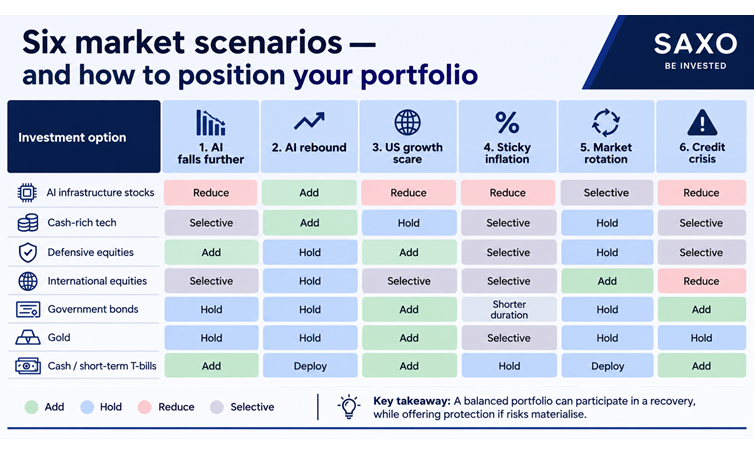
Our view: Stay invested, but change what you demand from your investments
We see merit in a combination of the second and fifth scenarios: the recent selloff could eventually offer opportunities in quality AI businesses, while the broader equity market may increasingly find leadership beyond the previous technology winners.
That does not mean the risks have disappeared.
Nvidia's regulatory uncertainty, AI financing pressures and the possibility of weaker earnings could keep markets volatile. A growth slowdown or credit event could also turn a valuation correction into something more damaging.
Our preference is therefore for gradual and selective deployment of capital, rather than aggressive dip-buying or wholesale selling.
For investors with a long-term horizon, that means three priorities.
First, raise the quality bar. Look beyond the size of the share-price decline. Strong balance sheets, sustainable cash flow and realistic valuations are increasingly important.
Second, broaden the portfolio. Equal-weight equities, quality dividends, selected international markets and AI adoption beneficiaries can offer different sources of returns without relying entirely on the infrastructure spending cycle.
Third, retain resilience. High-quality bonds, an appropriate gold allocation and some liquidity can help investors withstand further turbulence and retain the flexibility to add risk when opportunities improve.
Markets may rebound sharply before all the problems are solved. They may also fall further if earnings or financing conditions deteriorate.
The objective is not to make one perfect market call. It is to build a portfolio that has upside if markets recover and enough resilience to survive if they do not.
The best investment opportunity after this selloff may not simply be the stocks that have fallen the most. It may be the chance to build a stronger portfolio for the next phase of the market cycle.