
Un seul compte Saxo suffit pour accéder à nos plateformes.

Walmart is a steady share, but its report days are not
Options 10 minutes to read

Résumé: Walmart is seen as a steady share, yet three of its last four report days moved it by more than 6%. This article looks at what options charge for the 19 November report, and at a covered call and a cash-secured put.
What do the options of a "quiet" stock charge around a report, and what could a holder or a would-be buyer do with that price?
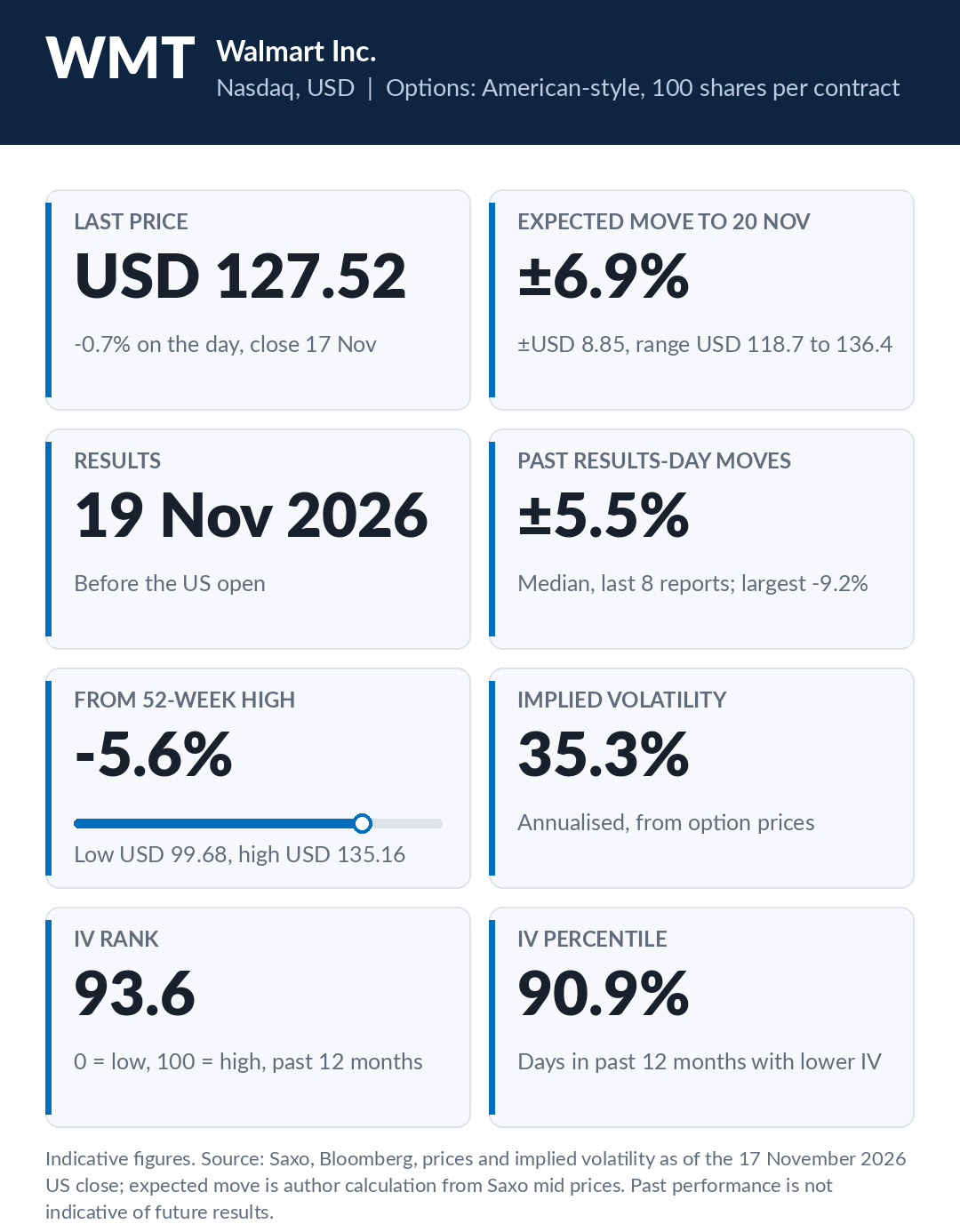 Key information on Walmart. Indicative figures. Source: Saxo, Bloomberg, as of 17 November 2026. Past performance is not indicative of future results.
Walmart reports its latest quarterly results on Thursday 19 November 2026, before the US open. Many investors treat the shares as a steady, defensive holding, yet recent results days have been anything but calm: three of the last four moved the shares by more than 6%, and the August report took over 9% off in a single session (Source: Saxo, Bloomberg). Past performance is not indicative of future results.
The shares have since recovered that drop and more, and trade near USD 127.50, about 5% below May’s record. For a holder sitting on this year’s gain and for an investor waiting to buy lower, the question is the same: what do the options charge for this report, and what could that price be used for?
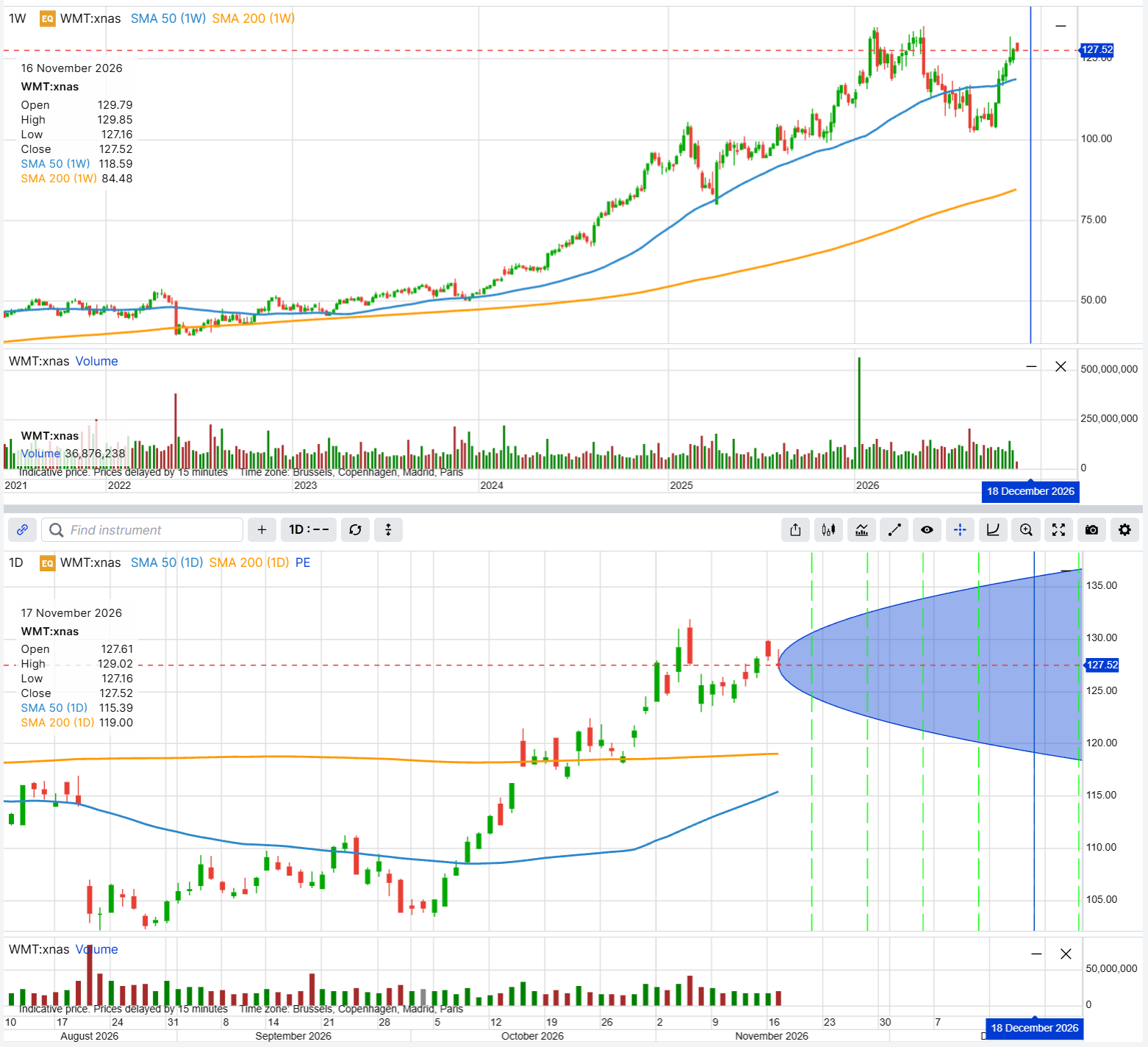 Walmart daily chart with the 200-day moving average. Source: Saxo. Past performance is not indicative of future results. This chart is illustrative and for educational purposes only; it is not predictive.
What the options charge for one report
One common gauge of the move the options market prices is the at-the-money call plus the at-the-money put for the first expiry after the event. For 20 November 2026, the 128 call at about USD 4.18 plus the 128 put at about USD 4.68 gives a straddle of about USD 8.85, close to 7% of the share price (Source: Saxo, indicative mid prices, 17 November 2026). It is a rough guide to the size of the move, in either direction.
The figure sits above the median results-day move of the last eight reports, about 5.5%, and below the August fall. In our view, the options appear to be pricing Walmart’s recent report days more than its defensive reputation. Past performance is not indicative of future results.
The December monthly shows how much of an option’s price belongs to the report. The 18 December straddle costs about USD 10.7, only a little more than the 20 November one at about USD 8.85, although it runs four weeks longer, which suggests most of a month’s option price may be payment for a single morning. Selling on 18 November collects that payment and carries the report’s risk, which may suit an investor who accepts that the shares could gap through the strike. Waiting until after the report usually brings a smaller premium, as the extra paid for the event tends to drain away, but the seller then picks a strike against a known result and a fresh share price.
Important note: The strategies and examples provided in this article are purely for educational purposes. They are intended to assist in shaping your thought process and should not be replicated or implemented without careful consideration. Every investor or trader must conduct their own due diligence and take into account their unique financial situation, risk tolerance, and investment objectives before making any decisions. Remember, investing in the stock market carries risk, and it’s crucial to make informed decisions.
For a holder near the record: a covered call at 135
A covered call may suit an investor who owns Walmart, has this year’s gain on the books and would be content to sell somewhat higher. Selling one call against every 100 shares obliges the holder to sell at the strike if the shares are above it at expiry, in return for a premium paid today and kept whatever happens. A 135 strike sits next to May’s record, so the shares would have to retake that level before the holder is asked to sell.
The 18 December 2026 call at 135 pays about USD 2.42 a share, roughly 2% of the share price, and part of it is there because of the report. Time decay, known as theta, erodes the option a little each day, which works in the seller’s favour. The holder still keeps the full downside of the shares: if the report disappoints, the premium is only a small, partial offset against the fall.
Walmart goes ex-dividend on 11 December 2026, a week before expiry. If the call is in the money by then, its buyer could exercise early to collect the dividend of about USD 0.25, and the holder would lose the shares and that payment.
The following example is hypothetical and for educational use only; it is not advice or a trade recommendation.
Example structure (illustrative only - not a trade recommendation)
- Hold 100 WMT shares (last price about USD 127.52)
- Sell 1 WMT 18 Dec 2026 135 call (mid about USD 2.42 per share; bid 2.34, ask 2.50)
- Premium received: about USD 242 per contract
- Maximum profit: about USD 990 per contract (USD 7.48 a share from 127.52 up to the strike, plus the USD 2.42 premium), if Walmart closes at or above 135 at expiry
- Maximum risk: about USD 12,510 per contract (the share price less the premium), if Walmart fell to zero; the shares carry the full downside
- Break-even at expiry: about USD 125.10
- (Source: Saxo, indicative mid prices as of the 17 November 2026 close; author calculation. All figures are hypothetical and for education only.)
This strategy carries substantial risk: the holder keeps the full downside of the shares, and the premium offsets only a small part of a fall. Costs and charges apply to each leg and vary by account and venue; check the applicable rates before entering any position.
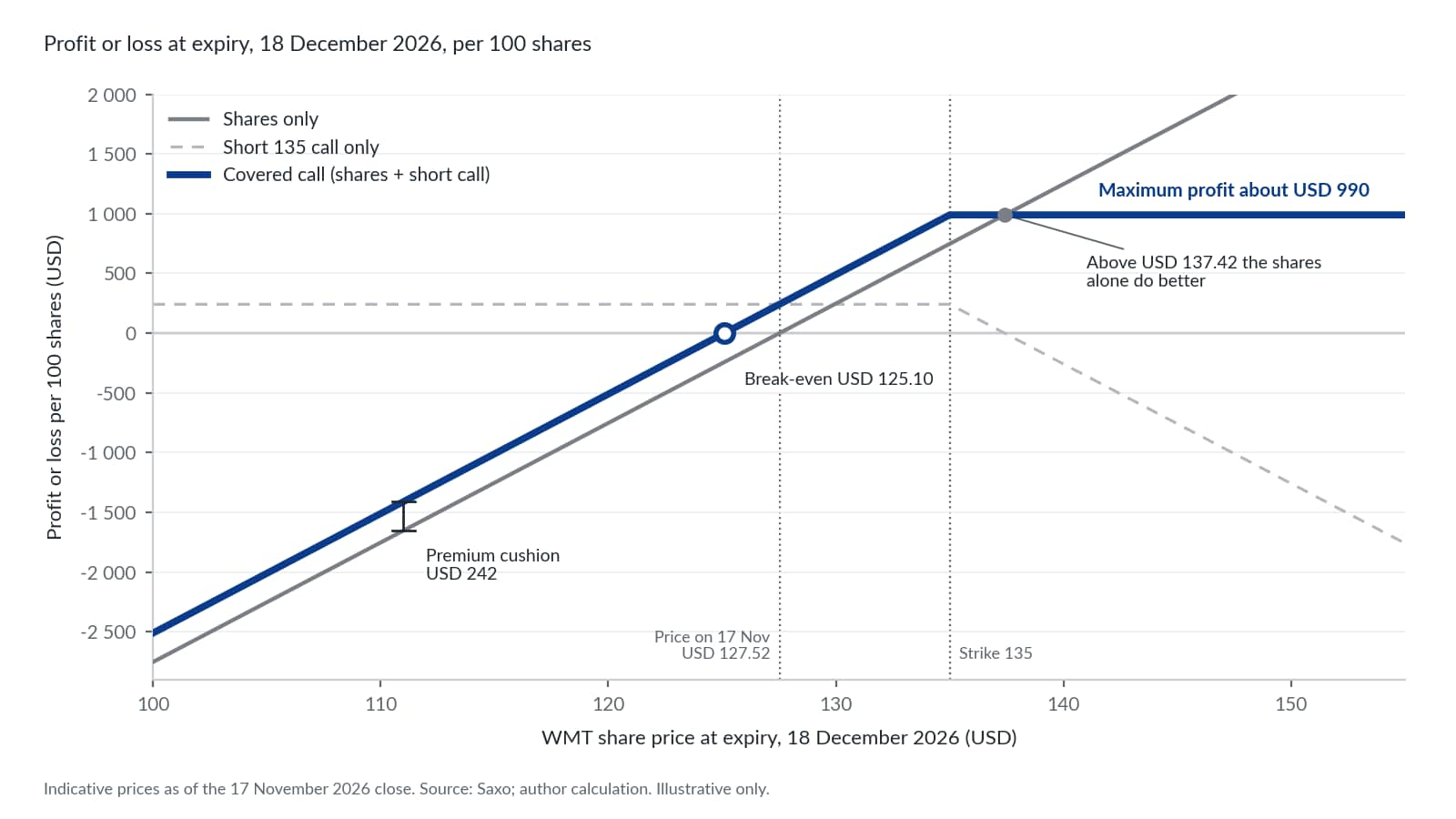 Profit or loss at expiry on 18 December 2026 for 100 shares bought at USD 127.52, alone and with a 135 call sold at USD 2.42. Below the strike the premium lifts the result by USD 242 but the shares carry the full downside; above USD 137.42 the shares alone would have done better. Indicative prices as of the 17 November 2026 close. Source: Saxo; author calculation. Illustrative only. Past performance is not indicative of future results.
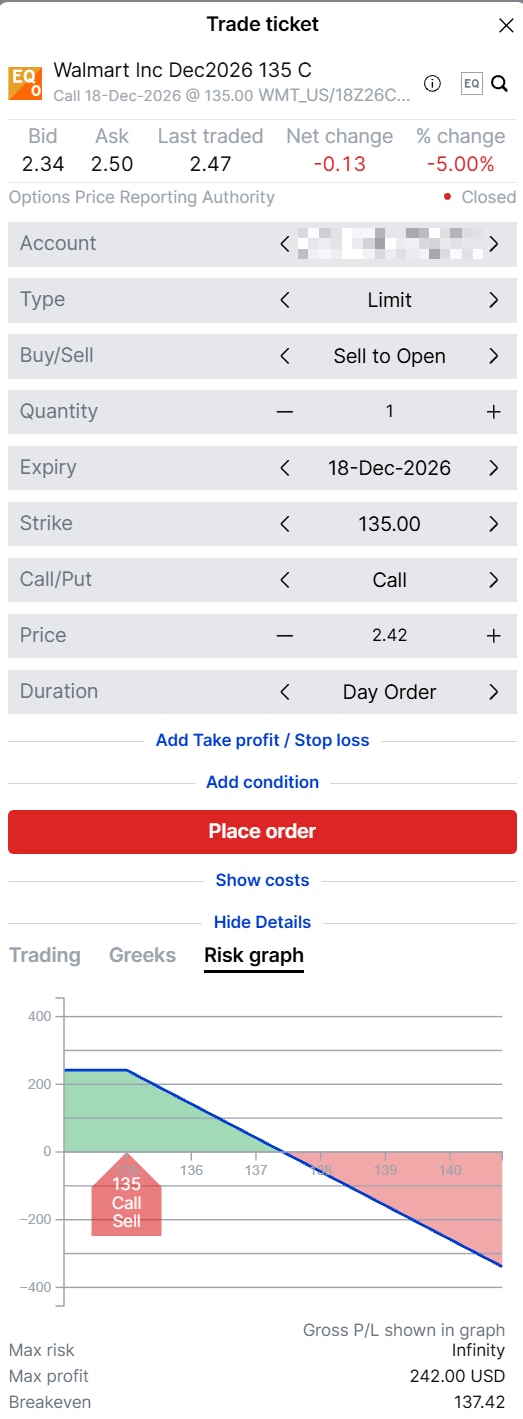
Platform risk graph for the 135 call sold on its own, 18 December 2026. The graph leaves out the 100 shares, so its unlimited maximum risk applies only to a call sold without shares; the payoff chart above shows the covered call as a whole. Source: Saxo. This graph is illustrative and for educational purposes only; it is not predictive. Past performance is not indicative of future results.
For an investor who would buy lower: a cash-secured put at 120
A cash-secured put may suit an investor who would like to own Walmart but finds a price this close to the record too high. Selling the put obliges the seller to buy the shares at the strike if they are below it at expiry, with the full purchase amount kept aside in cash. The 120 strike sits just above the 200-day moving average, around USD 119, which tracks the longer trend.
The 18 December 2026 put pays about USD 2.30 a share, and as with the call, part of it is there because of the report. If the shares are below the strike at expiry, the investor buys them at an effective price of about USD 117.70 once the premium is counted; above it, the investor keeps the premium and owns nothing. The risk is owning the shares at the strike while they keep falling, with the premium cushioning only the first part of the loss.
The following example is hypothetical and for educational use only; it is not advice or a trade recommendation.
Example structure (illustrative only - not a trade recommendation)
- Sell 1 WMT 18 Dec 2026 120 put (mid about USD 2.30 per share; bid 2.20, ask 2.39)
- Premium received: about USD 230 per contract
- Cash set aside: USD 12,000
- Net purchase price if assigned: about USD 117.70, about 7.7% below USD 127.52
- Maximum profit: about USD 230, if Walmart closes at or above 120 at expiry
- Maximum risk: about USD 11,770, if Walmart fell to zero after the investor bought at 120
- Break-even at expiry: about USD 117.70
- (Source: Saxo, indicative mid prices as of the 17 November 2026 close; author calculation. All figures are hypothetical and for education only.)
This strategy carries substantial risk: below the strike the investor carries the full loss of owning the shares, and the premium offsets only a small part. Costs and charges apply to each leg and vary by account and venue; check the applicable rates before entering any position.
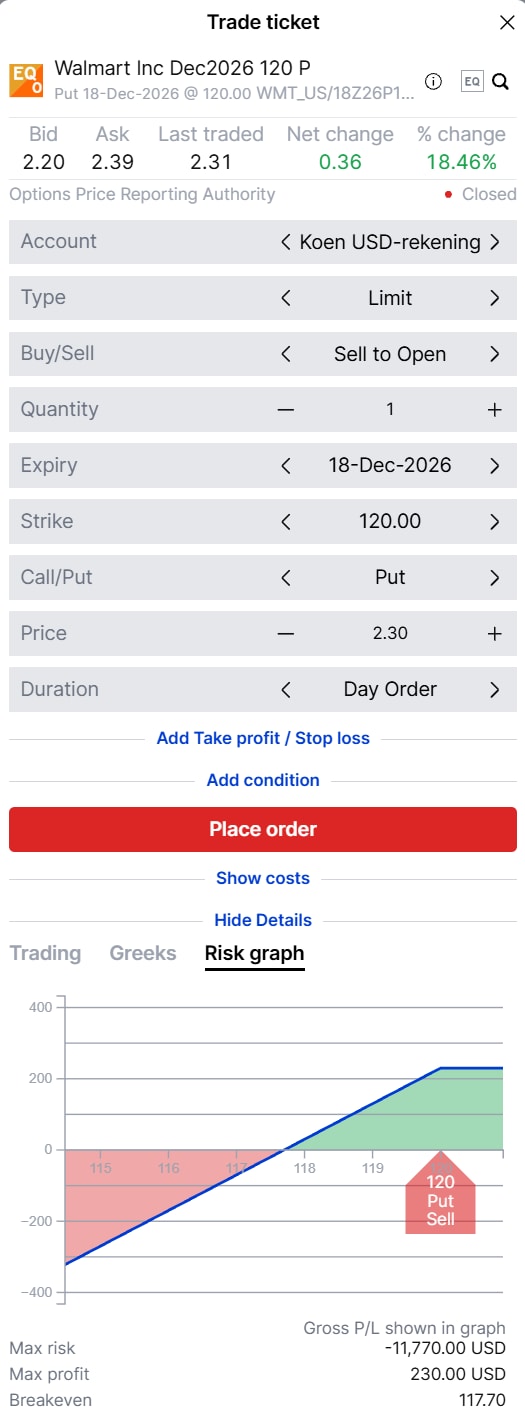
Risk graph for a short put with a 120 strike, 18 December 2026. Source: Saxo. This graph is illustrative and for educational purposes only; it is not predictive. Past performance is not indicative of future results.
Testing the premise: a new record, a repeat of August, or neither
Both examples work best if the report lands somewhere ordinary. If it is strong and the shares push through May’s record, the covered call caps the holder’s gain at 135 and the shares may be called away while they keep rising; an investor expecting that may prefer to hold the shares without a call. The put seller keeps the premium but still owns nothing, and the chance to buy lower may have gone.
If the report disappoints the way August’s did, the holder takes the full fall and the call premium is only a small offset. A drop of that size from today’s price would land below 120, so the put seller could end up buying at the strike while the shares trade lower still; an investor expecting that may prefer to wait, or stay out. Between the two sits the neutral case, a move inside the priced range, where the call expires worthless, the put is not assigned and both sellers keep their premium. Options carry a high risk of rapid loss and are not suitable for every investor.
Before any position:
- Bid/ask spreads and open interest at the chosen strike; the December monthly lists strikes in USD 5 steps
- Whether carrying the report is acceptable, or whether selling after 19 November fits better
- For the put, cash for 100 shares and comfort with owning them at 120 after a weak report
- For the call, early-assignment risk around the 11 December ex-dividend date; Walmart options are American-style
- An exit plan: positions can often be closed before expiry
Final thoughts
Walmart has a reputation for steadiness that its recent results days have not lived up to, and the options price that: a straddle charging close to 7% for one report, and a December premium that is mostly payment for the same event. In our view, the report may be most of what an option seller is paid to carry. Options carry a high risk of rapid loss and are not suitable for every investor.
A covered call and a cash-secured put use that price in two ways: one names a sale price near the record, the other a purchase price near the long-term average. Neither protects against a report like August’s, and holding the shares or the cash without any option is an equally reasonable choice.
The author does not hold positions in any of the instruments mentioned in this article and is permitted to wait at least 24 hours from the time of the publication before trading the instruments themselves.
| Related articles/content |
|---|
| Nvidia after the sell-off three ways to use options around earnings | 10 Nov 2026 Prune and plant after the storm what a sell-off changes for two option trades | 6 Nov 2026 Finding unusually expensive or cheap options in the Saxo screener | 18 Sep 2026 What IV crush really means in practice reviewed version | 9 April 2026 Trading earnings with defined | 31 Mar 2026 |
| More from the author |
|---|