
Un seul compte Saxo suffit pour accéder à nos plateformes.

Asia Market Quick Take – 19 August, 2026
Macro 6 minutes to read

Asia Market Quick Take – 19 August, 2026
Key points:
- Macro: US-Iran tensions continue; SoH traffic remains limited
- Equities: Equities risk off; SOXX slumps 5%
- FX: USD strengthens amid risk off and higher long dated yields
- Commodities: Precious metals and copper sell off
- Fixed income: Treasury yields lower but remain elevated
------------------------------------------------------------------
Disclaimer: Past performance does not indicate future performance.
Macro:
- US–Iran tensions remain high, keeping supply risks elevated and the Strait of Hormuz constrained. Trump says there are no talks with Tehran and confirms the US naval blockade. Despite claims the waterway is open, traffic remains limited. Iranian forces have escalated hostilities, with eight vessel attacks reported this month, including on UAE- and Saudi-linked ships.
- Japan’s core machinery orders rose 9.7% m/m in June 2026 to JPY 1.06 trillion, beating forecasts and reversing May’s 12.4% drop. It was the fastest gain since February, with broad strength across manufacturers and non-manufacturers. Orders jumped 16.9% y/y, versus a 1.9% fall in May, well above expectations.
- US housing starts fell 12.4% in July 2026 to an annualized 1.239 million units, well below expectations of 1.35 million and near a six-year low. Multi-family starts dropped 15.6% and single-family 9.9%. Regionally, starts fell in the Midwest, South, and West, but rose in the Northeast.
- US manufacturing output rose 0.2% in July 2026, matching expectations. Durable goods production climbed 0.7%, while nondurable output fell 0.4%. Capacity utilization edged up to 76%, still 2.2 points below its long-run average.
- US import prices fell 0.4% m/m in July 2026, the biggest drop since May 2025 and defying expectations for a 0.1% rise. Fuel import prices slumped 7.2% on lower petroleum costs, while nonfuel import prices rose 0.4%. Import prices were up 5.9% from a year earlier.
- The UK jobless rate was unchanged at 4.9% in the three months to June 2026, versus expectations for 4.8%. Unemployment fell by 36,000 on the quarter but rose by 88,000 over the year, while employment increased by 84,000 to 34.47 million.
Equities:
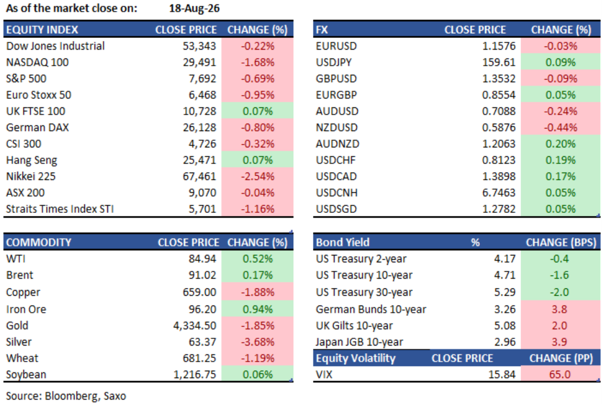
- US — US equities retreated on Tuesday, with the S&P 500 falling 0.69% to 7,691.76 and the Nasdaq Composite declining 1.33% to 26,289.71, while the Dow Jones shed 0.22% to 53,343.40. The Philadelphia Semiconductor Index slumped 5%, leading losses as chip and AI hardware stocks were pummelled amid elevated Treasury yields and inflation concerns. Notable decliners included Micron, Credo, and SanDisk. NRG Energy fell 5.57%. After hours, Nasdaq futures extended losses, pulled lower by the Kospi selloff in Asia, raising the risk of a sharper open.
- EU — European equities were under pressure on Tuesday as elevated bond yields and global inflation concerns weighed on sentiment. The global bond rout was a key driver, with French borrowing costs hitting their highest since 2008 and German 30-year yields at 2011 levels following a €4bn August 2056 syndicated bond sale. UK gilt yields approached 6%. Defensive names offered some relative shelter, but the broader market struggled against the backdrop of rising sovereign yields and persistent oil price strength.
- Asia — Asian equities are sharply lower on Wednesday morning, with the MSCI Asia Pacific Index falling over 1% to 273.09. South Korea's Kospi is the standout underperformer, plunging approximately 6% to around 6,454, dragged down by Samsung Electronics and SK Hynix, each falling around 7%, following the overnight US semiconductor rout. The Kosdaq slipped more than 3%. Japan's Topix fell 2.1% to 4,054.19, with the Nikkei also under pressure. Nasdaq futures are being pulled into the Kospi's downward spiral, slicing through Tuesday's intraday lows. Hong Kong and China markets are opening weaker, tracking global chip weakness. Separately, Japanese companies posted their largest earnings beat in five years, with 71% of firms exceeding forecasts and aggregate net income at the 500 biggest companies topping ¥21 trillion. Xiaomi saw strong EV growth but lower profits due to high chip costs, while Baidu's profits plunged 68% as AI cloud gains couldn't offset a steep drop in traditional ad revenue.
Earnings this week:
- Wednesday - Lowe’s, Target, TJX, Estee Lauder, Analog Devices, HKEX, Kuaishou Technology
- Thursday - Walmart, Deere & Co., Ross Stores, Alibaba, Ping An Insurance, Pop Mart
- Friday - BJ’s Wholesale Club
FX:
- USD is stabilizing, with the Bloomberg Dollar Spot Index at 99.61 after earlier hitting mid‑May lows, as a bear‑steepening US yield curve blunts traditional rate support.
- USDJPY is at 159.46 and edging toward the key 160 level, with elevated US yields, high oil and Middle East risk supporting the pair, though reduced speculative shorts leave it vulnerable to a sharp squeeze on a break.
- EURUSD is at 1.1581, with 1‑month risk reversals turning euro‑bullish for the first time since March as markets price an ECB hike versus a Fed on hold in September.
- GBPUSD trades at 1.3540, holding up in G10 but increasingly exposed to UK gilt yields near 6% amid the global bond selloff.
- AUDUSD is at 0.7084 after underperforming on Tuesday (-0.32%) as weaker metals and risk‑off sentiment hit the commodity bloc, with Q2 wages and RBA signals in focus; NZDUSD at 0.5873 is supported by recommendations to buy the kiwi as an El Niño hedge.
- KRW, strong on earlier equity inflows, is likely to weaken after a sharp Kospi drop (~6%) on chip losses.
Commodities:
- Oil settled around $85/bbl, near three-week highs, as US-Iran talks over the Strait of Hormuz remain deadlocked. Elevated oil prices are a key driver of global inflation concerns and are contributing to the ongoing bond market selloff.
- Copper saw a historic LME squeeze partially ease on Tuesday after Trafigura and other traders made significant deliveries of metal to the exchange. The cash-to-three-month backwardation narrowed to $248/ton from as wide as $545/ton on Monday, though spreads remain historically extreme. Copper is up approximately 16% year-to-date, with BHP reporting a 30% rise in underlying attributable profit to $13.2bn for the year ended June 30, driven by record copper prices.
- Gold declined as much as 1.8% to around $4,338/oz on Tuesday as the global bond selloff sent yields higher and buoyed the dollar, creating twin headwinds for the precious metal. Despite the pullback, the GLD ETF recorded its largest single-day inflow since 18 June, with $1.01bn added, reflecting continued institutional demand for gold as a hedge.
Fixed income:
- US 30-Year Treasury yields hit 5.31–5.32%, the highest level since June 2007, driven by investor angst over surging government spending, a flood of long-dated bond supply, and inflation that has remained above the Fed's target for five years. The US Treasury disbursed a record $85bn in semi-annual coupon payments to bondholders on 17 August.
- Global sovereign yields are surging in tandem, with French 30-year borrowing costs at their highest since 2008, German 30-year yields at 2011 levels, and UK gilt yields approaching 6%. Japan's 10-year yields climbed to multi-decade highs. The global rout is being attributed to a combination of AI-driven corporate bond supply crowding out government debt, persistent inflation, and growing fiscal deficit concerns across developed markets.
For a global look at markets – go to Inspiration.
This content is marketing content and should not be considered investment advice. Trading financial instruments carries risks and historic performance is not a guarantee for future performance.The instrument(s) mentioned in this content may be issued by a partner, from which Saxo receives promotion, payment or retrocessions. While Saxo receives compensation from these partnerships, all content is conducted with the intention of providing clients with valuable options and information.