
Un seul compte Saxo suffit pour accéder à nos plateformes.

Stock lending: the rent your shares might be earning

Résumé: Most investors earn from price moves and dividends. Stock lending adds a quieter third source: a share of the fee when someone borrows the shares you hold. How it works, what changes and the main risk.
What if shares you plan to keep anyway could also pay you a little rent?
Most investors earn from their shares in two ways. The price goes up, or the company pays a dividend. There is a third source that gets far less attention. Someone may want to borrow your shares and pay a fee for it. That fee is rent, and stock lending is how you can collect part of it.
Why anyone borrows shares
A borrower needs the shares for a short time. There are three common reasons. Some want to hedge another position. Some want to sell short, which means selling shares they do not own yet and buying them back later. Others need shares to meet a delivery deadline after a trade.
The borrower pays a fee for the loan. The more people want a share and the fewer shares are available, the higher the fee. Shares that are hard to borrow earn the most. Shares that nobody asks for earn little or nothing.
How it works at Saxo
When you opt in, you allow Saxo to borrow your stocks and ETFs and lend them on to other market participants. Saxo is the borrower on your side of the deal. The final borrower sits on the other side and pays the fee.
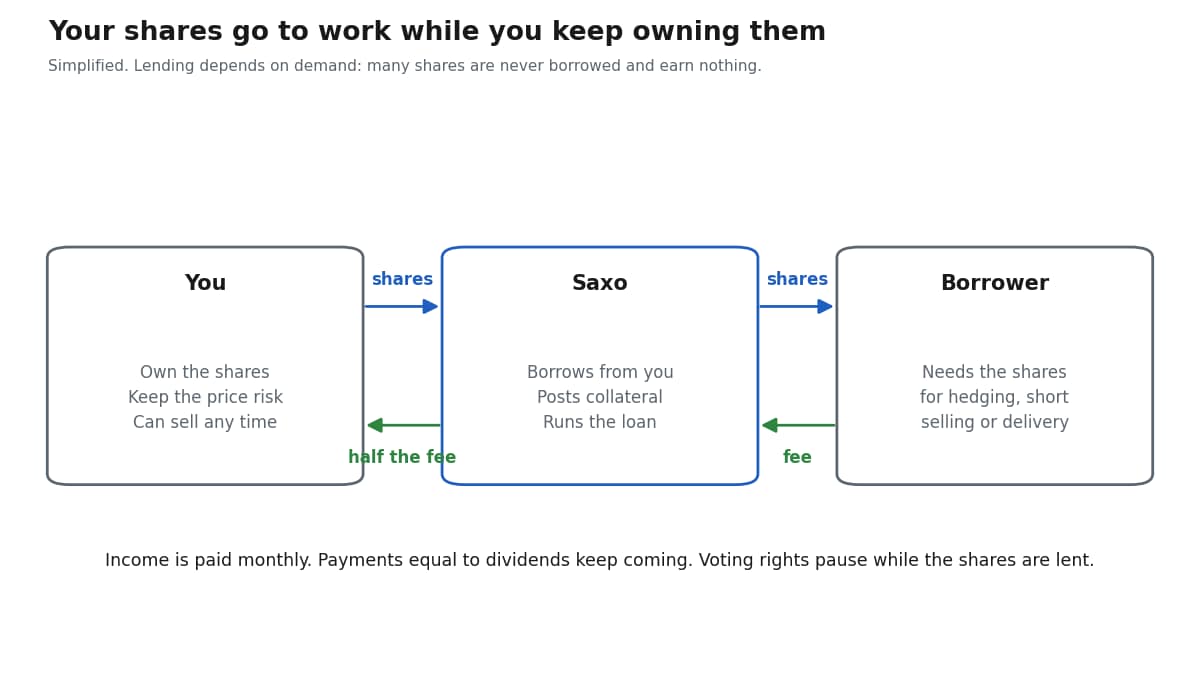
Illustrative example with a fictitious company and made-up prices. Not a recommendation.
The fee is split 50/50 between you and Saxo. Your half is credited at the end of each month, and you can follow it in the Stock Lending dashboard.
Two things are worth knowing. First, you do not pick individual holdings. Once you activate stock lending, all eligible stocks and ETFs in your account become available. Second, you can switch it on or off at any time in your account settings.
Lending depends on demand. Nothing is guaranteed: shares may not be lent, and there may be no income in a given month.
What changes and what stays the same
Lent shares stay in your portfolio. You still own the price exposure, so if the price rises or falls, your result moves with it. You can sell at any time. If the company pays a dividend while your shares are on loan, you receive a payment equal to the dividend.
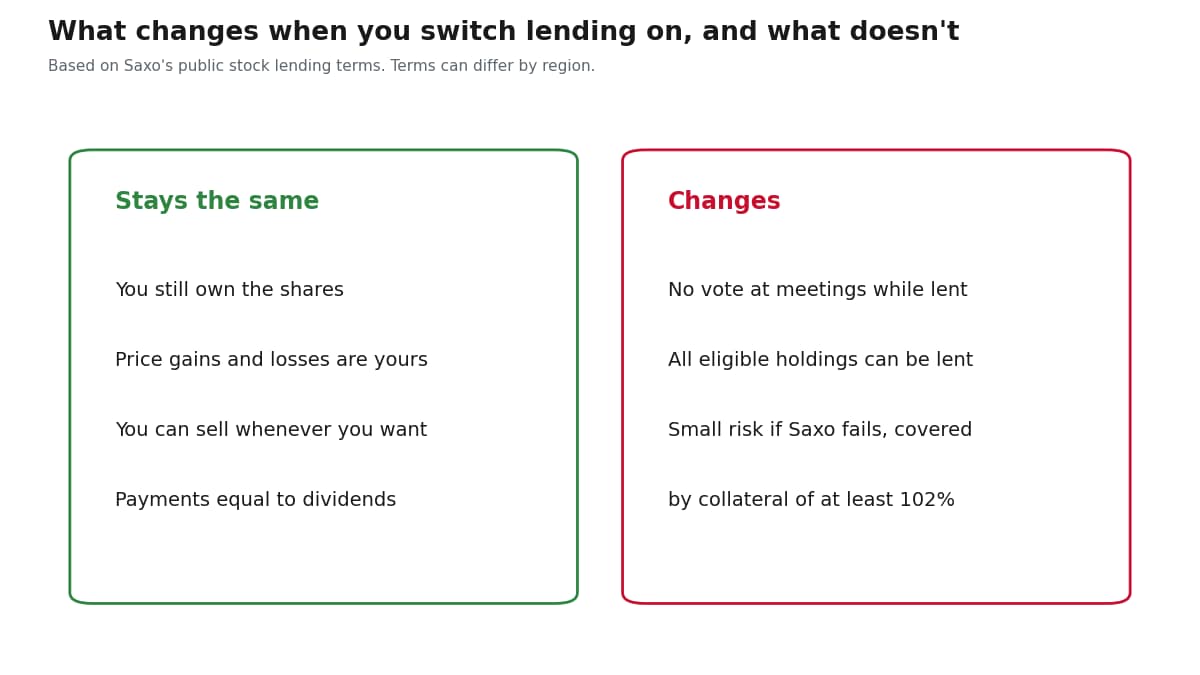
Illustrative example with a fictitious company and made-up prices. Not a recommendation.
One thing does change. While your shares are lent, they carry no voting or meeting rights. If you like to vote at shareholder meetings, keep that in mind.
What backs the loan, and the main risk
In this set-up Saxo is the borrower. As protection, Saxo provides collateral worth at least 102% of the open loans.
The main risk is Saxo’s own insolvency. If that happened, you would bear the economic risk until the collateral had been distributed.
Collateral lowers the risk but does not remove it. You should be comfortable with this before you opt in.
Who it suits
Stock lending fits long-term holders who would keep their shares anyway. You are not changing your portfolio. You are asking whether idle shares can earn something on the side.
Keep your expectations modest. Many shares are rarely borrowed, so they earn little. Income tends to come from names that are in demand, and demand changes over time. Treat any income as a bonus, not as a reason to hold a share.
Terms differ between Saxo entities, including how the fee is shared and which products are eligible. Check the stock lending page for your region before you decide.
A different way to earn rent
Lending earns rent only when someone else wants your shares. Investors who prefer to earn rent on their own terms can sell covered calls on shares they hold. Our step-by-step guide to covered calls shows how it works.
Options carry a high risk of rapid loss and are not suitable for every investor.
Important note: The strategies and examples provided in this article are purely for educational purposes. They are intended to assist in shaping your thought process and should not be replicated or implemented without careful consideration. Every investor or trader must conduct their own due diligence and take into account their unique financial situation, risk tolerance, and investment objectives before making any decisions. Remember, investing in the stock market carries risk, and it’s crucial to make informed decisions.
Sources: Saxo stock lending page (home.saxo); "7 truths about stock lending" (Saxo, January 2024).
| Related articles/content |
|---|
| Covered calls step by step getting paid to wait | 26 Nov 2026 Protective puts step by step insurance for your shares | 26 Nov 2026 |
| More from the author |
|---|